The Sacred Blow: Why the Ancient Laws of Tsarat Redefine the Mystery of Suffering
1. Introduction: The Taxonomy of the Stroke
In the modern psychological landscape, adversity is almost reflexively categorized as either a biological malfunction or a personal moral failure. We view the "scabs" and "blemishes" of our existence—be they financial, physical, or relational—as evidence of a system in breakdown. We interrogate the heavens with the question "Why me?", operating under the assumption that suffering is a cosmic error or a punitive response to a specific transgression.
However, a rigorous examination of the Levitical codes regarding skin afflictions—specifically Leviticus 13—unveils a perspective that is as ancient as it is radical. Often dismissed as a primitive medical manual, these texts actually function as a profound theological exploration of how the human person interfaces with the Kadosh (the Set-Apart). Through the lens of the "divine blow," we discover that our most visible wounds are not necessarily signs of sin, but are often "marks" of a higher, albeit painful, qualification. What if your greatest adversity is not a fluke of nature, but a sign of divine selection?
2. The Nega Paradigm: Leprosy as a Divine Strike
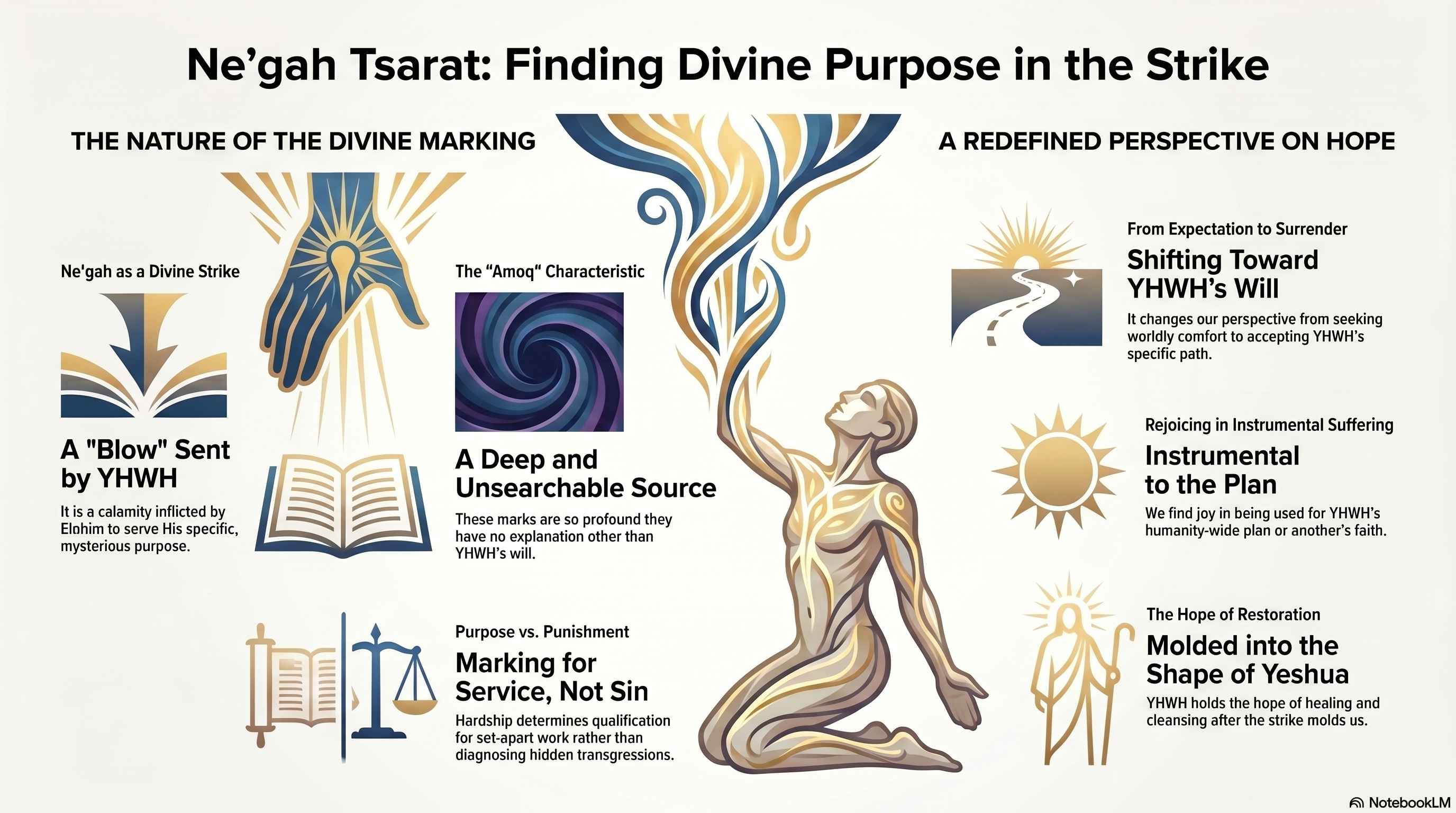
The terminology found in the Hebrew text of Leviticus 13 is far removed from modern clinical pathology. The scriptures speak of Nega and Tsarat. In its primary sense, Nega signifies a "strike," "blow," or "stripe"—a calamity that Elohim inflicts upon a person. Similarly, Tsarat refers to one who has been "smitten."
This was not the modern Hansen's Disease. It was a physical manifestation of a spiritual circumstance—a "mark" placed upon the flesh by the Creator himself. Because this condition was viewed as a direct blow from the Divine, the afflicted individual did not seek a physician; they sought a priest. The blemish was a summons to determine if the individual was Tahor (qualified) or Tamae (disqualified) to approach the presence of Elohim.
Gesenius on Tsarat — "One smitten; inasmuch as the plague of leprosy was regarded as being sent by God."
3. The Mystery of Amoq: When the Wound is Unsearchable
A critical diagnostic marker for the priest was whether the affliction was Amoq—a term meaning "deeper than the skin." This word does not merely suggest physical depth; it points to that which is profound, mysterious, and ultimately "unsearchable."
When a trial is characterized as Amoq, it signifies that it possesses no earthly explanation. It defies the simplistic logic of cause-and-effect or "instant karma." This shifts the theological focus entirely: if the wound is unsearchable by human reason, its source and purpose must reside solely within the will of YHWH. This insight removes the crushing burden of seeking a "why" within one's own failures and acknowledges that certain challenges are simply the marks of His sovereignty.
4. The Counter-Intuitive Purity of the Scab
Leviticus distinguishes between Tamae (foul, disqualified) and Tahor (pure, unalloyed, qualified). Our natural vanity, or Havl—which denotes the chasing of the "breath" and appetites of our nephesh (soul)—compels us to hide our scabs. We fear they suggest a lack of perfection or "infamy."
Yet, Lev. 13:6 offers a startling reversal: if the blemish is "but a scab," the priest pronounces the person Tahor. To be Tahor is to be "unmixed" or "unalloyed." A scab is a physiological sign that healing and protection have already occurred; it is a covering grown over a potential infection. Spiritually, we often mistake the process of healing for the presence of disease. Being declared qualified does not require the flesh to be aesthetically perfect; it requires the individual to be "unmixed" in their devotion, ready to interface with the Divine even while bearing the marks of a healing wound.
5. The Job Cycle: The Archetype of the Divine Blow
The Job cycle serves as the definitive archetype of the divine blow. The Hebrew name for Job, Iob, literally means "object of persecution." Paradoxically, YHWH pointed Job out to the adversary not because he had failed, but because he was "blameless and upright."
Job's adversity was a Nega authorized by Elohim to demonstrate a faith that transcends the physical hedge of protection. His response remains the gold standard for navigating the "unsearchable" blow, recognizing that the Divine hand that gives is the same hand that strikes:
Job 2:10 — Shall we indeed accept good from Elohim, and shall we not accept adversity?
6. The Spendo Reality: The Violent End of the Qualified
The Western "prosperity" narrative suggests that being qualified by YHWH leads to a comfortable retirement. The historical record of the Apostles suggests the exact opposite. Those most Tahor to carry the message of Messiah often met the most violent ends, treated as Tamae by the world while remaining perfectly qualified in the eyes of the Creator.
The Greek term used by Paul is Spendo, meaning to be "poured out as a drink offering." This term historically described the blood of a victim poured out in a violent death for a cause.
- James, son of Zebedee: Beheaded by the sword.
- James the Just: Thrown from the temple pinnacle, then stoned and clubbed.
- Paul: Tortured and beheaded under Nero.
- Peter: Crucified upside down, deeming himself unworthy to die like his Master.
- Bartholomew: Flayed alive and beheaded.
This Spendo reality is tied to the concept of Nikao—to overcome. While for Yeshua Nikao meant total victory over His foes, for the believer it specifically means "holding fast to the faith even unto death."
7. The 2020 Nega and the Failure of Edification
The global events of 2020 served as a modern Nega—a divine strike that triggered a global Segar. While Segar is often translated as "isolation," its figurative root implies "surrender." It was a test of the body's willingness to surrender its own rights and trust the authorities YHWH placed.
The response within the body of believers revealed a significant failure in spiritual maturity. Rather than focusing on edification—the building up of the body—the reaction shifted toward moral accusation. Believers began to define "qualification" based on external interpretations of actions rather than seeking the wisdom of the Torah. The real day of testing requires a body that can withstand the divine stroke without turning on itself in accusation.
8. Conclusion: Beyond the 70-Year Perspective
In Jeremiah 29, the captive Israelites were told to wait 70 years for a "return." To the human mind, 70 years is a "lifetime"—a total span. But from an eternal perspective, it is merely "lite time"—a temporary duration of captivity.
There is a profound linguistic mystery in the promise of the "Return." When the Yode (representing the mighty hand or the "mark") is removed from the divine name, we find the root Awb (Aleph-Vav-Bet), which signifies the Father, the House, and the Return. The mark is the catalyst for the journey home.
When we experience a Nega that feels like a life sentence, we must look to 2 Cor. 4:16. Our outward man may be wasting away, but our inward man is being renewed. The mark in your flesh is temporary; the glory it achieves is Amoq—unsearchable and eternal.
The final question is not whether we are marked, but where we fix our eyes: on the seen (the temporary blemish) or the unsearchable (the eternal weighty glory)?