The Dirt
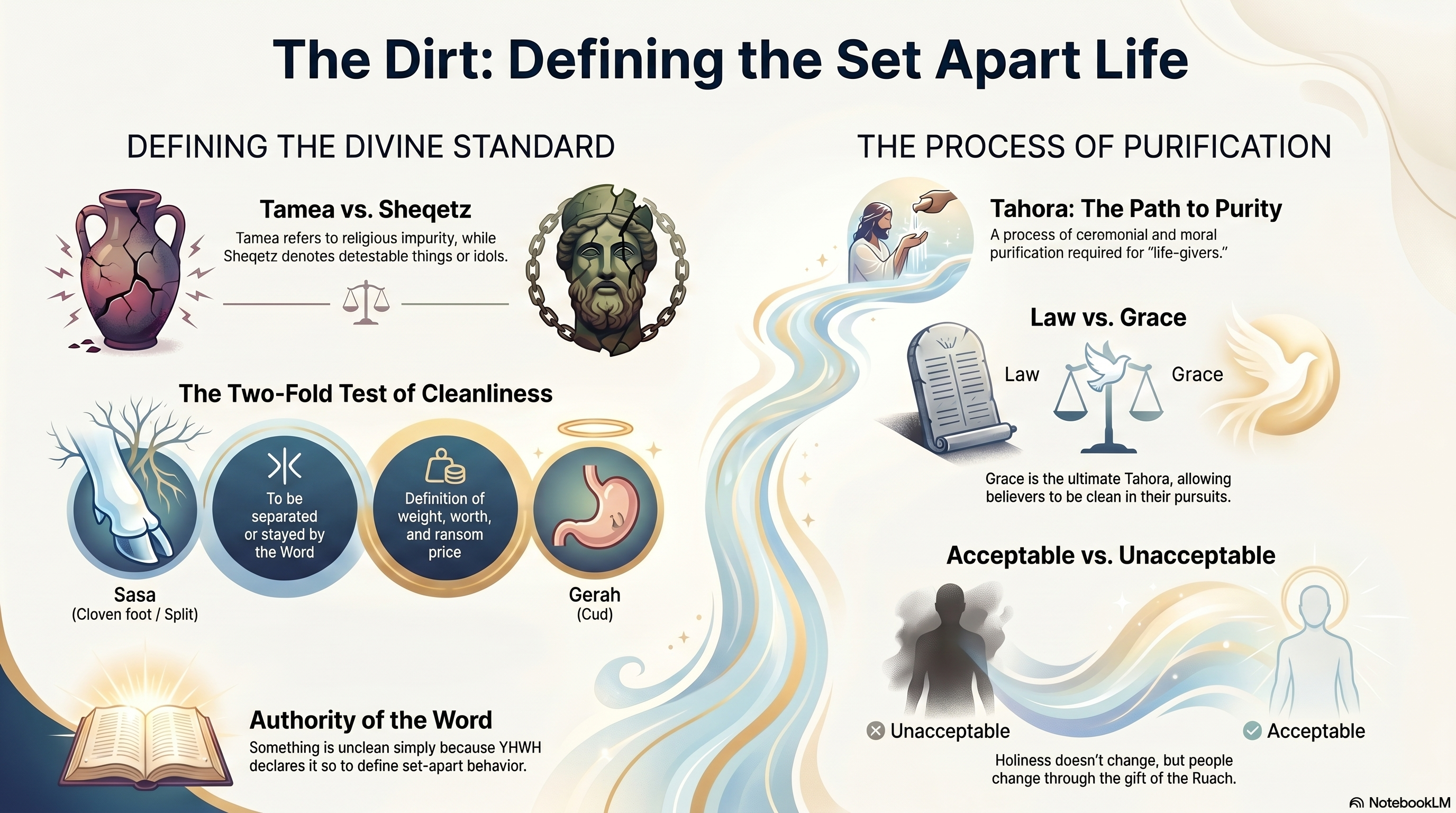
Sermon infographic — May 30, 2026
Beyond the Plate: 5 Surprising Lessons on Holiness from Ancient Law
The Challenge of the "Set Apart"
How can a fundamentally entropic human experience interface with a completely qadowsh Creator? This is the central existential tension of the ancient texts. By our very design, certain functions of our biology and existence render us temporarily "unfit" to interface with that which is set apart. Ancient law, therefore, functions as a form of spiritual epidemiology — a meticulous system designed to preserve the sanctity of the communal space from the entropic nature of the mundane. To find the profound spiritual insights hidden within these mandates, we must look past the surface-level "dirt" of the rules to the deep Hebrew definitions that govern our alignment with the Divine.
1. Your Appetite is Your First Definition of Behavior
The first boundary YHWH establishes for a people called to be "set apart" is not a moral code of conduct or a ritual of sacrifice, but a definition of food. In Leviticus 11, the Creator reveals that our identity is inextricably tied to our appetite. What we choose to consume serves as the primary diagnostic for whether we are interested in what God calls "set apart" or what He defines as Tamea — unclean to you.
Leviticus 11:2–3 (KJV) — "Speak unto the children of Israel, saying, These are the beasts which ye shall eat among all the beasts that are on the earth. Whatsoever parteth the hoof, and is clovenfooted, and cheweth the cud, among the beasts, that shall ye eat."
The word Tamea suggests an existential weight; it refers to being "foul in a religious sense" or, as Gesenius notes, being "polluted of name" and "infamous." However, the text distinguishes this from Sheqetz — that which is "detestable" or "filth." While Tamea is a state of religious impurity, Sheqetz carries the stench of idolatry. To ignore these distinctions is to deny the very authority of the One who defines reality. Our appetites are the testing ground for our motivations; we either fuel ourselves with what is sanctioned or we satisfy ourselves with that which is "polluted of name."
2. The Metaphor of the Cloven Foot — The Power of "Rending"
The physical requirement of the "cloven foot" possesses a profound linguistic depth often lost in translation. The Hebrew root šāsaʿ means to split or cleave, but Gesenius provides a striking metaphorical application: to "upbraid with words" or to "rend." This suggests that "cleanliness" is not merely a physical state, but the ability to use the Word of YHWH as a surgical tool to rend unrighteous impulses.
We see this "rending" in action when David, hiding in a cave, is urged by his men to strike down King Saul. David's heart smites him for merely cutting Saul's robe, and he responds with a spiritual "rending."
1 Samuel 24:7 (KJV) — "So David stayed (Sasa) his servants with these words, and suffered them not to rise against Saul."
David did not merely "stay" his servants — he rent them with words. He used the declared authority of YHWH to split their intentions from their actions. To be "clean" is to possess a path that is "cloven" — a life where the Word of YHWH acts as the scalpel that separates our base instincts from our pursuit of righteousness.
3. Why the "Cud" is a Matter of Currency
The second qualification for a clean land animal — chewing the cud — reveals a surprising connection between spiritual meditation and standard value. The Hebrew word for "cud," gerah, is the exact term used for the smallest unit of weight and worth in the sanctuary. According to the standard of the shekel, the "ransom price" for a soul was measured in these units.
Exodus 30:12–13 (KJV) — "...they shall give every man a ransom for his soul unto YHWH... a shekel is twenty gerahs."
This linguistic overlap suggests that "chewing the cud" is a metaphor for the processing of value. Just as the animal re-processes its food, the clean soul is one that constantly "weighs" its intake against YHWH's standards of worth. Our "ransom" is not defined by our own self-assessment, but by the gerah of the sanctuary. We are "clean" when we have aligned our sense of value with YHWH's weight, chewing on His words until they become the very currency of our souls.
4. Grace is Hidden in the Natural Cycles
The laws concerning childbirth and menstruation in Leviticus 12 are frequently dismissed as "anti-woman" by modern observers. However, such a view ignores a pivotal scholarly "hook": Leviticus 12:4 marks the first time the word Tahora is used in all of Scripture. Defined as "ceremonial purification" and "purity of heart," Tahora represents a unique process of cleansing that naturally occurs within the life-bearing members of the community.
While the Apostle Paul notes in Romans 5 that sin and death entered the world through the "headship" of one man, Adam, the law of Tahora provides a counter-testimony. The woman, who did not originate the transgression but carries the burden of the "infirmity" of the flesh, is given a recurring, biological picture of grace.
Romans 5:20 (KJV) — "Moreover the law entered, that the offence might abound. But where sin abounded, grace did much more abound."
In this light, Tahora is the purifying process that allows the life-giver to be set apart. The natural cycles of the woman become a fleshly testimony of life-affirming grace abounding over death. She carries a process of "purification of heart" that men do not possess, acting as a living witness that justification is a work of the Creator's refining grace.
5. The Geography of the Humble Heart
The ultimate goal of these meticulous definitions — food, language, and biology — is to lead the individual to a specific internal geography. Despite all ritual requirements, the "High and Lofty One" reveals that His primary dwelling place is not a physical structure, but a specific state of being.
Isaiah 57:15 (KJV) — "For thus saith the high and lofty One that inhabiteth eternity, whose name is Holy; I dwell in the high and holy place, with him also that is of a contrite and humble spirit, to revive the spirit of the humble..."
The various processes of "purifying" described in the law are intended to produce this contrition. As the text continues in verses 18–19, YHWH promises to "heal him," to "restore comforts," and to create the "fruit of the lips." This result is Shalom — peace to him that is far off and him that is near. The "dirt" of the law is the abrasive meant to polish the heart, leading to a revival of the spirit where the Holy One can finally dwell among His people.
Conclusion: A Question of Alignment
These ancient definitions are not relics of a primitive past — they are the architectural drawings of a qadowsh life. They test our appetites, our motivations, and the "fuel" we use to drive our pursuits. If we allow YHWH to define what is "set apart," we inevitably find ourselves weighing our lives by the gerah of the sanctuary and rending our impulses with the surgical precision of His Word.
Ultimately, we are left with a single, unavoidable question: Who defines what is "set apart" in your life? To align with the Holy is to accept His definitions of value and to find, in the cycles of purification, a grace that abounds over every infirmity. When we align our fuel with His righteousness, we move beyond the plate and into the very presence of the Lofty One.
📥 Downloads
The Dirt
Walking in the Set-Apart: A Devotional Exploration of Purity and Presence
1. The Foundation of Authority: Who Defines Your "Set-Apart"?
The strategic importance of divine authority is the cornerstone of spiritual formation; without it, boundaries are merely subjective preferences. For a qadowsh Creator to facilitate ontological proximity to a human population, a rigorous protocol for interaction is required. Human existence, by its very biological and moral nature, involves functions that render an individual unfit for the Holy. These "bans" on interaction — whether temporary, prolonged, or total — are not arbitrary exclusions but are necessary protocols for interfacing with the Divine. They function as a spiritual quarantine, much like medical isolation prevents the spread of contagion within a vulnerable population.
In the Levitical economy, YHWH categorizes the profane environment using two distinct designations: Tamea L'Kem (Unclean to YOU) and Sheqetz L'Kem (An Abomination to YOU). Tamea denotes that which is foul or "polluted of name" — an infamy that stains the reputation of the believer as a representative of the King. Sheqetz is more severe, representing detestable filth or idolatrous objects. To dismiss these definitions as archaic is to execute a functional denial of YHWH's authority. If we accept His authority in the declaration of the Sabbath or our justification through Yeshua Ha Mashiach, we cannot logically bifurcate that authority when it pertains to His definitions of "clean." The "YHWH said so" standard is the absolute metric. To ignore it is to claim the right of the creature to redefine the standards of the Creator.
Self-Reflective Questions
- Authority: Who is currently the primary architect of "right" and "wrong" in my daily life — is it my personal autonomy or the divine decree?
- Boundaries: Do I view divine boundaries as restrictive bans that limit my freedom, or as the necessary protocol for ontological proximity to the Divine?
Actionable Challenge
Conduct a "24-Hour Appetite Audit." For one full day, log every "appetite trigger" — whether for food, digital media, or social interaction — and evaluate if your response is governed by personal desire or the "YHWH said so" standard of holiness.
Understanding the authority that defines our boundaries allows us to examine the specific biological metaphors of discernment utilized by the Creator to evaluate our spiritual progress.
2. The Anatomy of Discernment: The Cloven Foot and the Chewed Cud
The Hebrew root words šāsaʿ and gerah provide the strategic framework for evaluating a believer's "walk" and "worth." These are not merely primitive dietary markers; they represent the essential anatomy of spiritual discernment. A clean life requires the integration of external restraint and internal valuation.
The "cloven foot" is derived from the root šāsaʿ, which means to split, divide, or rend. Scholarly analysis, including that of Gesenius, notes its metaphorical application: to "upbraid with words." We observe this in 1 Samuel 24, where David's heart smote him for cutting Saul's robe. David "stayed" (šāsaʿ) his servants with words, restraining them from regicide. This reveals a critical spiritual truth: a clean walk is a restrained walk. It is the capacity to use the Word to "stay" unrighteous impulses.
Complementing this is the "cud" — gerah. In the sanctuary economy, the gerah was the fundamental unit of weight and worth. Exodus 30:13 specifies that "a shekel is twenty gerahs," providing the exact numerical measure for the "ransom for the soul." A clean animal possesses a gerah — it internalizes and re-processes its intake based on the sanctuary's standard of value. If our internal "digestive" process does not weigh experiences against the twenty-gerah standard of the sanctuary, our walk remains unclean regardless of outward appearance.
Self-Reflective Questions
- Words: Are my words used to "stay" (restrain) unrighteous actions in myself and others, or do they merely rend and tear down the community?
- Worth: When I "digest" information, am I weighing it against the twenty-gerah sanctuary shekel of worth, or a fluctuating worldly valuation?
Actionable Challenge
Identify the primary "fuel" or motivation currently driving your most significant goal. Perform a "Sanctuary Audit": Does this motivation possess the weight of twenty gerahs (biblical worth), or is it a "light" and unclean pursuit of the profane environment?
Beyond these external metaphors of discernment, we must confront the internal cycles of purification that testify to the reality of grace.
3. The Cycle of Purification: Tahora, Infirmity, and the Testimony of Grace
The concept of Tahora is frequently misinterpreted through a modern, secular lens as a mechanism for female exclusion. However, a scholarly examination reveals that Tahora — which makes its first appearance in all of Scripture in Leviticus 12:4 — is a strategic, recurring testimony of purification. It is not a permanent disqualification but a supervised transition from "infirmity" to the sanctuary.
Leviticus 12 frames the biological processes of the life-bearing members of the community as states of ceremonial "infirmity." This is not a slight against women; rather, it provides them with a unique "testimony in the flesh" that men lack. To understand this, we must look to the "Headship" context provided by the Apostle Paul in Romans 5. Because sin and death entered the world through the "one man" (Adam), the recurring cycle of Tahora in the woman serves as a living laboratory of redemption. As the woman moves from a state of infirmity to being "purified for the sanctuary," she mirrors the transition from the condemnation of the law to the "abundance of grace" found in Yeshua Ha Mashiach. Grace is the ultimate Tahora. It is the purifying process that allows the "life-bearing" aspects of our walk to be reclaimed from the reign of death.
Romans 5:20 — "Moreover the law entered, that the offence might abound. But where sin abounded, grace did much more abound."
Self-Reflective Questions
- Seasons: Do I view my seasons of spiritual "infirmity" as a permanent ban from presence, or as the first stage of a divine process of Tahora?
- Grace: How does the realization that "Grace is the Tahora" shift my focus from the shame of my "unclean" past to the reality of my current justification?
Actionable Challenge
Identify a recurring "infirmity" — a specific habit or thought pattern that makes you feel tamea (foul/disqualified). Intentionally speak the "declaration of justification" over that area today, refusing to allow the old testimony of the flesh to outweigh the new testimony of the Spirit.
Purification serves as the necessary preparation for the final objective: the restoration of the heart as a dwelling place for the Divine.
4. The Dwelling Place: Contrition as the Catalyst for Presence
Maintaining a relationship with the High and Lofty One who "inhabiteth eternity" requires a specific strategic posture of the heart. Holiness is not merely the clinical avoidance of "the dirt"; it is the cultivation of a specific spiritual environment. The paradox of the Divine is that the one whose name is qadowsh chooses two dwelling places: the high and holy place, and the contrite and humble spirit.
Isaiah 57:15–19 — "For thus saith the high and lofty One that inhabiteth eternity, whose name is Holy; I dwell in the high and holy place, with him also that is of a contrite and humble spirit, to revive the spirit of the humble..."
Isaiah 57:17 identifies the catalyst for YHWH's wrath as the "iniquity of his covetousness." Covetousness — the unbridled appetite for that which YHWH has not sanctioned — turns the heart into a "troubled sea" that casts up mire and dirt (v. 20). In contrast, the contrite heart is the site of divine revival. YHWH promises to heal the "ways" of the humble, leading them and restoring comfort. He creates the "fruit of the lips," a specific declaration of Shalom, Shalom — peace to those who are "far off" and "near."
True set-apart behavior is not a platform for religious pride; it is a discipline that drives the believer toward humility. The objective of all dietary laws, walk restrictions, and purification cycles is to silence the "troubled sea" of covetousness so that the King may find rest in the spirit of the believer.
Self-Reflective Questions
- Fruit: Is my pursuit of "set-apart" living producing a "contrite and humble spirit," or is it fueling a new form of pride?
- Covetousness: In what ways is the "iniquity of covetousness" currently making my heart a "troubled sea," and what "fruit" are my lips producing as a result?
Actionable Challenge
Practice "Prescriptive Humility": Identify someone you have categorized as "far off" — perhaps someone you have judged through a lens of ritual or moral superiority. Intentionally extend an act of Shalom to them today through a concrete service that acknowledges their worth in the eyes of the Creator.
From the ancient, foundational inquiry — "Who can bring a pure thing out of an impure one?" (Job 14:4) — we find our answer in the healing of the contrite. The ultimate goal of every "set-apart" protocol is not the achievement of perfection for its own sake, but the restoration of a spirit that is sufficiently revived and purified to dwell eternally with YHWH.