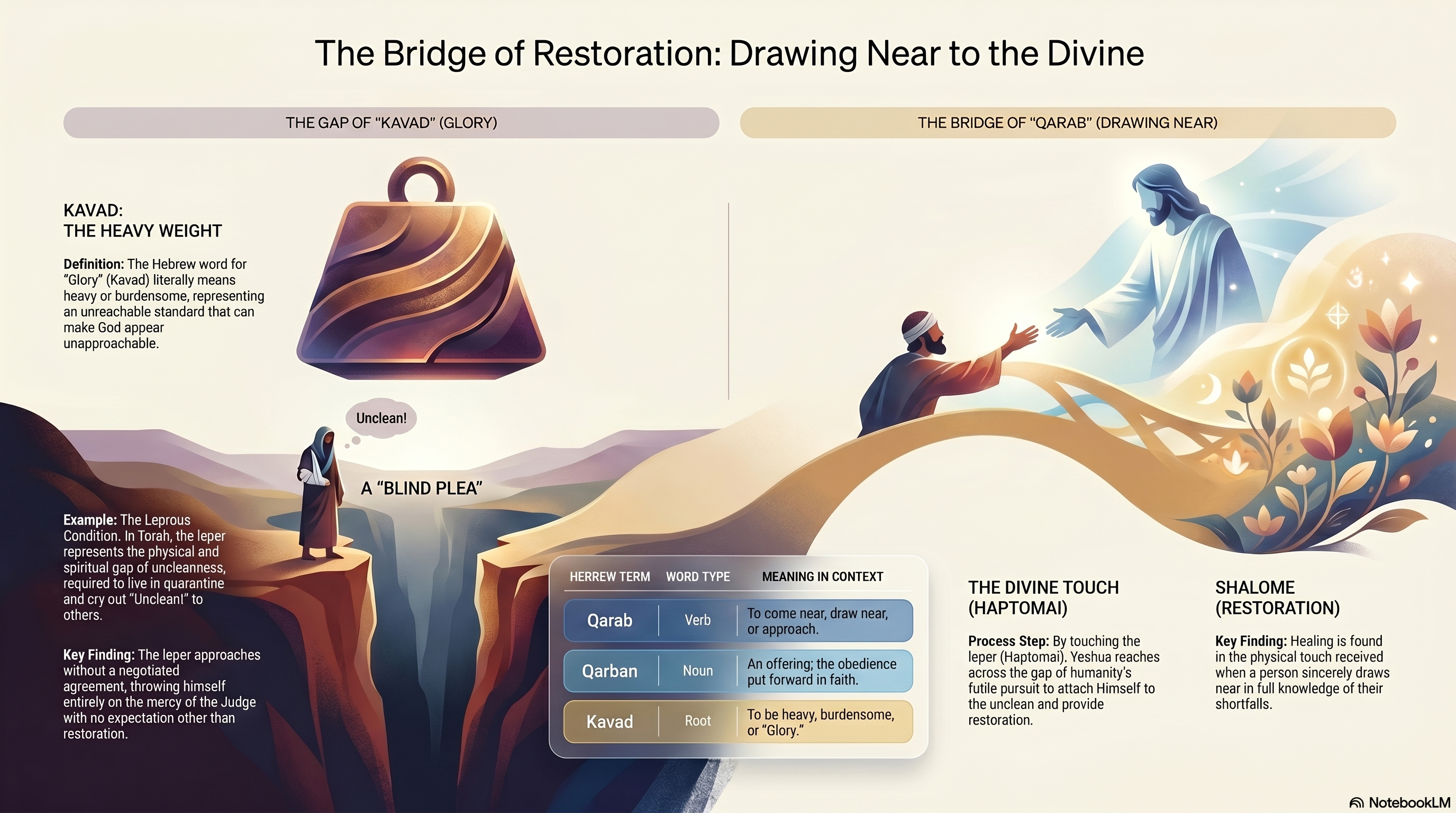
Bridging the Impossible Gap: 5 Surprising Lessons on the "Weight" of Drawing Near
The "Not Seeker-Friendly" Mountain
Modern spiritual discourse often prioritizes accessibility, comfort, and immediate emotional resonance. However, a philological examination of the mishpatim—the legal rulings and judicial applications of Torah—delivered by Yeshua in the Sermon on the Mount (Matthew 5–7) reveals a startlingly different reality. Here, Yeshua outlines a standard of "set apart behavior" so elevated that it renders the divine presence seemingly unapproachable.By the conclusion of Matthew 7, the bar has been set at a height that defies human effort. In the parlance of contemporary ministry, this mountain is decidedly "not seeker-friendly." Yet, as Matthew 8 opens, we encounter a radical intersection between the "unapproachable" and the "unclean." Through the lens of ancient Near Eastern legal frameworks and Hebrew etymology, the leper’s encounter with Yeshua provides a blueprint for how humanity can bridge the impossible gap—not by lowering the standard, but by submitting to the "weight" of drawing near.
1. Takeaway 1: Glory Isn’t Just Light—It’s "Weight"
In Western thought, "Glory" is often relegated to the ethereal: light, clouds, or a vague shimmering radiance. In the Hebrew mind, however, the concept is intensely visceral. The word for Glory is Kavad (or Keved), and its primary linguistic root denotes "heaviness" or "gravity."To a philologist, the construction of the word reveals its essence: the letters suggest a "taming or shaping hand upon the House and the door." It is the abiding gravity of a presence that cannot be negotiated. This is why the root Keved is also the word for the liver—the weightiest internal organ. When the Glory of YHWH filled the Tabernacle in Exodus 40, Moses was unable to enter. This was not due to a blinding light, but because of the Anan (cloud). In Hebrew, Anan is spelled with two ayns (eyes) and a nun, signifying a state of being "obscured." Moses suffered from a lack of vision in the face of this "abiding gravity.""You ever have that person or teacher that no matter what you did or how hard you tried you just weren’t going to move the meter. The expectation was all consuming and the bar unreachable. That’s glory in the Hebrew."
2. Takeaway 2: Worship is More Like a Dog Than a Song
When the leper approaches Yeshua in Matthew 8:2, the text employs the Greek term Proskeneyo (G4352) to describe his "worship." Far from the modern association with musical performance, this term describes a specific, physical posture of absolute submission: falling upon the knees and touching the forehead to the ground. Linguistically, Proskeneyo means "to kiss, like a dog licking his master's hand." It is a posture of total surrender, performed "not in greeting" and "not face to face." This act acknowledges the vast ontological disparity between the Master and the servant. It is the necessary precursor to approaching the "unapproachable" Glory—a recognition of one's place before the "weight" of the Sovereign.
3. Takeaway 3: The Power of the "Blind Plea"
In the legal framework of the mishpatim, an "Open" or "Blind Plea" occurs when a defendant pleads guilty without a negotiated agreement or a promised sentence. They simply throw themselves upon the mercy of the Judge (Shaphat). The leper arrived with such a plea. He was a "convicted person," fully aware that he failed to measure up spiritually (under the standards of the Mount) and physically (as one carrying uncleanness). It is important to note that biblical leprosy was not the same disease we know today as Hansen's disease; it was a physical manifestation of a spiritual state. While a "hardened heart" like Pharaoh’s responds to holiness with rebellion, the leper displayed shuwb (return) and shama (hearing). His cry of "UNCLEAN" was not the "toxic self-talk" of the hopeless, but a legal conviction of truth. He acknowledged the "weightiness of the skin"—the external organ that, since Adam’s fall in Genesis 3, has served as a heavy reminder of our iniquity and our tendency to hide from the VaYikra (the calling out) of God.
4. Takeaway 4: An "Offering" is Actually an "Approach"
The Hebrew phrase Qarab QARBAN provides a profound philological bridge to the Divine. In this structure, the noun Qarban ("Offering") is derived directly from the verb Qarab ("to draw near").
- Qarab (Verb): To come near, to draw near, or to approach.
- Qarban (Noun): The thing produced by the action of drawing near.
An offering, therefore, is not merely a gift; it is "the obedience we put forward in faith to draw near the unattainable." We see this in the book of Leviticus, titled VaYikra ("And He called"). When the Glory made the Tabernacle unapproachable, YHWH closed the gap by "shouting out" to Moses. Moses stayed within "shouting distance" and brought his Qarban to bridge the remaining distance. It is the mechanism that allows us to move from the obscured vision of the Anan into the physical presence of the Shekinah.
5. Takeaway 5: The Radical Authority of the "Touch"
The most startling moment in the narrative is when Yeshua "put forth his hand and touched" the leper. This was "not a 'Kosher' move." Under Torah, lepers were quarantined and required to warn others of their presence. By touching the man, Yeshua performed a "healing action" that linguistically links the Greek hap'-tom-ahee (G680) back to the Hebrew Qarab. Hap'-tom-ahee means "to attach oneself to." Throughout the Gospel of Matthew, this specific "touch" bridges the gap between humanity's futile pursuit of righteousness and the Master’s untainted holiness:
- Touching Peter’s mother-in-law to rebuke a fever (8:15).
- The woman attaching herself to the hem of His garment (9:21).
- Touching the eyes of the blind to grant sight (9:29, 20:34).
- Touching the disciples at the Transfiguration to dispel fear (17:7).
"It’s a picture of the gap between humanity’s futile pursuit and untainted righteousness. Fully acknowledging the short fall, get as close as you can with no expectation except restoration."
Conclusion: The Invitation in the Heaviness
The "unapproachable" mountain of the Law and the "heaviness" of God's Glory create a gap that no human effort can close. However, the ancient concepts of Qarab and Qarban reveal that God provides the very means by which we draw near. In the final movement of the encounter, Yeshua commands the leper to offer the gift commanded by Moses (Leviticus 14). This ceremony involved a bird killed in an "earthen vessel" over "living water." This is a philological shadow of the Shekinah—the Living Water inhabiting the earthen vessel of humanity to give His life for the many. Yeshua serves as the ultimate Qarban made flesh, the word made shakan (dwelling) among us. He does not lower the bar of holiness; He reaches across the quarantine of our iniquity with an authoritative touch. Are you willing to bring your "blind plea" to the weight of Glory, or are you still trying to negotiate the distance on your own?