More Than a Feeling: 5 Surprising Truths About the Ancient Meaning of Shalom
In our contemporary landscape, we have sanitized the concept of peace, reducing it to a "Zen-like" state of psychological tranquility. We define it by what is absent: the absence of noise, the absence of stress, the absence of conflict. The Oxford Dictionary codifies this modern myth, defining peace simply as "freedom from disturbance." Yet, the lexical lineage of the Hebrew term Shalom and the Greek sōtērion suggests something far more robust—and far more demanding.
To the ancient mind, peace was not light; it was heavy. When the presence of YHWH dwelt among Israel, it brought the "heaviness of glory" (Kavod) into the camp. This was a Set-Apart presence so profound that Moses could only remain within earshot, and the people, by nature, were not at peace with it. We are not naturally compatible with the weight of the Divine. Consequently, the Torah—the covenant instruction—was not a list of chores but a survival manual, a guide on how to "draw near" (Qarab) to a presence that would otherwise consume us. True Shalom is not the removal of a disturbance; it is the restoration of ontological wholeness.
Takeaway 1: Peace is a "Requital," Not Just a Feeling
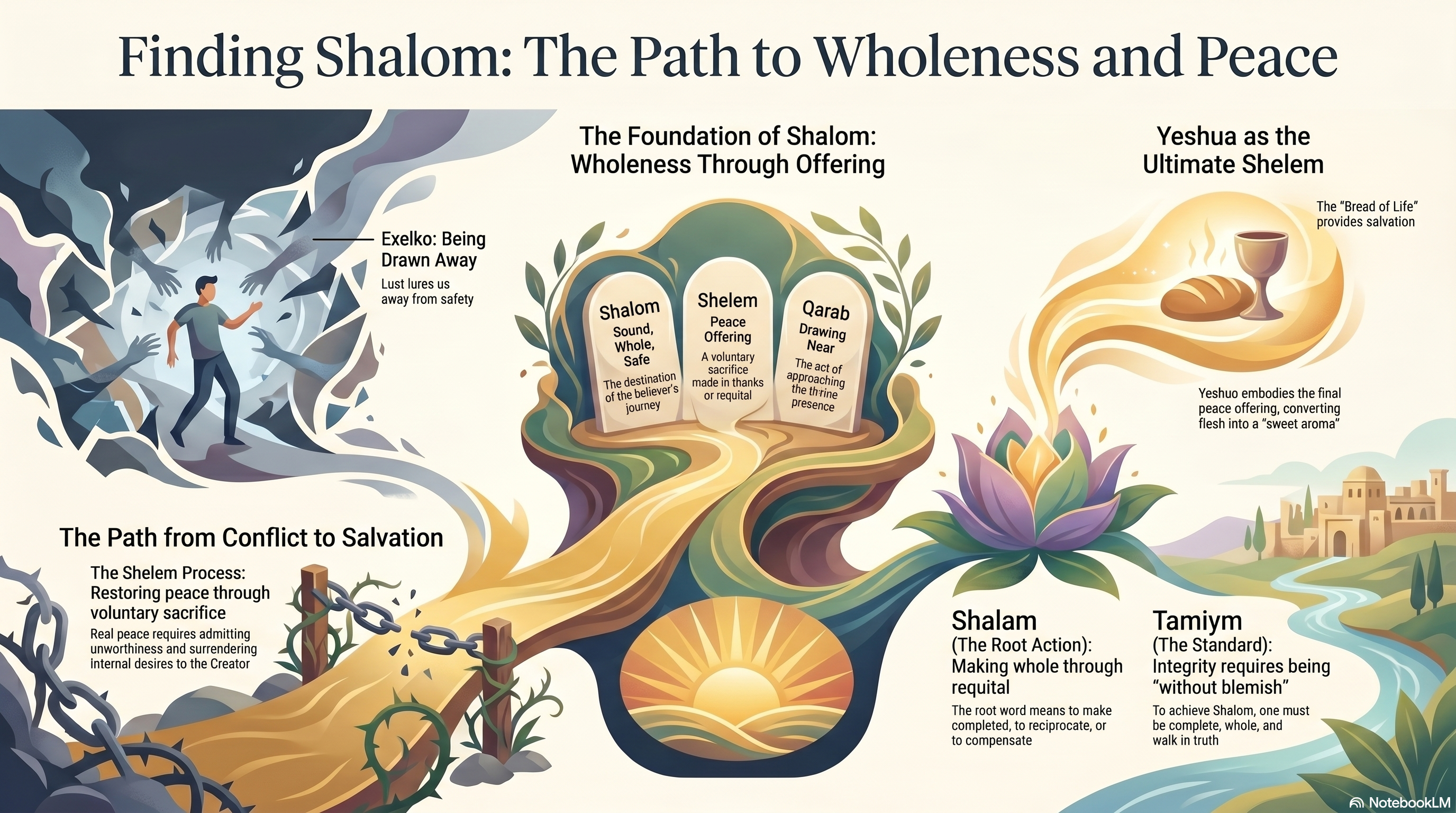
The biblical engine of peace is the Shelem (H8002), typically translated as the "peace offering." Etymologically, it is a "requital"—a voluntary sacrifice in thanks. To understand this, we must look to the 1828 Webster’s definition, which distinguishes between "compensation for services" and "retaliation for evil." In the context of the Divine, Shelem is a voluntary return of benevolence, a reciprocal action that acknowledges a debt and seeks to make the relationship whole.
This concept is inextricably linked to the root Shalam (H7999), meaning "to make completed" or "to reciprocate." To understand Shalom, one must understand the Beriyt (Covenant). In the ancient world, a covenant was "cut," implying that any violation brought the weight of death. Thus, "making whole" is not a polite gesture; it is a life-saving restoration of a broken bond. Peace is the active, reciprocal work of mending what has been fractured.
To be safe (in mind, body or estate); figuratively, to be (causatively, make) completed; by implication, to be friendly; by extension, to reciprocate.
Takeaway 2: The Geography of the Soul (Qarab vs. Drawn Away)
There is a distinct "geography" to the biblical narrative of the soul. On one hand, we have the movement of Qarab—the act of drawing near to the Divine presence. On the other, we have the Greek concept of exelkō, often translated as being "drawn away." The apostle James uses exelkō as a metaphor taken from hunting and fishing; it describes game being lured from its covert. It is the image of a soul being enticed by its own lust from the "safety of self-restraint."
While we are frequently lured away by our own definitions of what is "set apart," true peace is found only in proximity to the Divine. This is why Yeshua’s promise to make his disciples "fishers of men" is so profound—it is a mission of reclamation, a spiritual rescue of those who have been lured from the safety of the covenant and into the path of death. Peace is the result of resisting the lure of self-will and choosing to draw near through covenant instruction.
Takeaway 3: "Perfect" Doesn't Mean What You Think It Means
Few words induce as much modern anxiety as "perfect." We view it as a standard of flawless performance, an impossible peak of achievement. However, the Hebrew Tamiym (H8549) carries a different weight. It means "complete, whole, sound, having integrity." When the Bible describes Noah and Jacob as Tamiym, or when Abraham is commanded to walk this way, it is an instruction of posture, not a demand for robotic flawlessness.
To be Tamiym is to have a "sound" walk. In the sacrificial system, an animal had to be "without blemish" to be a Shelem, but this was symbolic of the integrity required for the soul (nephesh) to be restored. We must also remember that "Truth has been known to disturb the peace." The pursuit of Tamiym includes a commitment to truth that often disrupts modern "tranquility" in order to establish a deeper, more enduring wholeness. Integrity, not performance, is the requisite for peace.
Takeaway 4: The Divine Menu—Peace as "Lechem" (Bread)
In Leviticus 3, the peace offering is described with startling anatomical specificity. It is called Lechem—the "bread" or food of the fire. The instructions demand the offering of the Cheleb (the fat), which represents the "richest or choice part," and the internal organs (Qereb). In the Hebrew mindset, the Qereb (entrails) were the seat of thought and emotion. The kidneys represented the "mind," and the liver represented the "glory" or substance of the individual.
YHWH’s "perpetual statute" forbade the eating of fat or blood, reserving the "choice parts" for Himself. This reveals a profound truth: real peace is achieved when we offer the "internal man"—our deepest thoughts, appetites, and choice emotions—to be consumed by the Divine fire. This ancient practice finds its fulfillment in Yeshua, the "True Bread from Heaven" (John 6). He is the Lechem who set aside His own will to perform the will of the Father, inviting us to trade our lust-driven pursuits for a seat at the Divine table.
Takeaway 5: Surrender is the Shortcut to Wholeness
The mechanics of salvation are found in the linguistic bridge between the Hebrew Shelem and the Greek sōtērion. The Septuagint uses sōtērion—meaning "defense" or "salvation"—for the peace offering. This name, Yeshua (Salvation of Yah), is the embodiment of the Shelem. He is the "choice bread" offered for our lack of integrity.
In the ancient sacrificial system, the Olah (burnt sacrifice) literally means "ascent." The ascending smoke converted flesh into something that could reach the Divine. Yeshua, as our Shelem, was consumed to secure our "ascent" on the last day. Real peace is not earned through our performance of the instruction; it is found in the admission of unworthiness and the trust that the offered Shelem is "more than enough." To have peace with Elohim is to believe that He has declared you worthy and that your fractured nephesh has been mended by the Mediator.
Cast all your anxiety on him because he cares for you.
Conclusion: A Forward-Looking Wholeness
Shifting our pursuit from "tranquility" to "completeness" (Shalom) fundamentally alters how we navigate the disturbances of life. Peace is not a vacuum where nothing happens; it is a "making whole" that mends and stitches together the soul. This is the essence of Rapha—the divine healing described in Isaiah 57, where YHWH promises to lead us, restore comforts, and "heal" (mend/stitch together) those who are near and far.
As you consider your own life, look past the pursuit of a quiet environment. True Shalom requires a surrender of the choice parts. Ask yourself: What part of your "internal man"—the kidneys of your mind or the Qereb of your emotions—is currently being lured away by lust, and what part is waiting to be drawn near? Your wholeness is waiting in the "heaviness" of His presence.