In Stitches
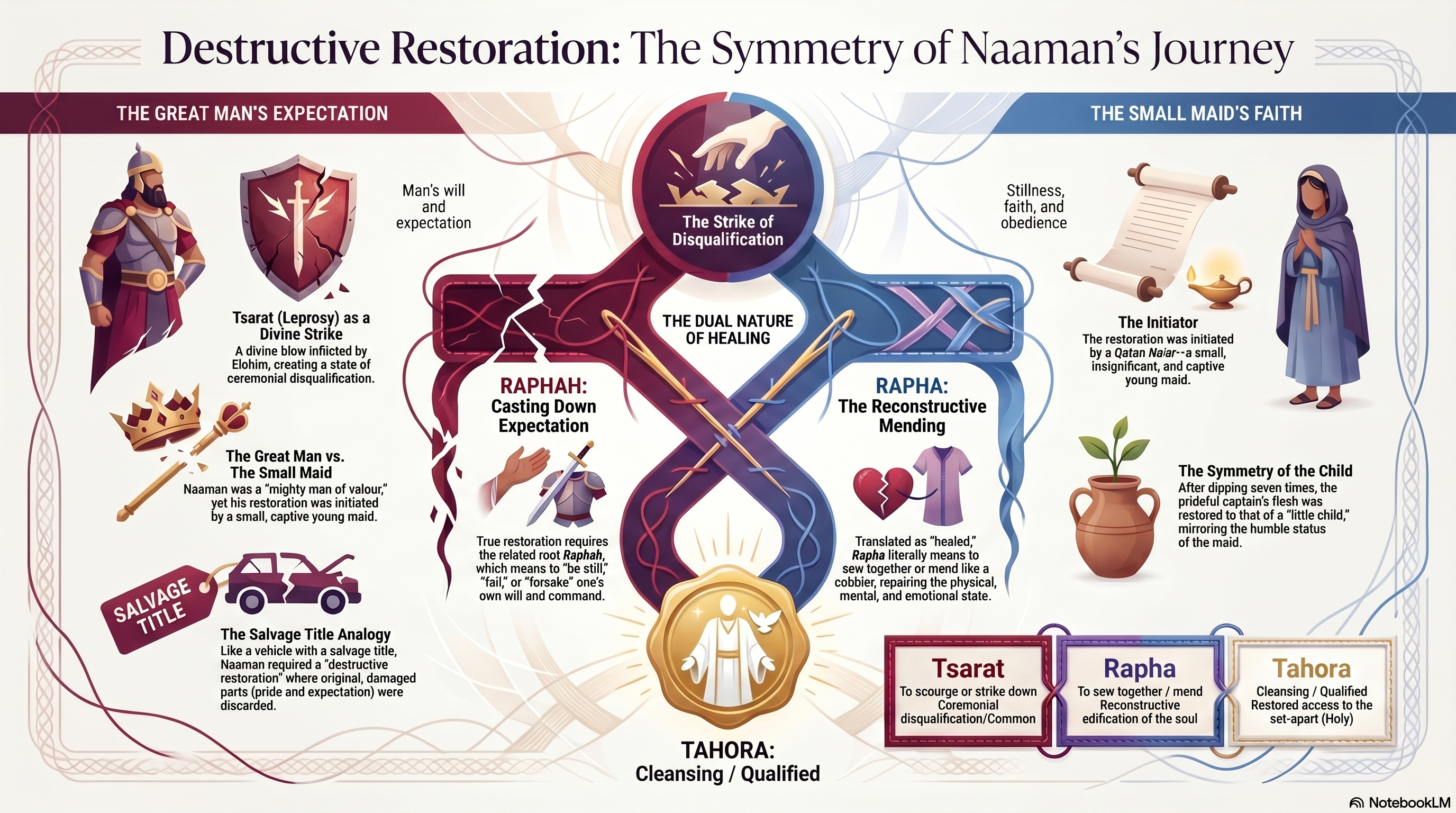
Sermon infographic — June 13, 2026
In the modern lexicon, to be "in stitches" is a sign of overflowing joy—an image of laughter so visceral it causes pain. Yet, in the surgical reality of spiritual and psychological restoration, the phrase takes on a more literal, somber weight. True healing is rarely a gentle mending of what remains; it is, more often than not, a destructive work. It is a process that necessitates a total dismantling of the architecture we have built for ourselves before a new structure can be raised. To be restored is to be unmade.
Restoration begins with Rapha (H7495), a term that transcends the simple biological recovery of a "scab." While natural processes may provide a surface-level fix, Rapha is an act of supernatural edification. The etymology of the word suggests the craft of the tailor or the cobbler: to sew together, to mend, to repair.
The very phonetic structure of the root—the "Resh-Pey" stock—mimics the rhythmic, rapid sound of a needle piercing fabric. This linguistic "stitching" implies that restoration is not merely the return to a former state, but the introduction of new material into a damaged frame. We are not simply "fixed"; we are mended with a divine thread that replaces our original substance. We are stitched together with less of us and more of him.
There is a profound lexical thread connecting Rapha (to heal) with its neighbor, Raphah (H7503). While the former is the act of mending, the latter is the state of letting go—to cast forth, to fail, to wax feeble, or to forsake one's own strength.
This connection offers a stark reinterpretation of the often-quoted Psalm 46:10: "Be still and know that I am Elohim." In a contemporary psychological framework, "stillness" is marketed as a tranquil, meditative peace. However, the linguistic root demands something far more aggressive: to become feeble. To "be still" is to leave off our own ways and exhaust our own save-yourself strategies. The divine needle only begins its work when the human spirit has finally become "slack." Healing does not begin when we find our center; it begins when we lose our grip.
The process of restoration can be understood through the lens of a vehicle sold under a salvage title. A car with such a history cannot be returned to the road through a simple car wash or a cosmetic polish. It requires a "destructive restoration"—the removal of damaged original components or those that fail to meet the standard of roadworthiness. These parts are discarded, and the frame is rebuilt with components that ensure the vehicle can safely interact with the world again.
In this framework, we must distinguish between Rapha and Tahora.
- Rapha (The Internal Rebuild): This is the internal, life-changing work of rebuilding the engine and the frame. It is a transformation of character and spirit that occurs in the hidden places.
- Tahora (The External Licensing): This is the ceremonial cleansing, the inspection, and the social "licensing" that restores an individual's access to the community.
Too often, we seek Tahora—the appearance of being "clean" or "qualified"—without submitting to the Rapha of the internal rebuild. But the engine must be sound before the license can be granted.
The narrative of Naaman, the Syrian captain, serves as a psychological study of the ego in crisis. Naaman's name means "pleasant," yet when faced with the requirement for restoration, he was revealed to be anything but. Afflicted with Tsarat (leprosy), he arrived with a caravan of gold and horses, expecting a "heroic" miracle—a public display where the prophet would "strike his hand" over the spot and perform a cosmetic recovery.
Naaman sought Asaf (H622)—a "scraping together" or a superficial assembly of parts. He wanted to be "fixed" while remaining the heroic general. When told to wash in the common, "filthy" waters of the Jordan, he was "wroth." In the Hebrew, this rage implies a "breaking." His anger was the beginning of his dismantling.
The danger lies in Naaman's internal dialogue: "Behold, I thought..." (Amar). This Amar is the expression of our will, our intent, and the expectations we bring to our own healing. Naaman preferred a mountain-top miracle because it would have preserved his pride. He was offended by the "common" nature of the instruction, failing to see that the healing started with the "little maid" (qatan)—the small and insignificant voice that pointed the way.
Restoration is Amoq (H6013)—a depth that is unsearchable and mysterious. It defies "fleshly explanation." Naaman sought a surface-level cure for his skin, but Elohim demanded a destructive restoration of his very nature.
By requiring him to dip seven times, the process forced Naaman to cast down his Amar and accept the Raphah of feebleness. He had to let go of the "General" to find the "Man." When he finally obeyed, the result was not just a return to healthy adult skin, but something far more radical.
Then went he down, and dipped himself seven times in Jordan, according to the saying of the man of Elohim: and his flesh came again like unto the flesh of a little child.
This is the ultimate irony of divine restoration: the death of the old self is the birth of the child. He did not come out of the water as a mended general; he came out as a new creation, possessing the spirit of one who has finally learned to be still. It was the male tense of the same language used to describe the little maid.
True restoration is not a performance we put on for the world; it is a mending that happens in the feeble moments of total surrender. We are often like Naaman, waiting for the skies to part and a heroic narrative to validate our struggle. We want to be "recovered" without being changed.
But the work of the Divine Cobbler requires us to be "in stitches"—to be dismantled, discarded, and sewn back together with material that is not our own. Are we willing to accept a healing that leaves us with less of ourselves, or are we still waiting for a miracle that leaves our pride intact?
📥 Downloads
In Stitches
In the economy of the Divine, healing is rarely a simple cosmetic touch-up or a return to a former state. Instead, true restoration—what the ancient texts call Rapha (H7495)—is a strategic "mending" process. It is a divine edification where the broken are not merely glued together but are meticulously sewn into a new configuration. As the noted lexicographer Gesenius observes, the root of Rapha fundamentally means "to sew together, to mend." This suggests a rugged, mechanical restoration. The Divine Physician functions here as a "cobbler," working with the hide of our souls, pulling together the disparate edges of a wound until they are unified.
The central thesis of this work is clear: being mended by Elohim results in a reconstruction where there is "less of us and more of Him." Linguistically, the "Resh-Pey" stock of this root is onomatopoeic; it imitates the rhythmic, rapid sound of a person sewing. It is the sound of a needle piercing through material to bring structural integrity where there was once a tear. This mending is Amoq—deeper than the skin, penetrating the mental and emotional layers of our being. To be healed by Elohim is to be purposefully reconstructed, beginning with a recognition of the specific "mark" that necessitates the stitch.
To understand restoration, we must first correctly diagnose our condition, distinguishing between a "health issue" and a "qualification issue." We often view hardships as random biological accidents, yet the scriptures use terms like Ne'gah (H5061) and Tsarat (H6883). According to Gesenius, Ne'gah refers to a "strike or blow"—strokes or calamities which Elohim inflicts upon men. Similarly, the "leprosy" (Tsarat) of the biblical text was not the modern Hansen's disease but a "mark" or "stroke" indicating one was smitten by Elohim.
The distinction is vital: the mark of Tsarat made an individual "common" or ceremonially disqualified. Therefore, the remedy required two distinct movements: healing (Rapha) and cleansing (Tahora). While healing is a supernatural act of mending, cleansing restores "access to the set apart." Healing is the real work of restoration; cleansing gives you access to the set apart. We must realize that the "sore" in our lives may be a divine "stroke" meant to prepare us for His set apart purposes.
- Is the current "sore" or hardship in your life a biological accident you want removed, or could it be a Ne'gah—a divine stroke intended to pause your current path?
- In what ways have you been seeking a "health fix" (relief) when what you actually need is a "qualification check" (ceremonial cleansing and restoration of purpose)?
Identify one current hardship. Instead of praying for its removal, pray specifically for "healing and qualification." Ask Elohim to reveal what this "mark" is meant to teach you regarding your access to His instruction, and move toward the "destructive" nature of the repair process.
It is easy to ignore that restoration is, by definition, "destructive work." To illustrate this, consider a vehicle sold under a "salvage title." Such a car cannot be merely polished; it requires a total reconstruction. This involves the aggressive removal of damaged parts that do not meet operational or safety standards. These original pieces—no matter how much they were once part of the car's identity—must be discarded. They are replaced with components "meet for inspection."
In the same way, Elohim's Rapha involves discarding parts of our character that are no longer "roadworthy" for the kingdom. He aggressively removes our self-reliance and pride to mend us with His own components. We are being edified so that we can meet the requirements for "licensing, emissions, and safe interaction" with others in a set-apart life. This restoration is not a preservation of who we were; it is the destruction of the old to make way for a functional new.
- What "original parts" of your identity are you fighting to keep, even though they have failed the safety standards of a righteous life?
- Does the idea of Elohim "discarding" pieces of your past feel like a loss, or can you see it as a necessary step toward being "meet for inspection"?
List three traits or habits you recognize as "damaged." This week, consciously "cast them forth." Commit to the aggressive removal of these parts to make room for divine mending, acknowledging the requirement of stillness.
There is a profound linguistic interplay between the word for mending, Rapha (H7495), and the word Raphah (H7503). Though they sound nearly identical, Raphah means to be still, to be feeble, to forsake, or to let go. You cannot have the mending (Rapha) without the letting go (Raphah). We see this in the command of Psalm 46:10: "Be Raphah (still) and know that I am Elohim."
To "be still" is to become "feeble." It means to "leave off" of your own ways and "forsake" your own strength. In a culture of heroic effort, being "feeble" feels like disqualification. However, as the scripture notes, "I will be exalted in the earth." He will be exalted in you or not in you. The choice to be feeble is the prerequisite for Him being exalted in your life.
- Why does becoming "feeble" or "idle" feel so threatening to your sense of value in a culture of "heroic expectations"?
- Are you preventing your own mending (Rapha) because you refuse to let go (Raphah) of the control you have over your situation?
Spend 10 minutes in absolute silence. Practice Raphah by "forsaking" your list of expectations for how Elohim should fix your situation. Tell Him, "I am becoming feeble so that You can be strong."
The story of Naaman is the ultimate case study in "expectation vs. faith." Naaman, whose name means "pleasant," was a "mighty man in valour," yet he was a leper (Tsarat). When he sought healing, he arrived with horses and gold, projecting a "heroic" expectation. Conversely, the instruction came through a "little maid"—the Hebrew qatan (H6996), meaning small, insignificant, or unimportant. The "pleasant" man was filled with "rage" because of a "small" instruction.
Naaman's rage was a result of his Amar (H559)—his internal expectations and intent—being at odds with YHWH's command. He wanted the prophet to wave a hand and part the skies. Instead, he was told to wash in the Jordan seven times. He wanted a mountain-top experience; Elohim offered a muddy river. True faith is not the heroic desire to climb a mountain, but the "common" discipline of performing a simple act of obedience.
- Are you missing your "cleansing" because you are waiting for a "heroic" miracle instead of performing a "common" act of obedience?
- How much of your "faith" is actually just a strong Amar (expectation) that YHWH will do things exactly the way you've imagined?
Identify one "simple/common" instruction you have been ignoring. Execute this discipline, whether a simple act of forgiveness or a mundane task, "seven times" this week without complaint, focusing solely on the repetition of obedience.
To be "in stitches" is to occupy a state of holy reconstruction. The goal of the Divine Cobbler is to ensure we are "edified into the image of Mashiach." This is a supernatural rebuilding, a work that is Amoq—unsearchable and mysterious, leaving no room for fleshly explanation.
As you navigate your current calamity, remember that you cannot expect only "good" or "bad" from Elohim; you must expect righteousness and set-apart purpose. The "Hebrews writer" reminds us of the "two immutable things"—the oath and the promise—by which "it is impossible for YHWH to lie." You are a "salvage title" life in the hands of the Great Repairman. The stitches may be tight, and the destruction of the old self painful, but the result is a life that is functional and restored. Wait on YHWH, believing in His faithfulness even while you are currently "in stitches."