In The Flow
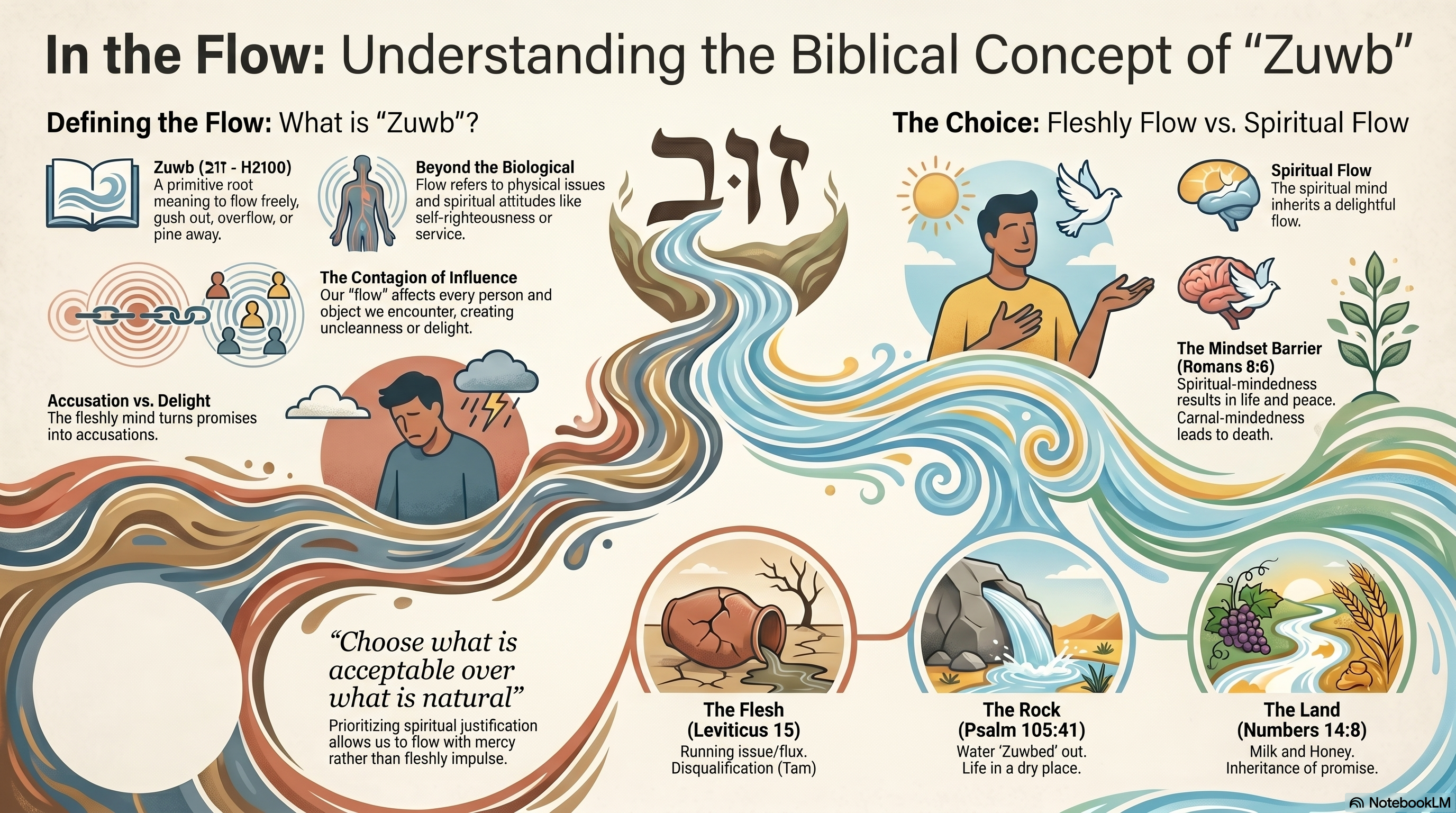
Sermon infographic — June 20, 2026
In our modern era, we have developed a secular liturgy around the "flow state"—that frictionless pursuit of productivity where time dissolves and effort feels like grace. We chase it in our boardrooms and our creative studios, treating it as the ultimate metric of psychological alignment. We have been taught that to be "in the flow" is the pinnacle of human functioning.
However, a deeper architectural analysis of the spirit suggests that our understanding of this state is dangerously thin. The ancient wisdom found within the Torah provides a much more challenging, and perhaps unsettling, definition. It suggests that "flow" is not merely a high-performance mental state we occasionally inhabit, but a constant physiological and spiritual reality that we are perpetually projecting into the world.
The Torah reveals a profound truth: we are never not flowing. We are conduits by design. The question is not whether we are in the flow, but rather the quality, the direction, and the consequence of the current we carry. By examining the Hebraic foundations of this concept, we discover that what we perceive as our greatest strength can, under the wrong conditions, become the very leak that disqualifies our future.
To understand the weight of our internal current, we must grapple with the Hebrew word Zuwb (H2100). At its primitive root, Zuwb describes a free, gushing movement—a river in its strength. Yet, embedded within this word is a striking paradox: it represents both an "overflow" and the act of "wasting away" or "pining."
In the Levitical context, Zuwb specifically relates to a reproductive flux. Here lies the "a-ha" moment: that which is biologically intended for life-giving reproduction can, when misaligned, become the very "issue" that drains our life force. A flow can be a river of abundance, or it can be a leak—a slow hemorrhage of vital resources that leaves the soul in a state of Tamae (H2930). This is not merely "uncleanness" in a ritual sense; it is a state of disqualification that halts the intended divine flow. We are often most exhausted not by what we do, but by what we are unintentionally leaking.
"Speak unto the children of Israel, and say unto them, When any man hath a running issue out of his flesh, because of his issue he is unclean. And this shall be his uncleanness in his issue: whether his flesh run with his issue, or his flesh be stopped from his issue, it is his uncleanness (Tamae)." — Leviticus 15:2-3
The sermon makes it clear that our internal flow dictates our external interpretation. Our state of being is the lens through which we view the promises of the Divine. We see this most tragically in the Israelites' journey toward the land "flowing (Zuwb) with milk and honey" (Numbers 14:8).
While the promise was one of the rich flow of Adamah (the ground), a corrupted internal state can rewrite history itself. By Numbers 16:13, the Israelites' internal bitterness had become so distorted that they redefined Egypt—the land of their slavery and systemic infanticide—as the land "flowing with milk and honey." This is the ultimate psychological gut punch: a corrupted internal flow doesn't just misinterpret the future; it hallucinates a better past to justify a cynical present. When we flow with accusation, even a divine promise is perceived as a threat.
"They took the promise of YHWH and turned it on Moses to flow as an accusation."
One of the most sobering insights regarding the "flow" is its inevitable impact on our environment. In the Levitical architecture, a person with an "issue" did not exist in a vacuum. Everything they touched—the beds where they rested, the chairs where they sat—became disqualified.
This serves as a profound metaphor for our social influence. Our internal state is never private; it is an atmosphere we carry. The source explicitly mentions the act of "spitting" (Leviticus 15:8) as a means of spreading disqualification. Consider this a metaphor for our casual overflow: the words we drop in frustration, the cynical remarks we breathe out in passing, the unconscious "spit" of our internal unrest. Even our most minor interactions have the power to disqualify the environments of others.
"It's important to point out, our 'flows' can have the same influence whether they are clean or unclean, qualified or disqualified. The difference is what we flow with, and the influence upon the one who encounters us."
We often believe that our ability to flow is dependent on our environment, yet Psalm 105:41-45 presents a counter-intuitive truth. It describes the moment the Creator "opened the rock, and the waters Zuwbed out." This is a rare, positive use of the word, highlighting a divine exception where life-giving water emerges from a cold, hard source in a parched land.
The "a-ha" moment here is the distinction between the Source and the Environment. The Rock contained the flow even when the desert provided nothing. This suggests that flowing is an internal capability, not an environmental response. Even in "the lands of the heathen"—the dry, uninitiated places of our lives—there is a rich flow of Torah and wisdom available to those connected to the Source. We do not flow because the world is kind; we flow because the Rock is open.
Finally, we must distinguish between the "natural" and the "spiritual." The flesh, or Basar (H1320), is defined as "flesh as frail or erring." This is our default setting—a natural flow that often leads to a state of enmity with the divine. To flow "naturally" is often to flow into decay.
To flow in a way that is "acceptable" requires a conscious, spiritual architecture. It is the intentional choice to be spiritually minded rather than carnally driven. We are designed to be conduits, but the quality of the transit is our responsibility. By choosing what is "acceptable" (Ephesians 5:10) over what is merely "natural," we move from a state of pining away to a state of justified, qualified movement.
"Choosing what is acceptable over what is natural allows us to flow qualified in justification."
The question is never whether you are in the flow; the question is what you are radiating. We are all conduits. We are all radiators. We are all leaving a wake in the water of others' lives. Our flow is either a life-giving river that cleanses our environment or a leak of vital energy that disqualifies everything we touch.
Flow is an inevitable part of being human, but the quality of that current is your primary spiritual responsibility. As you move through the architecture of your day, examine the wake you leave behind. What is currently flowing from you into your world?
📥 Downloads
In The Flow
The sermon introduces the biblical concept of Zuwb—a Hebrew word meaning to flow freely, gush out, or have an issue. In Leviticus, physical issues rendered a person and everything they touched ceremonially unclean or disqualified. However, this is deeply spiritual: our attitudes, complaints, and self-righteousness act as a contagious "flow" that influences everyone we encounter. Conversely, if we walk in obedience, we can flow with the delight of YHWH, much like the promised land flowing with milk and honey.
- What kind of spiritual "flow" do I bring into a room?
- When I interact with my family, coworkers, or congregation, am I spreading a contagious attitude of peace and edification, or am I spreading the uncleanness of complaining and self-importance?
Before you walk into your workplace or your home today, pause in your car or at the door to explicitly "check your spirit." Consciously surrender any negative baggage to Elohim so that you do not contaminate the environment with a fleshly flow.
Naturally, the carnal mind is an enemy to YHWH and flows toward death and rebellion. Yet there is a beautiful hidden hope inside the Hebrew word for flesh, Basar. At its primitive root, this word means to be fresh, cheerful, and to "announce glad news" or bear good tidings. This is illustrated using the "beautiful feet" of Isaiah 52:7. Feet represent our frail, dirty human condition; however, when yielded to YHWH to carry the Gospel of peace, even our flawed human flesh becomes a beautiful vessel of redemption.
- Am I allowing my carnal mind to dictate my reactions, producing enmity and conflict?
- Or am I yielding my human frailty to Elohim so that my "feet" can carry the good news of Yeshua?
Find one opportunity today to purposely announce "glad tidings" to someone who is struggling. Use your words to build them up and point them to the peace of YHWH, effectively using your flesh as a vessel for His message rather than your own.
Yeshua rebuked the Pharisees who cleaned the outside of the cup while their insides were full of lawlessness. In Leviticus 15:12, an "earthen vessel" touched by an unclean flow had to be completely broken, while a "wooden vessel" simply had to be rinsed. This is a powerful metaphor: if we are only born of the earth (carnal dust), our pride must be completely shattered. We must instead be shaped by the wood of Calvary's tree, undergoing an inside-out metamorphosis so our flow is not corrupted by hidden hypocrisy.
- Have I been prioritizing how holy I look on the outside while ignoring internal struggles with pride, covetousness, or lawlessness?
- Am I merely a whitewashed tomb, or am I allowing Yeshua to cleanse my inner cup?
Identify one area of hidden, internal sin or hypocrisy in your life. Bring it before YHWH in private prayer today, asking Him to break your carnal "earthen vessel" in that specific area and replace it with true, inside-out restoration.
To correct a corrupt flow, the protocol outlined in James 4 points the way: submit to Elohim, resist the adversary, and draw near (Karab) to YHWH. We cannot skip to the joy; we are commanded to cleanse our hands, purify our double-minded hearts, and even "be afflicted and mourn" over our fleshly condition. Our modern "microwave culture" wants instant spiritual validation without the necessary humility and mourning required to truly submit to the Torah.
- Do I expect Elohim to lift me up and comfort me without ever humbling myself or mourning over my own sin?
- Am I quick to act as a self-righteous judge of the law rather than a humble doer of it?
Choose to intentionally "afflict" your flesh today by fasting from something small—whether it is a meal, social media, or the habit of complaining. Use that time to draw near to YHWH in humility, asking Him to elevate your spirit over your carnal will.
In Leviticus, the cleansing process for a flow took eight days, mimicking the installation of the priesthood, and required bathing in running (living) water. Yeshua beautifully fulfilled this prophetic shadow on the "great eighth day" of Sukkot. He stood and declared that whoever believes in Him will have "rivers of living water" flowing out of their belly. This living water is the Ruach (Holy Spirit), which provides a supernatural flow that continually cleanses believers from the inside out, allowing them to bring edification to everyone they encounter.
- Is the Ruach Hakodesh (Holy Spirit) the primary source of what flows out of me?
- When I feel spiritually depleted or unclean, do I try to fix it myself, or do I go to Yeshua to drink from His living water?
Every time you wash your hands or take a drink of water today, pause for five seconds to thank Yeshua for His Ruach Hakodesh. Pray a simple prayer asking that His living water would be the only thing that flows from you today.