Hard Division
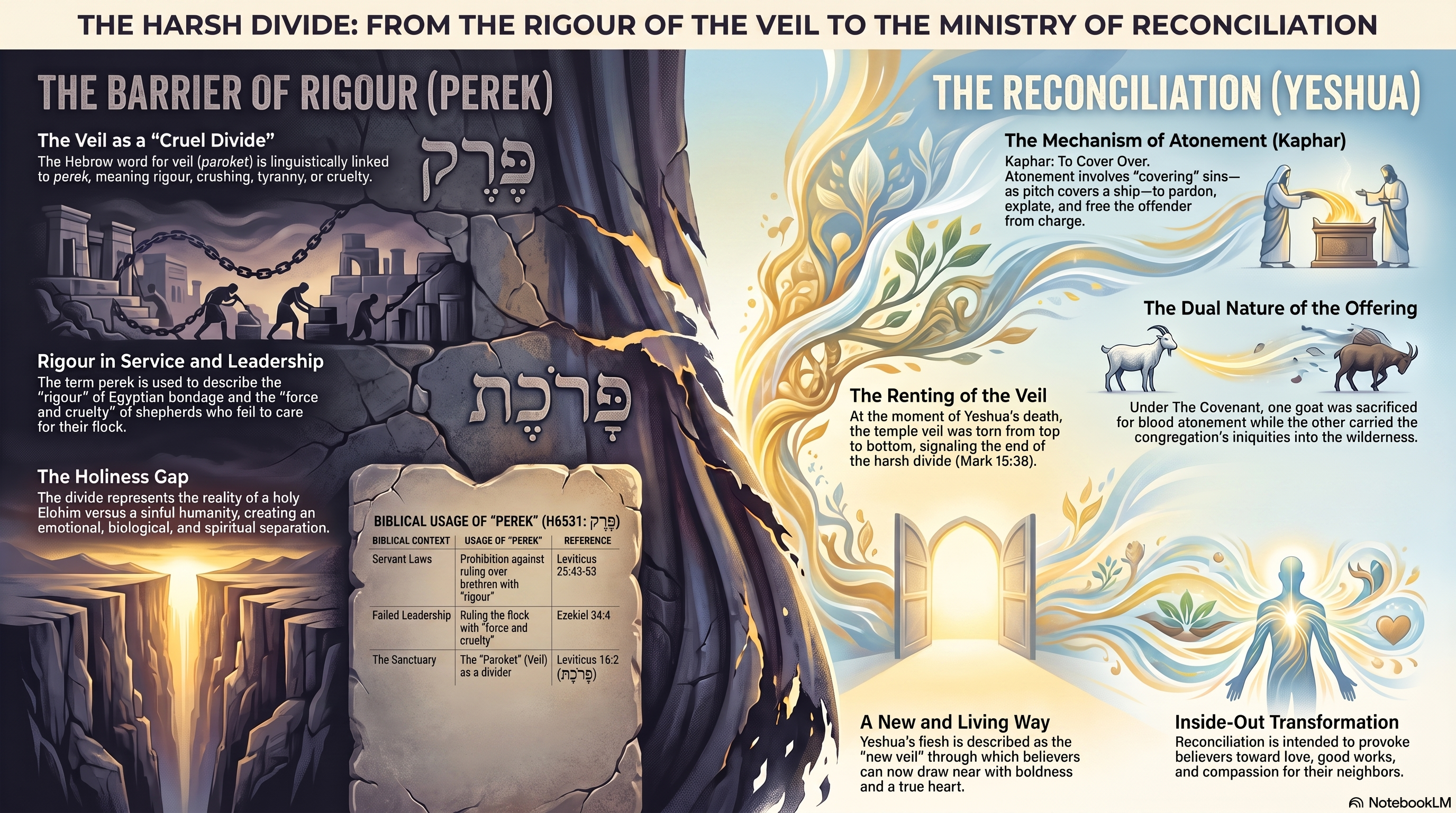
Sermon infographic — June 27, 2026
Have you ever stood on the edge of a massive canyon, looking across at a beautiful, sun-drenched city that you simply cannot reach? In the space between you and that city is a terrifying drop into darkness and fire. There is no bridge, no path, and no way over. This vivid imagery is more than just a picture; it is the reality of the "Hard Divide" that exists between us and the Divine.
We often feel this gap in our daily lives. We feel it when we think about a holy Elohim who seems too far away, and we feel it when we look at the broken relationships around us. We feel locked out, separated by a wall we didn't build but can't seem to tear down. A deeper look at the original language of the Bible reveals a shocking truth about this gap, how it was created, and the heavy price paid to cross it.
In the ancient Tabernacle, a thick vail separated the people from the most holy place. In Hebrew, this vail is called the parokhet. While we might imagine a soft, decorative curtain, the Hebrew root tells a much darker story. The word comes from perek, which means "rigour," "oppression," or "cruelty." Linguistically, parokhet is an active participle — it is "currently in service." Think of the difference between saying "I run" and "I am running." The vail wasn't just hanging there; it was actively working. It is closely related to the Hebrew word tachan, which means to grind or crush. This vail represented the crushing force of YHWH's absolute holiness against human sin.
"It wasn't just a curtain, it 'Was Curtains' for whoever would approach on a 'bad flow' day. To the unclean, YHWH's holiness feels harsh because it cannot allow sin to exist in its presence. It acts as a grinding barrier for anyone attempting to enter on their own terms."
The word perek appears only six times in the entire Bible, and its placement is very intentional. Five of those times are found in the books of Law (Exodus and Leviticus), and the final instance is in the book of Ezekiel. This shows us that the "Hard Divide" spans the entire biblical narrative, from the sanctuary to our social interactions.
- The Burden of Rigour: In Exodus 1:13, the Egyptians forced the Israelites to serve with perek—rigour and cruelty.
- The Failure of Shepherds: In Ezekiel 34:4, YHWH rebukes leaders who ruled the weak with "force and with perek cruelty" instead of healing the sick and seeking the lost.
This reveals that the "Divide" isn't just a physical vail in a temple; it is a "self-serving cruel divide" created when those in positions of authority ignore the helpless. In Leviticus 25, YHWH explains that those who have an "inheritance" (authority or position) have a direct responsibility to those in need. Cruelty is the failure of using YHWH-given position to self-serve rather than serve others — and this requires an inside-out transformation.
In Matthew 9:35-38, Yeshua looks at the crowds and tells His disciples to pray to the "Lord of the Harvest." We often picture a peaceful wheat field, but the Greek term Therismos is much more intense. It refers to a time of final judgment and destruction, where the righteous are gathered but the wicked are delivered up to be destroyed.
When Yeshua looked at the crowds, He didn't just see a "hassle" or a busy group of people. He saw souls facing a final, crushing judgment across a gap they couldn't bridge. Seeing the "Hard Divide" this way should move us to compassion rather than annoyance. It requires an "inside-out transformation" to stop seeing people as a problem to avoid and start seeing them through Yeshua's eyes.
For the High Priest Aaron to pass through the vail, he couldn't just walk in. He had to pay a specific price, starting with a "Young Bullock" (Ben-Baqar). The root word Baqar means "to cleave open" or "to plough a field." Essentially, the bullock was the "Way Opener."
Significantly, the "Young" part of this sacrifice is the Hebrew word Ben, meaning "son." The price was a reminder that the way would be opened not just by an ox, but by a Son. Aaron also brought an Ayil (ram), a word that describes a "projection of strength." In Hebrew scholarship, this is a polymorphic term that can mean a "mighty man," an "oak tree," or "strong posts."
Aaron didn't have this strength or holiness naturally. He had to wash, put on holy garments, and offer a strength he didn't possess just to survive the encounter. This proves that drawing near to YHWH requires a level of perfection that we simply do not have on our own.
The "Hard Divide" was finally crossed not by human effort, but by the ultimate Way Opener. Yeshua carried away the cruel, harsh, and rigorous divide through His own death.
Mark 15:37-38 tells us that at the moment Yeshua died, the vail of the temple was "rent in twain"—torn in two from top to bottom. The crushing barrier was physically and spiritually destroyed. Hebrews 10:19-25 calls this a "new and living way." We no longer stand on the edge of the canyon looking across in fear; the "Way Opener" has cleared the path for us to enter with boldness.
The "Hard Divide" was the result of our sin and the "rigour" of a broken world. It was a barrier of crushing holiness that kept us separated from our Creator. But through the sacrifice of the Son, the vail has been torn, and the way has been opened.
This reality should change how we live every day. When you look at your "neighbors" or the "crowds" in your life, do you see a hassle, or do you see people who need a way across the gap? We must experience an inside-out change that reflects the heart of the One who paid the price.
"A price was paid so that I, and the crowds, MIGHT draw near."
📥 Downloads
Hard Division
In our spiritual lives, we often speak of "knowing Elohim," but there is a profound difference between casual knowledge and the strategic work of reconciliation. The "Hard Division" represents the massive chasm that exists between the holiness of the Divine and the reality of human sin—a separation that is not merely emotional but biological and spiritual. According to 2 Corinthians 5:18–19, this gap was so significant that it required Elohim to take the initiative. He was in Yeshua, reconciling the world to Himself and, remarkably, choosing "not to impute their trespasses unto them."
This "ministry of reconciliation" is not just a theological concept for the history books; it is the very foundation of our daily lives. If we don't understand the bridge that has been built for us, we risk living in a state of perpetual distance, trying to earn what has already been given. We have been "brought back" from a state of exile, but to truly appreciate this homecoming, we must understand the physical and spiritual symbol of the barrier that once stood in our way: the Veil.
In the ancient Tabernacle, the "Vail" (Paroket) served as the definitive boundary between the Holy Place and the Most Holy Place. While we might think of a curtain as a simple, decorative divider, the Hebrew reveals a much more intense reality. Paroket is the active participle form of the word perek (H6531). In Hebrew, this implies something "currently in service"—an active force of "rigour," "crushing," or "tyranny." The weight of this word is felt in Exodus 1:13, which describes how the Egyptians made the children of Israel serve with "rigour" (perek).
This tells us that the veil was a constant reminder of the crushing distance between a holy Elohim and the "bad flow" of human sin. It wasn't just a curtain; for anyone who approached improperly, it "was curtains"—a place where the weight of Divine holiness would crush the uncleanness of man. When we see the "rigour" of holiness against sin, we begin to realize how that same harshness can leak into our own lives and how we treat those around us.
- In what areas of our lives do we feel a "crushing" distance between ourselves and Elohim?
- Are we trying to reach Him through our own hard work and "rigour," or are we trusting the way He has opened?
Spend five minutes in silence today. Acknowledge one specific "crushing" weight or habit you've been carrying. Mentally hand it over to Yeshua, our "Way Opener," acknowledging that you were never meant to carry the weight of that divide on your own. Actively turn — leave off — from the things that made you feel the separation.
There is a grave danger in possessing power when our hearts haven't been transformed from the inside out. When we operate out of our own strength rather than through the lens of reconciliation, we often default to perek—ruling with rigour or cruelty. This shows up in the "improper interactions" between those in authority and those in need.
We see this warning in Ezekiel 34, where the shepherds of Israel are rebuked for feeding themselves while the flock suffered. They ruled the people "with force and with perek (cruelty)." In Leviticus 25, Elohim reminds Israel that because He brought them out of Egypt, they must not rule over their "brethren" with rigour. This is the heart of the matter: even though Israel was given the land, they were told it wasn't because of their own righteousness, as they were a "stiffnecked" people. The "inside-out" transformation is the only thing that removes the "rigour" of vanity and replaces it with empathy. When we are harsh with those "under" us—children, employees, or the needy—it is a sign of a heart that has forgotten its own need for mercy. To move away from this harshness, we must look to the ultimate High Priest and the staggering price He paid to remove the rigour of the divide.
- When we find ourselves in charge, do we lead with "rigour" (harshness) or with the kindness we've received from Elohim?
- Is there someone "under" our care whom we have treated with a "self-serving" attitude lately?
Identify one person toward whom you have been "stiffnecked" or harsh. Reach out to them today with a simple act of service or a kind word. Let's choose to break the spirit of perek in our relationships by modeling the mercy we ourselves depend on.
Entering the presence of the Divine was never meant to be casual; it was costly. In the ancient system, Aaron, the High Priest, had to pay a specific price to represent a sinful people before a holy Elohim. He had to "dress up" in an external holiness, whereas Yeshua provides a transformation that starts within.
| The Price for Aaron | The Price Yeshua Paid |
|---|---|
| Washing & Garments: Had to wash his flesh and put on "holy linen" garments he didn't naturally possess. | His Own Flesh: He consecrated a new way "through the veil, that is to say, his flesh" (Heb 10:20). |
| The Young Bullock (Ben-Baqar): The "son who opens the way." Aaron had to seek and reflect on the way being opened through the Son. | His Own Blood: He entered the holiest not with the blood of bulls, but by His own blood (Heb 10:19) — the Son of Elohim who opened the way. |
| The Ram (Ayil): A "projection of strength." Aaron had to offer strength he did not naturally have. | Carried the Penalty: He departed with the penalty for all our missteps, providing a peaceful dwelling. |
| Symbolic Atonement: Aaron performed these rituals "incognito," trusting Elohim would honor them so he would not die. | Tearing the Veil: At His death, the veil was "rent in twain from the top to the bottom" (Mark 15:38) — in His flesh, though He was Elohim. |
Aaron's work required him to ponder the way opened through the Son, but Yeshua is that Son. He is the true "Way Opener" who carried away the cruel, harsh, and rigorous divide. Once we realize we've been brought near by such a costly sacrifice, our focus naturally shifts outward toward the "multitudes" who are still wandering on the other side of that divide.
- Do we realize that a high price was paid just so we can approach Elohim today?
- Are we still trying to "wash our own flesh" to be good enough, or are we resting in Yeshua's sacrifice and turning from sin out of love and appreciation?
- Do we see sin as the cruel divide, or do we find it appealing?
Read Hebrews 10:19–22 slowly. Today, "draw near" to Elohim in prayer with "full assurance." Take a moment to specifically thank Him for the "new and living way" that cost us nothing but cost Him everything. Confess to Him the sin that may still appeal to your flesh.
Our natural, "outside-in" perspective often sees crowds as a "hassle"—a frustration to our schedules. However, we must challenge this mindset. When Yeshua saw the multitudes, He didn't see a nuisance; He was "moved with compassion" because they were scattered like sheep without a shepherd.
In Matthew 9:35–38, Yeshua speaks of the "Harvest" (Therismos). Figuratively, this refers to the time of final judgment. When we see people through this lens, we realize the urgency: the righteous are gathered, but the wicked are "delivered to destruction." This sobering reality is what fuels our compassion. If we see people as "biological, emotional, or spiritual" needs rather than inconveniences, our annoyance transforms into the heart of the "Lord of the Harvest." A price was paid so that not only we, but also the "crowds," might draw near. This shift in vision is the final piece of the "inside-out" change required to live out our calling.
- When we see a crowd at the store or in traffic, is our first thought "annoyance" or "compassion"?
- How can we begin to see people as "wandering Israel" instead of just a "hassle"?
The next time you are in a crowded place and feel frustrated, stop and pray for three random people in that crowd. Ask Elohim to help you see their needs instead of your own schedule.
We are no longer on the outside looking in. The "Hard Division" has been breached, the "rigour" of the veil has been torn, and the way has been opened by the blood of Yeshua. We are now commissioned to carry this same heart of reconciliation into every interaction we have.
To live this out, we must:
- Acknowledge the Divide: Recognize the holiness of Elohim and our desperate need for His initiative.
- Accept the Sacrifice: Rest in the "new and living way" that Yeshua consecrated through His flesh while leaving off the things your own flesh may desire.
- Act with Compassion: Reject the "rigour" of cruelty and see the harvest through the eyes of the Shepherd.
As you walk through the new and living way today, let us "consider one another to provoke unto love and to good works" (Hebrews 10:24). You are a minister of the reconciliation you have so freely received. Go forth and freely give.