The Blood Line
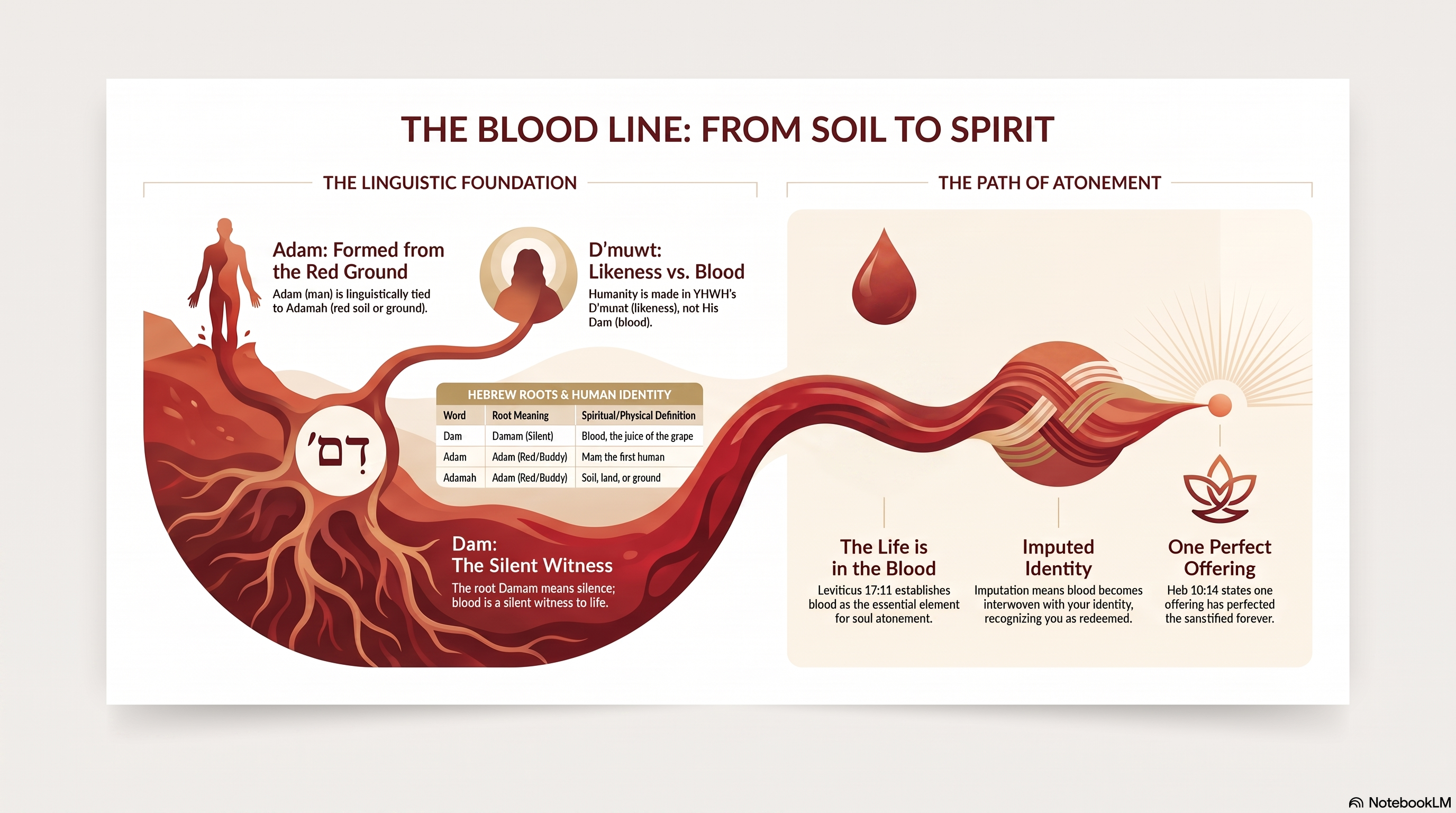
Sermon infographic — July 4, 2026
Most of us are appalled by the sight of blood. Whether it is a scraped knee or a deeper injury, seeing that red liquid usually means something has gone wrong. We know it is vital for life, but we often prefer to keep it hidden.
However, blood carries a meaning that is much deeper than biology. By looking at ancient Hebrew and biblical history, we find that blood is more than a part of our bodies—it is a witness to our history and our identity. This journey through the "bloodline" shows how a silent liquid tells the story of where we come from and where we are going.
In the Hebrew language, the word for blood is Dam (H1818). This word comes from the root Damam (H1826), which means to be silent, still, or astonished. Scholars describe this word as "onomatopoetic," meaning the word imitates the sound it represents.
In this case, Dam mimics the sound of a shut mouth—the quiet "hm, dm, mh" sounds you make when you are not speaking. This linguistic connection tells us something fascinating:
- Blood is designed to be a silent witness to life.
- As long as it is inside the body, it stays quiet and invisible.
- It only "speaks" when it is shed and becomes visible to the eye.
When blood appears, the silence is broken, and it calls for a response. Visible blood cries out. It represents life leaving and a reckoning required.
There is a deep connection between humanity and the earth hidden in ancient words. In Hebrew, the word for blood (Dam) is the building block for the word for man (Adam). Furthermore, the word for the ground or soil is Adamah. All these words are linked by the idea of being "ruddy" or red.
Even the famous King David was described as Adomowniy / Edom (ruddy or red). Because of this connection, he literally "looked like the land." The original design was for man to have a special relationship with the land. The Adamah was meant to yield its strength as a gift (Natan) to humanity.
However, the story changed when the first blood was spilled on the ground. When Cain killed his brother, the blood "spoke" from the earth, and the land stopped giving its strength as a free gift. Our lives are tied to the earth, and how we treat life affects our connection to the world around us.
When we think about being made in the "likeness" of someone, we usually think about looking like our parents. The Hebrew word for likeness is Demut. If you break this word down poetically, it contains two interesting roots: Dam (blood) and Moot (dead). Being born in the Demut of Adam means we inherit a bloodline tied to mortality. To have blood is to have a life that will eventually end.
After Adam's first two sons were lost to murder and exile, he had a third son named Seth. Seth was born in Adam's "stead," meaning he took the place of another. This is a shadow of what was to come. While we are born in the likeness of Adam—carrying blood and death—our goal is to change our identity to the bloodline of the Messiah. The cultural idea that we are all YHWH's children is technically incorrect; we are all children of Adam with the opportunity to become the children of YHWH.
The concept of the "bloodline" is best seen through two different doorways (Pateh):
- The Door of Cain: Cain was warned that sin was crouching at his door. He chose to walk through it and murder his brother, receiving an Oat (sign) leading to a cycle of cursing and wandering in the Eretz (land of bondage).
- The Door of Passover: Families who obeyed put the blood of a Tamim (unblemished) lamb on their doorposts as an Oat (sign). The obedience extended to preparing to leave before being called out — representing leaving the land of bondage to return to the Adamah (promised land).
We all face a choice: will we walk through the door of sin, or dwell behind the door marked by the lamb until called out?
In ancient traditions, the Minchah (free will/tribute offering) could be "fine flour"—requiring preparation and representing the effort of a life lived for YHWH. This connects to Yeshua as the "Living Bread."
While our "dead works" lead nowhere, Yeshua offers a life that was paid for with blood. He acts as the one "in another's stead," taking our place to pay for our sins. When we accept this, His life is "imputed" to us, interweaving His identity into our very being. We are no longer defined by a bloodline that ends in the grave, but by one that leads to eternal life.
The journey of the bloodline is a movement from Eretz toward Adamah. Everything comes down to which doorway we choose to stand behind. Are we dwelling under the "blood of the lamb," or are we still walking through the door of sin?
Carrying a new identity is a high calling—not a one-time event, but a goal we must press toward every day in obedience and service. By understanding the silent witness of blood, we can better appreciate the gift of life and the opportunity to change our "likeness" from death to life. Which mark will you choose to carry?
📥 Downloads
The Blood Line
In our journey through the Scriptures, we often encounter the word "blood." In our modern world, we think of it as a biological necessity, but in the Hebrew language, it is much more. The Hebrew word for blood is Dam. It isn't just something that flows through our veins; it is a spiritual witness. It provides identity and speaks to our relationship with the Creator. When blood becomes visible, it stops being quiet—it cries out, demanding a "reckoning" or an answer for the life it represents.
The word Dam comes from a root word called Damam. Scholars say this word sounds like the action it describes—specifically, the sound of a mouth being shut tight. It represents a silence so deep it carries the weight of life and death.
| Root Word: Damam | Meaning |
|---|---|
| Silence and Quietness | The state of being totally still or speechless. |
| Wonder and Amazement | Being so stunned by YHWH's greatness that you are left without words. |
| Destruction and Emptiness | The heavy, quiet stillness of a place that has been laid waste. |
Because blood is a silent witness, it only "speaks" when something significant has happened. You never hear your blood running loudly; it is quiet until it is shed. Once we see it, we are forced to ask: what happened to the life? When we look at the blood of Messiah, it serves as the ultimate witness. It tells the story of our identity. Either we are covered by His life, or we are left to answer for our own.
- When you think about your life, what kind of "witness" are you leaving behind for others to see?
- In moments of wonder before YHWH, do you find it easy to be silent, or do you feel the need to keep "your mouth running"?
Spend five minutes in total silence today. Don't pray out loud or listen to music; simply practice being a "silent witness" to YHWH's presence in your room.
Every one of us eventually stands at a doorway of decision. Think of it like a train station. On the departure board, there are two main tracks. One track leads to Eretz—the "earth" or the "world" of our own making. The other track leads to Adamah—the "land" of YHWH's promise and our Father's house. Our actions at these doorways prove our true intentions.
| Feature | Door #1: Cain's Exit | Door #2: The Passover Ingress |
|---|---|---|
| Location | The World (Eretz) | The Father's Land (Adamah) |
| Choice | Exiting YHWH's presence | Entering YHWH's protection |
| Action Taken | Shedding blood and sin; failing to "do well" | Obedience; receiving the gift (Natan) of blood |
| Outcome | Becoming a fugitive; a mark of a curse | Inheritance and safety; the mark of the Lamb |
In the Passover account, YHWH told the people to "strike" the blood on the doorposts. Interestingly, the Hebrew word used there is Natan, which means "to give" or "to gift." Even the act of putting blood on the door was a gift from YHWH, not a work of man. Cain, on the other hand, chose to ignore YHWH's warning. Sin was "crouching" at his door like a predator. Instead of turning back, he walked through that door into the world (Eretz). Our safety is never about how "good" we are; it is about staying "inside the house" under the protection of the gift YHWH has provided.
- Is there a "door" of bad habits or anger where sin is currently "crouching" in your life? Amazingly, what's crouching there is both sin and a sin offering (Chatat). Ponder the difference and how either is activated.
- Are you staying "inside the house" under YHWH's protection, or are you trying to face the world's judgments on your own?
Identify one specific area where you have not "done well" recently. Instead of making excuses, "turn from the door" by apologizing or making it right today.
We often hear the idea that everyone is naturally a "child of YHWH," but the Bible paints a different picture. We are all born into the "likeness" of our earthly parents. To change our future, we must be moved—or "imputed"—into a new bloodline. The Hebrew language connects these dots beautifully:
- Adamah: The red soil or ground.
- Adam: The man, named after the ground he came from.
- Demut: Likeness or resemblance. Poetically, this word can be seen as a combination of Dam (blood) and Moot (death). In our natural state, we carry a likeness that leads to death.
We see this in Genesis 5, where Adam has a son named Seth. The Bible says Seth was in Adam's "likeness," but Seth's name means "in the stead of another." This was a shadow of things to come. Just as Seth was a substitute, Yeshua came "in our stead" to pay the price of our bloodline.
"Imputation" simply means your identity is now interwoven with the blood of the Messiah — or it is interwoven with your missteps. It is "reckoned and recognized" as yours. Just as you might look like your earthly father, your spiritual identity is proven by how you "walk." If we are in Yeshua's bloodline, we should walk as He walked—loving the Torah and reflecting His character. We move from being children of "blood and death" to being children of Elohim.
- If someone looked at your "ID" based only on your actions this week, whose family would they say you belong to?
- How does knowing you can move from "Adam's line" to "Yeshua's line" change how you see your mistakes?
Choose one way to "walk as Yeshua walked" today. Specifically, show the same "likeness" of kindness or obedience to the Father that He showed throughout His life.
In the Tabernacle, there was a free will offering called the Minkah. It could be made of fine flour, oil, and frankincense. This was a "shadow" of Yeshua, the "Living Bread." While the blood of animals could never truly wash away a guilty conscience, Yeshua's once-and-for-all sacrifice changed everything. Yeshua's work does two things for our identity:
- He "takes away the first": He removes our old identity of sin and the "dead works" of trying to save ourselves.
- He "establishes the second": He places us into His own family line, where we are seen as righteous.
True atonement isn't about following empty rituals. It's about a heart that says, "Lo, I come to do thy will." We have to be careful not to offer "strange fire" to YHWH — what might be called "Franken-bread": bread with two bolts sticking out of the side because we've tried to stitch it together with our own rules and mixed-up intentions. YHWH isn't looking for our "Franken-bread" versions of holiness. He wants the "fine flour" of a life that is refined and surrendered to His precise directions.
- Are you trying to "draw near" to YHWH using your own rules, or are you following the directions He provided in His Word?
- Does your life taste like "Franken-bread" (your own rules) or the "fine flour" of a life refined by YHWH?
Identify one "dead work" in your life — perhaps a habit of self-reliance or a religious ritual you do without any heart behind it. Today, intentionally replace that "dead work" with a specific act of serving the living Elohim, such as helping someone in need or spending time in focused worship.
By standing at the Pata — the narrow way of the sheepfold — and trusting in the blood of the Lamb, we find our place in the family of Yeshua. We can enter His rest, knowing we have arrived at our true home in the Father's land while walking accordingly.