The Path Home
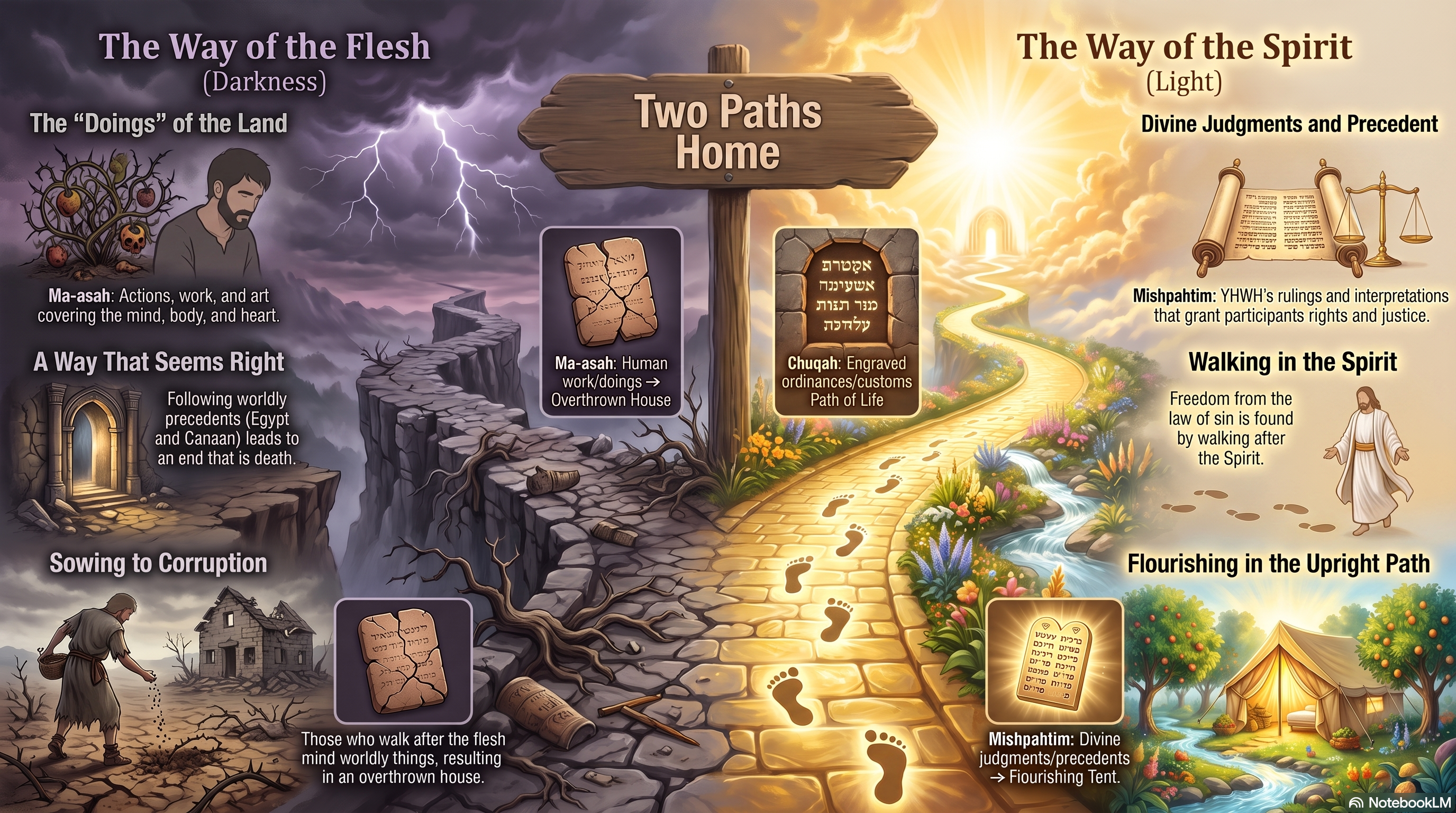
Sermon infographic — July 11, 2026
Have you ever been driving and felt completely sure you were on the right road, only to realize miles later that you were headed the wrong way? It is a sinking feeling in your stomach. We often feel just as confident in our life choices, only to find ourselves at a dead end or in a place we never intended to be.
It turns out, "following your gut" isn't always the best advice. This week's sermon shared some surprising wisdom on how to navigate these moments. It wasn't just a list of rules; it was a guide for finding the "Path Home." Here are the most effective takeaways that might change how you see your own journey.
We are often told to "trust our hearts," but our human intuition is often a poor compass. Using the wisdom of Proverbs, the contrast between the "house of the wicked" and the "tent of the upright" reveals a surprising irony: on the outside, a house looks strong and permanent while a tent looks fragile and temporary. Yet the "house" is the one that gets overthrown, while the humble "tent" is what actually flourishes. Our spiritual health isn't about how "sturdy" our life looks to others; it's about which path we are on.
"There is a way that seems right to a man, but its end is the way of death." — Proverbs 14:12
Just because a path feels "right" in the moment doesn't mean it's leading you home. Sometimes the road that looks the most solid is the one leading to the edge of a cliff.
When the Bible talks about our "doings," it uses the Hebrew word ma-asah. "Doing" is about much more than just a to-do list. The word is actually used to describe things like "needlework" and "art." This means our daily actions are like an intricate piece of embroidery. Every choice we make is an expression of what is happening inside our hearts. Our "doings" are not just labor; they are the art of our lives. Ma-asah encompasses:
- What you do: Your actual actions and work.
- How you do it: The labor, art, and effort you put into your tasks.
- How you interpret it: The mindset and meaning you give to your actions.
Our life is an expression of our internal state. Our "art" shows whether we are pursuing the Spirit or just going through the motions.
The word Chuqah means "ordinance" or "what is established." It is a sound-effect word — onomatopoetic. When you say CHU-qaq, it sounds like the rhythmic strike of a hammer against a chisel. It is the "rhythm of the writing" that becomes the beat we march to. This sensory language teaches us that the habits we develop from YHWH's instruction can and will testify to Him across all generations and cultures. It is written in stone, unchangeable:
- Hacked or engraved: Chiseled deep into our daily lifestyle.
- Etched: Made permanent so they can't be easily rubbed away.
We have to leave behind the "doings" of Egypt — our old, bad habits — to walk in the "land of promise." This requires a clean break. We must chisel a new way of living into our hearts so that we don't slide back into the old ways.
One of the most surprising claims in the sermon is that the "Law of the Spirit" and the "Law of Sin and Death" mentioned in Romans 8 are actually the "same Torah" seen through "different perspectives." The difference isn't the rules themselves, but our mindset. Walking "after the flesh" means you are only focused on the "what" — the physical rules and your own performance. Walking "after the Spirit" means your focus and pursuit are on the "Who." It is a change in perspective.
"There is therefore now no condemnation to them which are in Mashiach Yeshua, who walk not after the flesh, but after the Spirit. For the law of the Spirit of life in Mashiach Yeshua hath made me free from the law of sin and death." — Romans 8:1-2
When your mindset is on the Spirit, the path becomes a journey of life rather than a burden of death. It's about what you are pursuing as you walk.
The journey home is a community effort. Galatians 6 and the idea of "bearing one another's burdens" makes this clear. To "convert" someone in a Hebraic sense is related to the word for "procreate" — it's like growing a family or bringing someone into a whole new way of life, not just winning an argument. When we see someone wander off, we are called to restore them in a "spirit of meekness." The warning here is strong:
- Self-righteousness: If we help others while thinking we are "something" or better than them, we are actually deceiving ourselves and leaving the path.
- Believing unto righteousness: This is a heart-centered faith. It means we help others because we know we are justified by faith, not by how perfect we are.
True success on the path is measured by how we love and restore those walking beside us.
The path home is built on more than just "following your heart." It requires a new way of looking at the world. To find your way, remember to:
- Distrust "gut feelings" that lead away from spiritual health.
- See your daily "doings" as an expression of your heart's art.
- Chisel the rhythm of YHWH's ways into your life like stone.
- Focus your mindset on the Spirit rather than your own performance.
- Carry the burdens of others with a humble heart.
Which direction are you heading today? Are your "doings" leading you toward the Land of Promise, or are you still repeating the habits of the past?
📥 Downloads
The Path Home
In the strategic geography of the soul, our daily "walk" is never aimless; it is a calculated progression toward a specific destination. Every small choice and rhythmic step creates a trajectory that either leads us toward the flourishing life of the Kingdom or toward the quiet ruin of a wayward heart. The imagery of the path is not merely poetic; it is a diagnostic tool for the wise.
The core conflict of this journey is revealed in the striking architecture of Proverbs 14:11-12. Here, we see the "house" of the wicked contrasted with the "tent" of the upright. There is a profound irony in these structures: a house suggests permanence, solid walls, and a self-sufficient foundation, yet the text warns it will be "overthrown." In contrast, the "tent"—seemingly fragile, humble, and dependent on its placement—is the structure that "flourishes." This tells us that stability is not found in our own construction, but in our location on the right path. We are cautioned that our intuition is often a poor navigator; a way can "seem" right to the human eye while its final destination is the "way of death."
If we are to find our way home to the flourishing tent, we must stop looking only at the horizon and start evaluating the very mechanics of how we move.
Our spiritual life is built upon the strategic accumulation of our daily habits. These habits, or "doings," serve as the internal architecture of our character. In a very real sense, the way we express our lives is a strategic signal of our true destination. If we claim to be heading toward the "land of promise (Adamah)" while practicing the habits of our former bondages (Eretz), we are living in a state of spiritual friction.
In the Hebrew context, the term for these actions is Ma-asah (H4639). While often translated as "work," its biblical usage is far more expansive, covering the "art" and "manner" of one's life. Ma-asah involves three critical layers: what you do, how you do it, and—perhaps most importantly—how you interpret it. It is not just about the tasks you pursue, but the artistic expression of your soul through those tasks.
This is why Leviticus 18:3 contains a stern strategic warning: "After the doings of the land (Eretz) of Egypt... shall ye not do: and after the doings of the land (Eretz) of Canaan... shall ye not do." Our past environments cannot dictate our future behavior. We are forbidden from carrying the "doings" of Egypt—the defensive postures, the slave mentalities, the self-reliant strivings—into our new territory. To walk in the land of promise, we must adopt the "doings" of the promise.
- What "doings" from my past (my "Egypt") am I still trying to practice in my current season?
- How does the "art" of my life—the way I express my emotions and work—reflect my heart's true direction?
- In what ways am I following a path that "seems" right to my logic but feels like "Egypt" in my spirit?
Identify one "doing" inherited from a past environment that feels like a defensive posture — a tendency to hide mistakes or a habit of responding with sarcasm. Replace it today with an "Adamah" response: a posture of intentional transparency or a word of sincere encouragement.
Remaining on the path home requires a "ruling" or a "verdict" that serves as a constant reference point. Without an objective standard, we inevitably drift toward "the way that seems right," which is usually the path of least resistance or highest emotional comfort.
The Scriptures provide this through Mishpahtim (H4941), or "judgments." A Mishpah is a ruling or a verdict—YHWH giving a final decision on how His instructions (Torah) are to be applied. In the strategic realm of the law, this is akin to the doctrine of stare decisis—the legal principle of following precedents set by previous authoritative decisions. When we follow divine Mishpahtim, we aren't guessing; we are aligning our lives with a "higher precedent" that has already been settled in the heavens.
This alignment requires a radical perspectival shift. In Leviticus 18, the word for "land" is consistently Eretz (territory/region) rather than Adamah (physical soil). We aren't just walking on dirt; we are navigating a "territory of promise." This is reinforced by the term Chuqah (H2708), meaning an ordinance or custom — an onomatopoetic word that echoes the rhythmic CHU-qaq sound of a hammer and chisel hitting stone. Wise living is the "chiseling" of YHWH's ways into our hearts until His precedents become our second nature.
- Whose "precedent" am I following when I make tough decisions—the shifting "soil" of my feelings or the established "territory" of YHWH's Word?
- Am I allowing the Ruach to rhythmically chisel (CHU-qaq) YHWH's ways into my heart, or am I just a casual observer?
- How would my perspective of my current difficult "land" change if I viewed it as Eretz—a territory where YHWH has already set the precedent for my victory?
Pick one "ordinance" or "custom" from the Word — such as the practice of Sabbath rest or guarding the tongue against gossip. Apply the rhythm of CHU-qaq by intentionally practicing this custom three times this week, especially when your "feelings" suggest a different path.
The strategic pivot of the believer's walk is the transition from a law of measured performance to the "Law of the Spirit of Life." Attempting to walk the path home through human grit alone inevitably leads to the "Law of Sin and Death" — a cycle of failure followed by the paralysis of condemnation.
Romans 8:1-5 clarifies that the difference between the two paths is a matter of "mindset." It is possible to have the "same Torah" — the same set of instructions — but produce two entirely different lives based on perspective. "Minding the things of the flesh" focuses on our own ability to perform the law to earn life. Conversely, "minding the things of the Spirit" is the pursuit of righteousness that flows from life.
We must understand that spiritual practice is not a performance for salvation, but a pursuit of the One who has already declared us justified. Like Abraham, who "messed up while pursuing YHWH," our walk is not defined by perfection but by orientation. When we stumble, the Spirit of Life does not offer "condemnation," but the "restoration" of our focus. We walk in the light because our belief in our justification has changed the way we practice our lives.
- When I stumble, is my immediate reaction to hide in "condemnation" or to seek "restoration" through the Spirit?
- Is my mind currently "minding" the lack and the struggle (flesh) or the grace and the promise (Spirit)?
- Do I view my spiritual habits as a "performance" to keep YHWH happy, or as a "pursuit" of the Elohim who has already made me free?
Spend ten minutes today "minding the things of the Spirit." List three specific ways YHWH has shown you grace this week — not because you performed well, but because He is faithful. This practice shifts your perspective from the "Law of Sin" to the "Spirit of Life."
The "Path Home" is not a solo expedition; it is a journey taken within a community. Our ability to reach the flourishing "tent" is inextricably linked to our willingness to help others stay on the path.
Galatians 6:1-10 outlines the "Ministry of Reconciliation." We are commanded to "bear one another's burdens," while minding the manner of the bearing. We must restore those "overtaken in a fault" with a spirit of meekness. The text warns us to "consider ourselves," acknowledging that restoration without meekness is simply another form of self-righteousness. If we judge from a distance, we are "minding the flesh." If we restore with meekness, we are "minding the Spirit."
This communal walk is governed by the strategic law of sowing and reaping. Every act of restoration, every shared burden, and every word of grace is a seed. If we sow to the flesh — seeking our own reputation or ignoring the weak — we reap corruption and isolation. But if we sow to the Spirit through "well doing," we reap life. We are urged not to grow weary, for the harvest of a flourishing "tent" is certain for those who do not faint in their service to others.
- Is there someone in my circle "overtaken in a fault" whom I have judged rather than seeking to restore in meekness?
- In my relationships, am I "sowing to the flesh" by prioritizing my own comfort, or "sowing to the Spirit" by bearing the infirmities of the weak?
- Where have I become "weary in well doing," and how can I "consider myself" to remember that I, too, am a recipient of grace?
Identify one "burden" a brother or sister is carrying — perhaps a struggle they have shared or a task they are overwhelmed by. Find a practical, quiet way to help them bear it this week, specifically doing so with a "spirit of meekness" that seeks no recognition for yourself.
By refining our daily "doings," anchoring ourselves in the "higher precedents" of YHWH's Word, and walking in the life-giving pursuit of the Spirit, we ensure that our feet are fixed on the path that leads to the flourishing, eternal home of the upright.