Welcome To The Holy-hood
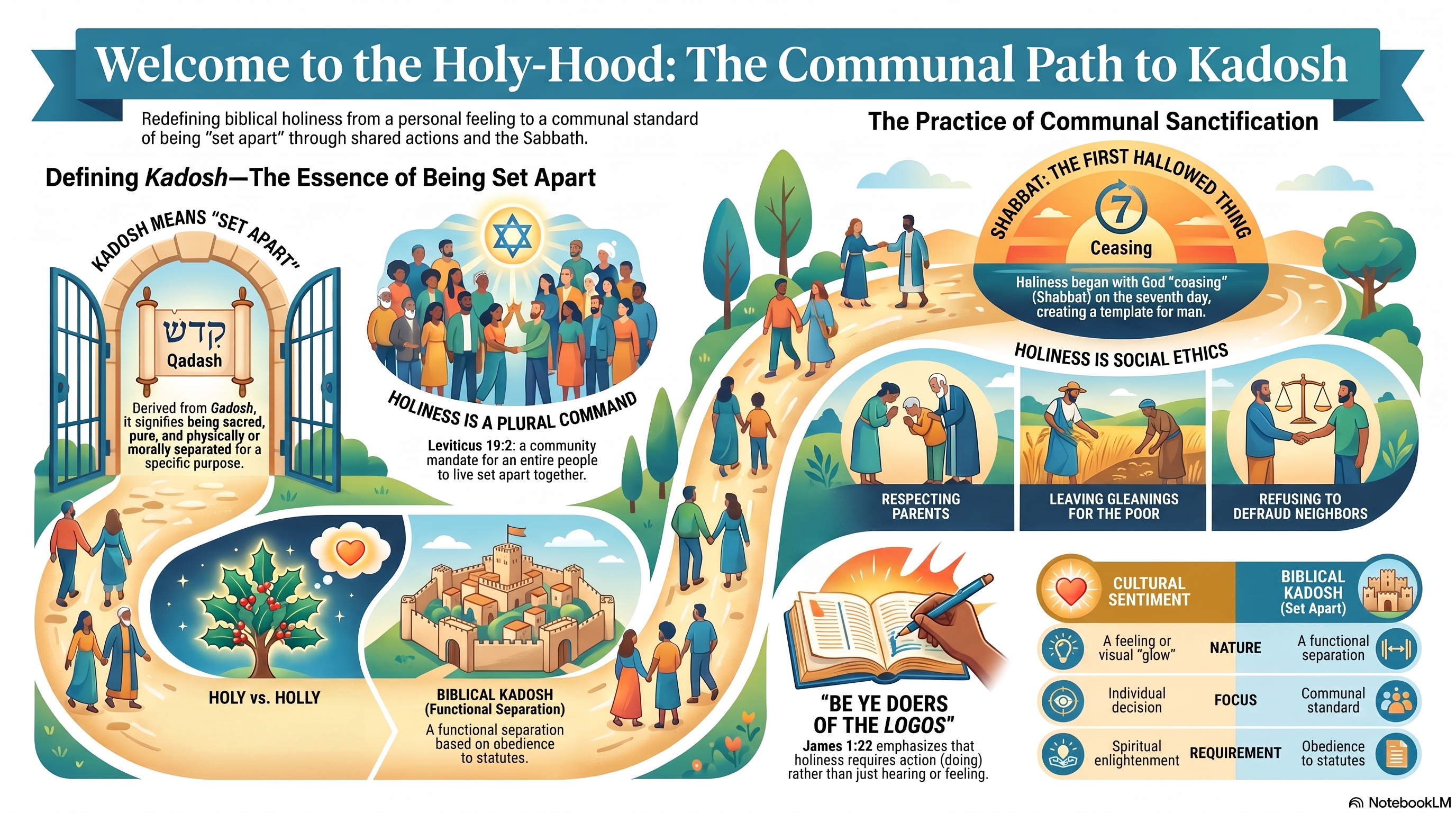
Sermon infographic — July 18, 2026
Imagine driving through the hills of Los Angeles, looking up at that iconic ridge, and seeing a sign that says "Holy-hood" instead of Hollywood. It changes the entire vibe, doesn't it? While "Holy-hood" isn't a real place, the way we think about holiness often resembles a Hollywood production—full of special effects, glowing halos, and dramatic feelings that have very little to do with the original script.
Most of us receive our faith as a "witness of everyone who came before." We trust our parents, teachers, and traditions without ever really challenging them. But as we explore the Word, we often find a massive gap between what YHWH said and what we actually understand. To close that gap, we need to look past the "glow" and get back to the definitions provided by the Father. Here are six surprising takeaways about the true nature of holiness.
In popular culture, "holy" is usually depicted with glowing saints or sacred relics that can thwart monsters. We tend to think of it as a supernatural "vibe" or an emotional high. However, if you look at the Hebrew word Kadosh (H6918), you'll find it's more about function than "feeling."
It is biblically defined as: to be "set apart" or "sacred." It's much easier to chase a "feeling" of holiness than it is to actually be set apart for YHWH's specific purpose. According to the Gesenius Lexicon, Kadosh means "pure, clean, free from defilement of crimes, idolatry, and profane things." If we ignore the law of YHWH, we avoid His "pure" standards, no matter how "holy" we feel at the moment. Holiness is not a supernatural glow; it is the act of being "un-mixed" with the profane.
There is a fascinating bit of "cultural drift" in our history. In many common folklore traditions, the words for "holy" and "holly" (the tree) were nearly identical. In communal traditions, the Holly tree was treated as a protector, believed to guard against evil spirits and even lightning. Modern etymologists claim "holy" and "holly" have different academic roots, but the "common people" didn't care about academic roots—they wrote phonetically. To them, the words sounded the same, were written the same, and eventually, the traditions blurred. The "Holly Tree" became the "Holy Tree."
"The communal traditions and pursuits of those who lived demonstrated that Holly was Holy regardless of who wrote the definitions."
This is a perfect example of how we redefine words based on what we feel or see in our culture. We have to ask: are we following the definitions of YHWH, or have we just adopted the "Holly" of the traditions passed down to us?
When we read Leviticus 19:2 ("Ye shall be holy"), we often miss a vital linguistic nuance. In Hebrew, the word is Kadoshim—which is plural. YHWH isn't just talking to you as an individual; He is speaking to the entire community. Kadoshim identifies us as "Holy Ones" or "Saints." This isn't just a personal walk; it is a representative community standard.
Modern culture treats holiness as a private decision, but when we lose the communal aspect, we end up fighting over whose version of holiness is "most holy." There's nothing holy about that. We are called to give witness to Elohim together.
The very first time the word Qadash (sanctified) appears in the Bible is Genesis 2:3. Interestingly, YHWH didn't start by setting apart a person or a building; He set apart a period of time. He sanctified the seventh day, the Shabbat, because He "ceased" from His work. He didn't set it apart because the other days were "bad"—He had already called them "good." He set it apart simply because He chose to cease.
Today, many use "legalism" as an excuse to ignore the Shabbat, despite it being mentioned 68 times in the New Testament. In the Greek text, the word is Sabbaton—a transliteration of the Hebrew because the Greek did not have a word to describe it. However, many English translations changed or added "the first day of the week" to reflect community sentiment and practice rather than the literal text. We've redefined a Hebrew word to fit our traditions, but regardless of our "feelings," the seventh day remains what YHWH declared holy.
If you want to see holiness in action, look at Leviticus 19:9-16. Here, holiness is tied directly to ethics. YHWH commands: do not "wholly reap the corners of thy field." This reveals a "Kingdom" view of property that stands in stark contrast to our modern "Government" or "Americana" culture. In our world, we build walls and gates. In the Kingdom, YHWH says, "It's not all yours. It's all mine. Give some."
Holiness also means refusing to be a "tailbearer" (a gossip). To put it in a modern context: there are plenty of news programs today that simply would not make it in the Kingdom. If we are pursuing material gain or social "likes" while degrading our neighbor, our "holiness" is just vanity.
In Mark 6, we see the tragedy of King Herod and John the Baptist. Herod actually liked John. He recognized him as a "just and holy man" and "heard him gladly." He even "did many things" based on John's teaching. But then a "convenient day" came and his wife, who wanted John killed for the truth he spoke, used it to her advantage.
It was Herod's birthday party. In a room full of lords and captains, Herod made a foolish oath after his wife's daughter danced before his noblemen. When he was asked for John's head, Herod was "exceeding sorry." Yet he chose to murder a holy man rather than "lose face" in front of his peers. The tragedy wasn't that Herod hated the truth; it was that he valued his "station" and social standing more than the command of YHWH. We all face "convenient days" where the pressure of our social circle challenges our commitment to being set apart.
Salvation is a beautiful gift, but it is the starting line, not the finish. We are called to be "obedient children," which means we must stop fashioning ourselves after our former ignorance and start looking at what YHWH actually defined as holy.
The good news is that Yeshua the Mashiach stands in the gap for us. He is the Logos made flesh, and because He stands there, we can chase after true holiness without the paralyzing fear of falling short. He provides the grace for the pursuit.
Are you pursuing what you feel is holy based on the traditions you were handed? Or are you willing to challenge those traditions—even at the cost of your "social face"—to chase after what YHWH has actually declared set apart?
📥 Downloads
Welcome To The Holy-hood
Correctly defining "holiness" is a strategic necessity for every believer. In our modern culture, the word "holy" has become tangled up with "holly" trees and ancient myths. Many of us grew up thinking holiness was a "feeling," a supernatural "glow," or even a lucky charm that protects us from bad spirits. This comes from the word's history.
The English word "holy" is linked to the 11th-century Old High German hulis, the Old English holan, and even the ancient Gaelic kulian—all of which mean "holly." Modern etymology shows us the words are not linked academically, yet they are linked in how they were communally pursued together through actions and traditions.
Ancient Celts often viewed the holly tree as a consecrated symbol of the "Holly King," a figure believed to govern the waning light of the winter season. Within Celtic and Norse mythologies, this plant was frequently linked to deities of thunder, serving as a supposed mystical shield against the strike of lightning. The Druidic tradition attributed specific protective properties to the holly, treating it as a supernatural ward against misfortune or malevolent spirits. This evergreen came to embody the enduring nature of the earth; eventually, within various cultural shifts, it was rebranded as the "Holy Tree," blurring the lines between botanical tradition and sacred status.
We still see this "luck" mythos today: people think holy water repels evil, or a crucifix can thwart monsters. But biblical holiness isn't a vibe or a halo that "glows with power." Nothing has to glow, and nothing has to thwart off monsters for it to be sacred. The Hebrew word is Kadosh (H6918). It simply means to be separate, apart, and sacred — a status of being clean and free from the defilement of crimes and idolatry. Biblical holiness is a choice to be set apart for YHWH's purposes, regardless of whether it "feels" supernatural.
- Have I been waiting to "feel" holy before I start obeying YHWH's instructions?
- In what ways have I let "good luck" or cultural traditions take the place of actual set-apart living?
Identify one habit you have that is based more on "tradition" than on the Word. This week, replace that habit with a specific action that honors YHWH's definition of being clean and pure.
The very first thing YHWH sanctified was not a person or a place, but a day. In Genesis 2:3, Elohim blessed the seventh day and set it apart (Va'yiQadesh) because He ceased (Shabbat) from His work. The Sabbath is holy because He declared it so. It doesn't matter if we recognize it or not; it remains holy.
However, we face a massive "cultural drift." Think of it like a "Cheeseburger." The hamburger came from Hamburg, Germany, but we took that word, added cheese, and now we "own" the cheeseburger as a completely different American tradition — there is no Cheseburg, Germany. We've done the same thing with the Sabbath. Cultural drift has led many to believe they can "choose" Sunday or any other day. This drift is even hidden in our Bibles. The word Sabbaton (G4521) appears 68 times in the New Testament. In the Greek, Sabbaton can refer to a "se'nnight"—the interval between two Sabbaths. Yet translators often filled that linguistic gap by adding the phrase "first day of the week" to reflect community sentiment rather than what YHWH actually said. When we honor the seventh day, we aren't being "legalistic." We are giving a "community testimony" that YHWH is the one who defines time and holiness.
- Am I treating the Sabbath as a day I can "choose" for myself, or am I honoring the day YHWH specifically set apart?
- When I face resistance about the Sabbath, do I see it as a chance to give a testimony for YHWH's standards?
This coming seventh day, practice "ceasing" (Shabbat). Stop your normal work and social media to focus entirely on learning the Word and resting in YHWH's presence.
Holiness is not just a private, individual decision; it is a "plural" command. In Leviticus 19:2, YHWH says Kadoshim—"Ye (in plural) shall be holy." This means holiness is our community standard. One of the best ways to understand this is through the word Mishpat. While often translated as "judgment," it includes the action to stand in the gap for others — to stand up for someone when everyone else is pointing fingers at them or when they are in need.
Leviticus 19 gives us physical evidence of a set-apart heart. We are commanded not to reap the very corners of our fields or gather every single grape. We must leave room for the poor and the stranger. True holiness also means we refuse to be a "talebearer" — someone who goes "up and down between cities" spreading gossip that destroys lives. These actions are the "fruit" of our set-apart status. If we want to represent YHWH, we must care for our neighbors as much as we care for our own reputations.
- Am I "reaping the corners of my field" by keeping every bit of my profit and time for myself?
- Do I participate in "talebearing" (gossip) that breaks down the holiness of my community?
Find a practical way to "leave the corners of your vineyard" this week by giving a portion of your time or a resource to someone who cannot pay you back.
The story of King Herod and John the Baptist is a warning about the danger of "saving face." Herod actually "feared John" and recognized he was a holy man. Mark 6 tells us Herod even "observed" John and "heard him gladly." But Herod was trapped by his own pride and by the wife he should have never had. On a "convenient day" — his birthday — his wife put into action a plan to have John killed for speaking the truth. The plan succeeded, and Herod made a boastful oath in front of his lords, captains, and chiefs. To avoid looking foolish in front of these "nobles," Herod murdered the very man he knew was holy.
We often face the same sort of social pressure between cultural stations and YHWH's commands. Are we more afraid of looking "weird" in front of our social circles than we are of disobeying YHWH? We must be willing to flee from evil the moment it appears. We must value YHWH's opinion more than our station in the crowd.
- Am I more afraid of my friends' opinions than I am of disobeying YHWH?
- Like Herod, do I "gladly hear" the Word but then ignore it when I'm around people I want to impress?
Identify a situation where you usually "go along to get along" with the crowd. Next time it happens, choose to quietly but firmly step away. Your legs are weapons — so get to steppin'!
To truly live set apart, we must understand the Hebrew concept of Shamar. There is a difference between hearing and acting. King Herod heard John gladly and even "observed" him, but he failed to Shamar—to actually guard the Word. True Shamar is an active form of worship where we guard YHWH's instructions by putting them into motion.
James 1:21-25 warns us not to be "forgetful hearers." He compares a hearer who doesn't act to a man who looks in a mirror and immediately forgets what he looks like. If we listen to a sermon but don't change our walk, we are "deceiving ourselves." We must lay aside the "superfluity of naughtiness" and receive the Word with meekness. Remember: salvation is the starting line, not the finish line. We are called to be "obedient children," no longer fashioning ourselves after our old desires.
- When I look in the "mirror" of the Word, do I make changes, or do I walk away and forget?
- Am I treating my faith as a "finish line" I've already crossed, or a "starting line" for a new way of living?
Read one chapter of the teachings of Yeshua today. Pick one specific instruction and Shamar it — act on it immediately so that you do not become a forgetful hearer.
YHWH is the one who sanctifies us, but He calls us to active obedience. When we choose to walk in His ways, we move from the myths of the world into the true, set-apart life of the Kingdom.