A Standard For The People
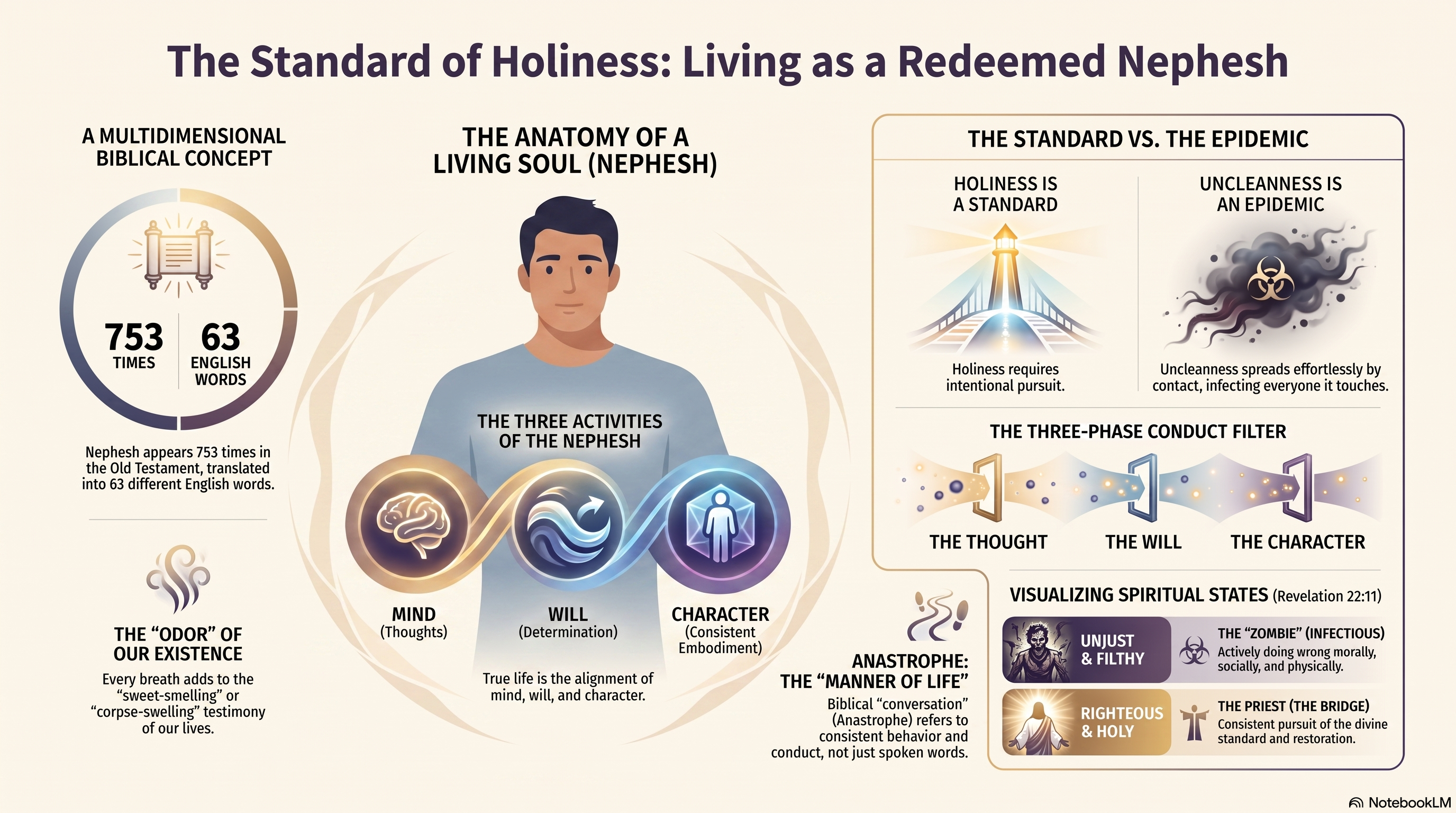
Sermon infographic — July 25, 2026
Have you ever been to a carnival and seen those height signs? Usually, they say, "You must be at least this tall to ride." We spend our childhoods stretching our necks, trying to reach that line so we can ride the big roller coasters. But when it comes to serving YHWH, the rule is flipped upside down. From the Bible's viewpoint the sign says: "You must be under this line to serve."
In the book of Leviticus, there is a big shift. The first half is about how to "draw near" to YHWH through sacrifices. The second half is about how to "dwell near" Him. Drawing near is heavy and about the approach, but dwelling near is about your daily life, your family, and your conduct now that you have arrived. Today, we are going to explore what it means to live in His presence and what kind of "scent" our lives leave behind.
In the world, we are told to climb higher and think more of ourselves. But to serve the Creator, we have to go the other way. The priest's job was to be a bridge between YHWH and the people. If a priest is full of vanity he becomes a detour sign — he blocks the way and points to another.
To portray Elohim accurately, we have to serve from a place of humility. When we lower ourselves, we become a clear bridge that helps others see YHWH instead of seeing us. We must think less of our own importance so that His character can shine through.
"You must be under this line to serve. Meaning, you can't serve from a place of highness. You have to serve from a place of lowness."
In Hebrew, the word for soul is Nephesh. It isn't just a ghostly thing inside you; it is your "animation" or your life in action. Your soul works like a three-part filter:
- The Mind: The thoughts you have.
- The Will: Your determination to act on those thoughts.
- The Character: The consistency in how you live them out.
These three work together as one witness. Man received the "Breath of Life" and became a living Nephesh. Every time you breathe, you exhale an odor — not a physical smell, but a spiritual one. This odor is the testimony of your life, what you have done with the original YHWH-given breath. You are either leaving behind a "sweet-smelling" existence or the scent of a "swelling corpse." Your life is a breath-by-breath witness of who you really serve.
"The last breath in the flesh will breathe out... every breath before adds to the odor of our existence."
The prophet Haggai once asked the priests a riddle. If a priest carries something holy, does everything it touches become holy? The answer was "No." But if that same person touches a dead body, does he become unclean? The answer was "Yes."
This teaches us a vital lesson: holiness is a standard we must choose to enact. It doesn't just rub off on us because we are near religious things. However, uncleanness is like an epidemic — it spreads effortlessly if we are not on guard. If we carry "dead works" into a room, we can infect everyone around us. This is why our "manner of life" is so critical; we are either acting as a bridge to what is set apart or spreading a spiritual infection.
When we see the word "conversation" in the Bible, we think of talking. But the Greek word used is anastrophea (G391). It actually means your behavior, conduct, and manner of life.
Think of it like a classic cop movie. When a cop gets a new partner, he asks, "What's the word on this guy?" He's asking about the man's reputation. That is your anastrophea — the "word" on you based on how you live. Our challenge is to make sure our daily behavior matches the "Divine declaration" that we are redeemed. If we say we belong to Yeshua but live like the world, our reputation is a lie.
In Ephesians, Paul tells us to stop living like the "uninitiated" who walk in darkness. This is being "Re-dead" — a spiritual zombie, someone who has been justified by Yeshua but keeps doing "zombie works" that infect everything they bite. Consider the word for "unjust" (adikeo). In Greek, the letter "A" at the beginning flips the meaning. While dikaos means "righteous" or "justified," adding the "A" makes it the opposite.
To stop being "Re-dead," you must use the "Put-Off / Put-On" rule. It isn't enough to just stop a bad habit; you must replace it with a holy one. A thief shouldn't just stop stealing — he should start working so he has something to give to others. You replace a dead work with a living one.
"He that is unjust, let him be unjust still... and he that is holy, let him be holy still."
Living for YHWH means following a standard. This is informed by the Nomos (the Law or Instructions) and walked in the spirit of the Logos (the Declared Word or Living Example, Yeshua). We don't just wait for the Kingdom to arrive; we make it appear through our service and character.
One day, you will take your final breath. That breath will be an exhale. The final judgment is essentially a "Divine Sniff Test." YHWH will look at what you exhaled with the life He gave you. Does your "breath-by-breath" life represent Mashiach accurately, or are you still carrying the odor of the "old man"? Every breath you have left is a chance to change your scent and live as a truly redeemed soul.
📥 Downloads
A Standard For The People
In our spiritual walk, we often imagine that we must climb a mountain of achievement to be useful to YHWH. However, the Kingdom presents a different requirement using the analogy of a carnival. To ride the big attractions, you usually have to be "this tall" to get on. But in the Kingdom of Elohim, the standard is reversed. The sign at the entrance of true service reads: "You must be under this line to serve." Strategic humility is not about losing our value; it is about lowering ourselves so that the greatness of YHWH can be seen. When we try to serve from a place of "highness" or pride, we fail to represent Him correctly because we are pointing to ourselves rather than the King.
This concept is grounded in Ezekiel 43:7, where YHWH describes His throne as the place for the "soles of His feet." The most sacred dwelling place of Elohim is at the lowest point. There is a vital distinction between "drawing near" and "dwelling near." We draw near through the mechanics of sacrifice, but we dwell near through our conduct and holiness. The Israelites defiled His name by bringing "high places" and "carcasses" near His throne. To truly dwell with Him, we must abandon our own high places — our titles and self-importance — and meet Him at the "soles of His feet," serving from a place of lowliness.
- When you serve your family or community, do you act like you are doing them a favor from a "higher" position, or are you serving at the "soles of His feet"?
- What "high place" or personal status are you holding onto that prevents you from truly dwelling near YHWH?
- How would your daily interactions change if you viewed your home as the place where YHWH's feet rest?
Identify one "lowly" task this week that you usually consider beneath your status or someone else's responsibility. Perform this task for a family member or neighbor, specifically setting aside your "right" to be served. Do it in silence, honoring the low place of the throne.
We often think of the "soul" as a private, passive feeling, but our Nephesh (soul) is an active, breathing testimony. Our life is lived breath-by-breath, and every exhale is a witness. YHWH breathed the first breath into man, making him a living Nephesh, but we are responsible for every breath that follows. Our existence carries an "odor" — either the sweet-smelling aroma of a living sacrifice or the stagnant smell of a corpse.
Leviticus 21:1 offers a scholarly insight: while many versions say a priest should not be defiled by the "dead," the original Hebrew word for "dead" is actually missing — it simply says Nephesh. This teaches us that a priest can be defiled by a person, specifically a lifeless or unclean Nephesh. Our soul is composed of three active parts:
- Mind: The thoughts we choose to harbor.
- Will: Our determination to act on those thoughts.
- Character: The consistency with which we embody our thoughts and will.
If our mind, will, and character are not set apart, we become "dead to holiness." We may be drawing physical breath, but we are exhaling "dead works" that defile our surroundings.
- If your recent decisions had a physical scent, would they smell like the "odor of life" or a "lifeless nephesh"?
- Which part of your soul — Mind, Will, or Character — is currently "leaking" an unpleasant odor into your home?
- Are you merely drawing breath, or are you using your breath to give a living testimony?
Three times a day, pause and take a deep breath. As you exhale, pray this: "YHWH, may the odor of my next words be a sweet-smelling sacrifice to You." Use this moment to check if your current thoughts or words are refreshing or offensive to those around you.
Haggai 2 teaches a striking lesson: holiness is a personal standard, but uncleanness is a contagious epidemic. When the prophet asks the priests if carrying "holy meat" in a garment makes everything the garment touches holy, the answer is "No." However, when an unclean person touches something, it becomes unclean immediately. This means that you cannot become holy simply by being near holy things. Holiness must be actively enacted.
Uncleanness, on the other hand, spreads through simple contact. This "contagion" creates what can be called "zombie works" — unrighteous actions such as bitterness, anger, or greed that "bite" and infect everyone they touch. Just as the Levites' idolatry caused the whole house of Israel to fall, our hidden uncleanness can infect our entire family. Uncleanness is the "base mode" of humanity; if we are not actively manifesting the clean, we are naturally spreading the epidemic.
- What "zombie works" — such as lingering bitterness or sharp words — are currently "biting" or infecting your loved ones?
- Do you assume you are holy by proximity, or are you actively enacting holiness in your redeemed state?
- Who in your life is being "infected" by the habits you have refused to change?
Identify one "unclean" influence in your life — perhaps a specific social circle, a habit, or a digital distraction — that is currently infecting your walk. Commit to a seven-day "quarantine" by completely removing that influence. Observe how your spirit and your home feel once the contagion is removed.
To live a holy life, we must understand the Greek word Kainos. In the New Testament, there are different words for "new." There is Protos (a brand-new prototype) and Neos (new in age, like a baby). But the "New" Covenant is Kainos — meaning "refreshed." The standards of YHWH are not discarded; they are refreshed and made accessible through Mashiach. We are called to be the "redeemed," not the "re-dead" — those who are saved but keep resurrecting the same old dead works.
Based on Ephesians 4, we are instructed to "put off" the old man and "put on" the new. This is a deliberate change of our "manner of life," also known as our Anastrophea — your reputation, or "the word on you." To live a life that is "redemption worthy," we must replace dead habits with living actions.
| Put Off (Dead Works) | Put On (Redemption Worthy) |
|---|---|
| Lying and deceitful speech | Speaking truth with your neighbor |
| Stealing and taking from others | Laboring to have something to give to those in need |
| Corrupt communication and insults | Edifying speech that gives grace to the hearers |
| Bitterness, wrath, and malice | Kindness, tenderheartedness, and forgiveness |
- Is your Anastrophea — the "word on you" at work or home — consistent with the character of Yeshua?
- Are you depending on your "consecration" (your position) while ignoring your "conversation" (your actual behavior)?
- Which "dead work" from the table above is most likely to "resurrect" in your life during a stressful day?
Do not let the sun go down on your wrath. Resolve one specific point of malice or anger before you sleep. Do not let a "dead work" stay in your bed overnight.
The journey of holiness leads to a solemn reality found in Revelation 22:11: "He that is unjust, let him be unjust still... and he that is holy, let him be holy still." This is understood through a linguistic breakdown of the Greek word Dikaos (Righteous). In Greek, adding the "a-" prefix swaps the polarity of a word. So Adikeo (Unjust) is the exact opposite of the justified state.
Our lives are a series of breaths, but eventually, we will have a final exhale. At that moment, YHWH performs a "sniff test." He isn't looking to see if we followed the Nomos (law) perfectly to save ourselves — Yeshua has already justified us. Instead, He looks to see if our thoughts, will, and character match His divine declaration of redemption. We live righteously because we want to remain in covenant and show our thanks for the mercy we've received.
- Does your current Anastrophea (manner of life) match the holy declaration YHWH has made over you?
- If your final exhale happened today, would the "odor" of your existence testify that you were truly redeemed?
Shama means both hearing and obeying. Every morning this week, verbally declare your intent to YHWH: "Today, I will manifest the Kingdom through my service, my love, and my humbleness. I choose to live as the redeemed." After declaring this, spend two minutes in silence, listening for His guidance on how to enact that holiness throughout your day.