Appointments
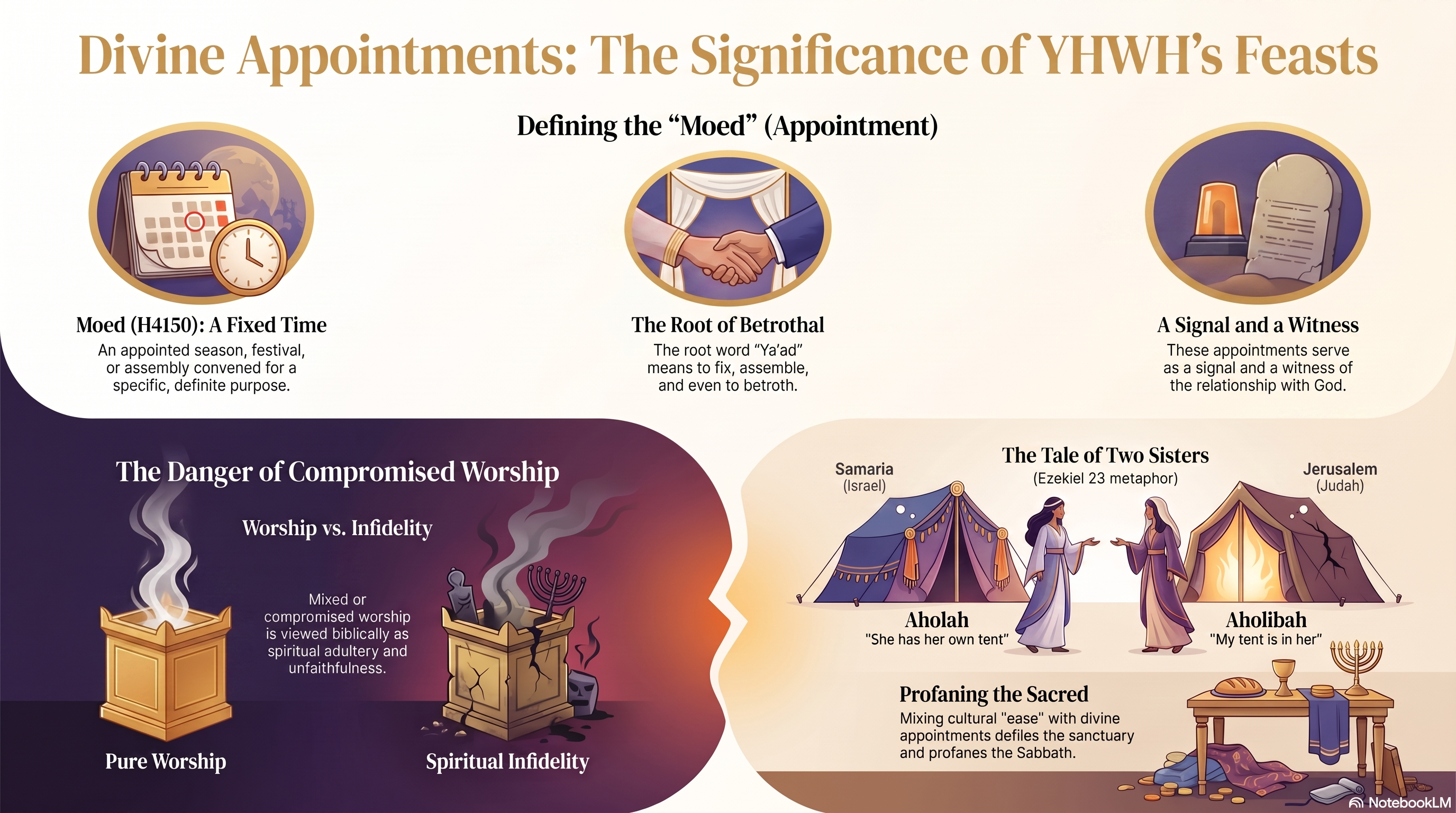
Sermon infographic — August 1, 2026
When you hear the word "feast," what comes to mind? Most of us think of a Thanksgiving turkey, a giant slice of cake, or a big party with music and laughter. We imagine a time to relax and eat until we can't move. But we might be missing the real point.
In the book of Nehemiah, there is a powerful story about the people of Israel hearing the law for the first time in years. They didn't just start planning a party; they began to weep. They were filled with sorrow because they realized they had been on the "wrong schedule." They had been pursuing YHWH the best they could, but they had been missing the mark because they didn't know His actual timing.
If we look at the Bible as a guide for how to live, we find that YHWH has a very specific schedule. If we think these days are just about having a big meal, we might be showing up for a party when we were actually supposed to be showing up for a life-changing meeting. Are we on the wrong schedule to really know Him? Let's look at why these "feasts" are actually the most important appointments on your calendar.
In our English Bibles, the word "feast" is often used. If you look up "feast" in a dictionary, it says it is an abundant meal or a celebration for enjoyment. This makes it sound like these days are just about entertainment. However, the original Hebrew word used is Moed.
A Moed is not a party; it is an appointment. It is a fixed time or a set season when two parties agree to meet. Think of it like a business meeting or a doctor's visit that is written in stone. If no one shows up to an appointment, the meeting doesn't happen, and you miss the purpose of that day.
"When you get a doctor's appointment, do you get a doctor's feast? No."
When we realize these days are appointments, our attitude changes. We aren't just looking for a good time; we are looking to meet with our Creator for a specific reason.
Our most sacred appointments are treated with urgency and participation. Think about the ceremony of a doctor's visit: you clean yourself up, you arrive early, and you sit in a set-apart, purposed place called the "waiting room." You wait and anticipate the moment you are called. Then you are called by name and moved into the "examination chamber." Once there, you are inspected for "blemishes" — vital signs like blood pressure and weight — all to prepare you to meet the Doctor, but you get a Practitioner. You walk away with a prescription, more tests, and little healing. The sermon suggests that we treat this ceremony more sacred than YHWH's holy days, yet they are the real ceremonies of healing and inspection. We show up to see what needs to be fixed and what needs to be strengthened in our lives.
The Bible also calls these days a Mikra, which means a "holy convocation." This word means a "calling out" or a public meeting. More importantly, it means a rehearsal. These days are like practicing for a big event. We repeat them year after year so that we know exactly what to do when the real event happens.
Why does YHWH care so much about a schedule? It's because He views His relationship with us as a marriage agreement, or a "betrothal." The Hebrew word for appointment, Moed, comes from a root word Ya'ad, which can actually mean "to betroth" or to promise to marry.
To understand this commitment, think of a wedding ring. A ring is a public witness that you belong to someone else. It is a sign of your fidelity. The Hebrew word for "witness" (Ed) is actually found right inside the word for "appointment" (Moed). Every time we show up for His appointments, we are wearing our "wedding ring" and witnessing to the world that we are loyal to Him.
Ezekiel 23 tells the story of two sisters, Aholah and Aholibah. Their names tell a deep story about their hearts. Aholah means "she has her own tent," while Aholibah means "my tent is in her." Aholah represents those who want to live by their own rules and their own schedule, while Aholibah was meant to dwell in YHWH's house. Unfortunately, both sisters began to follow the culture around them, mixing YHWH's holy things with worldly traditions. YHWH views this "mixing" as infidelity — like a spouse being unfaithful. When we ignore His appointments to follow our own schedule, or bring our own schedule to His appointments, we are like the sister who chose her own tent over His.
Of all the appointments YHWH made, the weekly Sabbath (Shabbat) is the most frequent. The Sabbath is not just a day to nap; it is a weekly appointment to cease from the world's work and dwell in YHWH's kingdom.
The Sabbath connects to the Parable of the Ten Virgins in Matthew 25. In that story, five virgins were wise because they had oil for their lamps, while five were foolish and had none. When the bridegroom arrived at midnight, the foolish ones were left in the dark. The "oil" we need to recognize Yeshua (the bridegroom) is the weekly practice of the Sabbath. In the midst of YHWH's appointed times, the reckoning is by Sabbaths — we must count and observe these Sabbaths, a total of 49 days, to arrive at the proper day of Pentecost. If we don't practice meeting Him every week, we won't know how to find Him when He returns for the final appointment.
"If Shabbat is the oil that lights the way, you had every week to find out which door he was going to come through."
The weekly Shabbat and the yearly cycle of appointments — like Passover (Pesach), the Day of Atonement (Yom Kippur), and the Feast of Tabernacles (Sukkot) — teach us how to "dwell near" YHWH. They are rehearsals for the end of the age.
Consider Yom Teruah, the day of blowing trumpets — a day of "shaking" and loud alarms meant to wake us up. Think of the Walls of Jericho. On that day, there was a great shout. For the people of Israel on YHWH's side of the wall, that shout was a sound of joy and victory. But for those on the Jericho side of the wall, it was a sound of absolute terror.
We cannot "improvise" our way into holiness. If we don't rehearse using YHWH's script now, we won't know what to do when the rehearsal ends and the real event begins. We must become accustomed to His ways today so we aren't caught trying to make it up as we go when the "walls" start to shake.
YHWH's appointments are not just old traditions; they are His way of teaching us how to live in His house. He wants us to draw near to Him and learn His character.
As we look at our lives and our calendars, we have to ask ourselves: is our faith based on how we feel, or is it based on obeying what YHWH actually said? When Yeshua the Mashiach returns, will He see a people who have been practicing for His arrival? If the Master arrived today at His appointed time, would He find you waiting at the right door, or would He say, "I know you not"? It is time to check our schedules and make sure we aren't missing the most important meetings of our lives.
📥 Downloads
Appointments
In Nehemiah 8:9, we find a pivotal moment in the restoration of the people of Israel following the Babylonian captivity. As Ezra the priest read the words of the Law, the people wept. This was a "Back to Basics" realization: they were grieving because they finally understood how far they had drifted from YHWH's will during their exile. This historical context is vital for us today. Many of us have been on a cultural schedule, seeking after Elohim with our hearts but consistently missing the mark because we neglected the specific instructions of His Word. To clear away cultural distractions, we must move past what we think the Word means to what it actually says.
Central to this restoration is the Hebrew word Moed (H4150). While frequently translated as "feast," the English word suggests an abundant meal for our entertainment — a "party hardy" mindset. However, Moed is strategically linked to the root Ed (H5707), meaning "witness," and Yahad (H3259), which carries the future-tense construction of "I will witness." It also points to the concept of "betrothal." A Moed is a signal, a fixed time appointed beforehand where the congregation meets with YHWH to bear witness to His holiness.
| Cultural Definition: "Feast" | Biblical Definition: "Appointment" (Moed) |
|---|---|
| An abundant meal for personal enjoyment | A fixed time, season, or signal set by YHWH |
| Centered on entertainment and ceremony | An assembly convened for a definite purpose |
| An optional social event | A non-negotiable meeting (like a doctor's appointment) |
| Determined by cultural preference | A public witness of the congregation's fidelity |
To understand the weight of this, consider the "loathsome ceremony" of the modern doctor's office. You dedicate time, clean yourself up, and sit in a "hollow place" called the waiting room. You pay your penance of time, waiting for the door to crack open. When your name is called, you are inspected for "blemishes" in your vitals, much like a sacrificial lamb — only to find you aren't meeting the "Doctor," but a "practitioner." YHWH views our neglect of His appointments similarly; He has set specific times to meet with us in His "House of Healing," yet we often treat His time as a nuisance or an optional social gathering.
- Do I approach YHWH's set times with the same intentionality and "penance of time" I give to a physical doctor's appointment?
- Is my participation in the Moedim a true "witness" (Ed) of my devotion, or am I just looking for a "feast" of entertainment?
- Like the people in Nehemiah 8, does the reading of the Law cause me to weep for the appointments I have missed while following a cultural calendar?
Treat this upcoming week as a "Kingdom rehearsal." Open your physical or digital calendar and explicitly mark the Sabbath and upcoming biblical appointments (Leviticus 23) as priority events. Remove any conflicting social engagements to show that you are ready to be "called by name" into His chamber.
Strategic clarity in our walk requires undivided worship. YHWH uses the imagery of betrothal and marriage to describe His relationship with us because spiritual infidelity — syncretism — is the greatest threat to our restoration. In Ezekiel 23, YHWH illustrates this through the metaphors of two sisters: Aholah and Aholibah.
The linguistic roots here are profound. Aholah (Samaria/Israel) represents Shamar-own — "what they guarded," which was their own rules and cultural traditions rather than YHWH's. Her name means "she has her own tent," symbolizing a religious improvisation where one lives by their own rules. Aholibah (Jerusalem/Judah) means "My tent is in her," representing the people intended to be the dwelling place of YHWH's Moed structure. Yet both became "old in adulteries." They painted their eyes and decked themselves with "cultural ornaments" to make themselves attractive to the world, mixing holy incense and oil with cultural habits.
YHWH views "mixed worship" as a betrayal of the marriage covenant. When we attempt to keep His Sabbaths while simultaneously painting our "spiritual eyes" with the eye-paint of the culture to fit in, we are acting as the daughter who is "out of the house" even while claiming to be in it.
- Am I living as Aholah, keeping "my own tent" and my own religious rules, or as Aholibah, allowing YHWH to place "His tent in me"?
- What "cultural eye-paint" or ornaments have I added to my faith to make it more attractive to the world around me?
- Does my worship reflect the "witness" of a faithful spouse, or the "loathsome ceremony" of a rebellious child returning home without repentance?
Identify one specific cultural tradition or habit you have "mixed" into your biblical observation. This week, perform a "spiritual housecleaning" and commit to removing that element entirely, ensuring your "tent" belongs solely to the Master.
The weekly Shabbat is the strategic foundation of the entire biblical calendar. It is the first and most frequent Moed, acting as the "onboarding" process for those who desire to dwell in the Master's house. Shabbat is a "ceasing" (H7673) from the work of the flesh and the noise of the culture.
The Shabbat is the "oil that lights the way to all other appointments." There is a rigorous logic here: if you neglect the weekly light, you cannot navigate the rest of the year. The entire "midst" of the biblical calendar — the count to Shavuote — is determined by the counting of seven Sabbaths. Without the weekly metronome of the Sabbath, it is impossible to "count" or anticipate the higher appointments. Missing the weekly Shabbat leaves you in the dark, turning your faith into a fragmented series of appearances where the middle of the journey is entirely lost.
- Is my Sabbath a true "ceasing" from the culture to diagnose what needs to be strengthened, or is it just a day for "entertainment and lunch"?
- Am I using the "oil" of the weekly Shabbat to keep my lamp trimmed for the more complex seasons of the year?
- If the Sabbath is the metronome of my life, is my spiritual rhythm steady, or am I consistently "off-beat" because I ignore the count?
Begin your Shabbat preparation on Thursday evening this week. Complete all shopping and "servile work" by Friday afternoon so that you can enter the holy convocation (Kodesh Mikra) with a heart prepared to dwell, not a heart distracted by catching up.
The yearly cycle is a strategic roadmap teaching the believer how to "draw near" (Karab) and then "dwell near" YHWH. A crucial distinction for the scholar-disciple is between a Moed (appointment) and a Hag (H2282). While all are appointments, a Hag is a pilgrimage or procession — a "moving witness" where the people journey together toward the Master.
- Pesach (Passover): A Moed where we receive immunity from the penalty of death and sin.
- Unleavened Bread: A Hag (pilgrimage) where we spend a week learning to recognize and avoid leaven (sin).
- First Fruits (Wave Sheaf): A lesson in humility — bringing the first of the harvest back to YHWH before we touch it ourselves.
- Shavuote (Pentecost): The culmination of the fifty-day count, where we receive the Ruach Ha Qodesh to become a powerful Ed — a witness.
- Fall Festivals: Beginning with Yom Teruah (a day of tumult, signaling, and shaking), leading to the Day of Atonement (afflicting the soul while the High Priest atones before YHWH), and ending in Sukkot (dwelling in tents — the Kingdom).
Each step prepares us to inhabit the Kingdom. Ignoring the "Spring" makes it impossible to survive the "Fall" judgment. We must observe the "middle" through the counting of Sabbaths to ensure our witness is complete.
- Am I a "pilgrim" in the Hag of Unleavened Bread, actively processing away from sin, or am I standing still — redeemed from sin, but not dead to it?
- Do I recognize the "shouting" of Yom Teruah as a signal of joy for the Kingdom, or as a shout of terror because I am on the wrong side of the wall?
- How am I practicing "humility" by giving YHWH the first of what He has grown in my life?
Review Leviticus 23 this week and identify the Hag seasons. Research what it means to make a "procession" in your faith — moving from a state of stagnant belief to a state of active, public obedience.
The word for "holy convocation" is Mikra (H4744), which technically means a "rehearsal" or a "recital" — something told again and again. These are not theatrical performances; they are "dress rehearsals" for the return of Yeshua. There is a strategic urgency to these rehearsals because, at some point, the rehearsal is over.
In Matthew 25, the parable of the Ten Virgins provides a chilling warning for the improvident believer. Midnight is the "midst of the night" when work has already ceased. The foolish virgins had no oil because they had not gathered the "weekly guiding light" of the Shabbat during the work week. When the Mikra (cry) went out at midnight, they tried to buy oil, but the "markets of grace" were closed. Because they had ignored the rehearsals, they were forced to "improvise" their holiness at the door. The Bridegroom's response — "I know you not" — is the result of them never taking the time to meet Him on His terms.
We must ensure that what we call "faith" is recognized as faith by the Mashiach. If we treat His appointments as holy today, the day He calls us out will be holy. If we do not, we will be left searching for oil we never owned.
- If the "midnight cry" went out tonight, would I be operating from a place of "rehearsed holiness" or frantic "improvisation"?
- Do I "know" the Messiah through the intimacy of His appointments, or do I only "know about" Him?
- Is my lamp currently filled with the oil of consistent obedience, or is it going out because I neglected the weekly Shabbat?
Treat this coming Sabbath as if it were the final dress rehearsal before the wedding of the Lamb. Focus your mind, trim your lamp, and enter the assembly with the gravity of one who knows the Bridegroom is at the door.
Ultimately, we must ask ourselves: when the Bridegroom arrives, will He recognize His own schedule and His own "witness" in us, or will we be strangers at our own wedding?