The Hebdomadal Equation
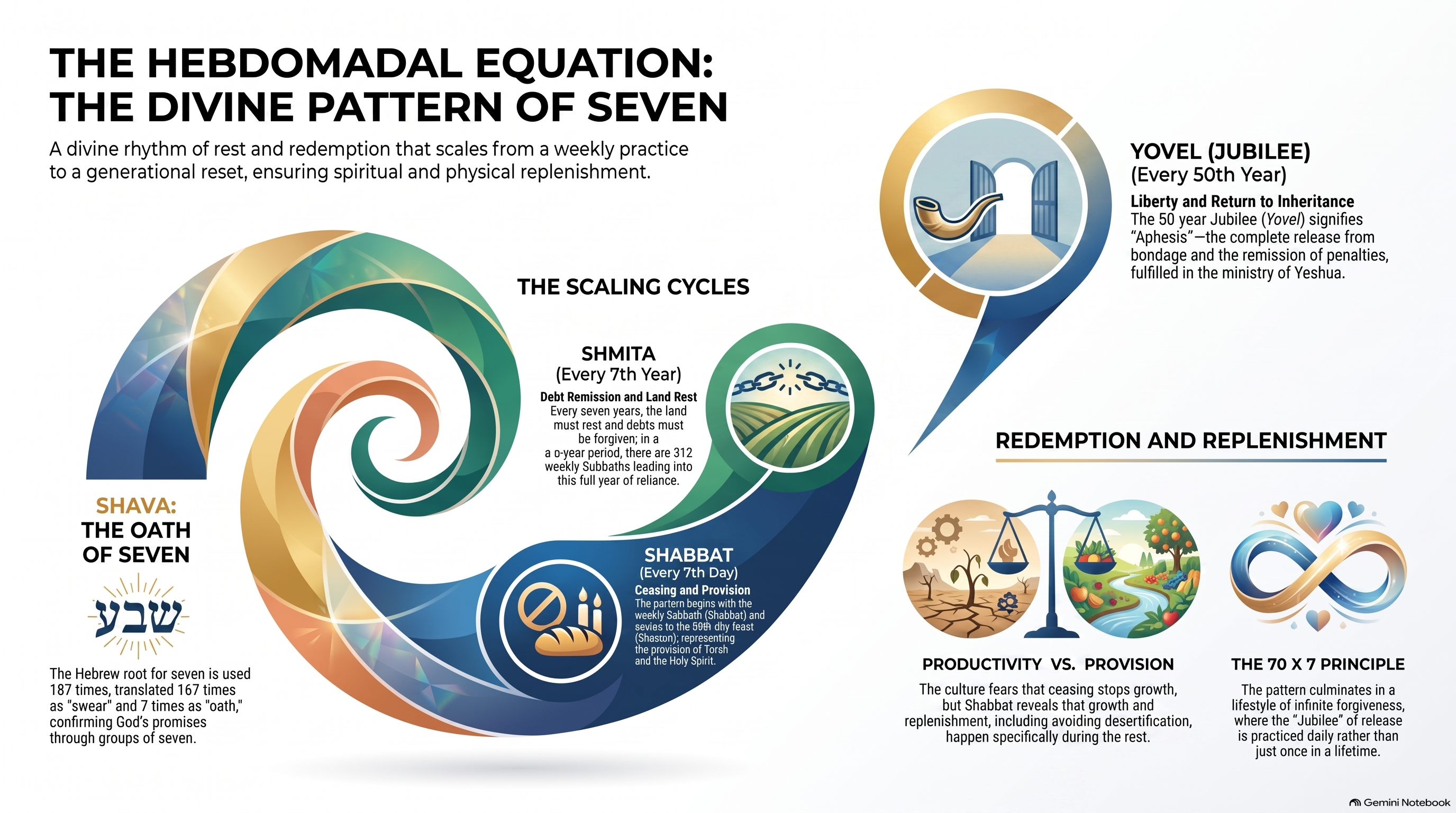
Sermon infographic — August 15, 2026
Do you ever feel completely drained, like your soul is a field that has been worked until the soil is nothing but dust? In our 24/7 culture, we are all "over-farmed." We push ourselves to produce more and more until we hit a wall of exhaustion.
This sermon introduces a fascinating concept to solve this: "harmonics." In music or signals, a base frequency creates harmonics — patterns that repeat and expand as they travel. Scripture works the same way. YHWH has a specific rhythm called the "Hebdomadal Equation." It is a pattern of sevens that starts with a single day and expands into decades. By digging into the "archaeology" of these ancient Hebrew words, we can find the life-giving rhythm YHWH designed for us to thrive.
In Hebrew, the number seven is far deeper than a digit on a page. The root word for seven is Shaba (H7650). As a scriptural archaeologist would tell you, the pictographic letters in Shaba reveal a story: Sheen (teeth/repetition), Bet (house/family), and Ayn (the eye). Together, they mean "to repeatedly see the house." When YHWH uses the number seven, He is confirming an oath or a promise — putting His signature on a contract. Keeping the Shabbat isn't just about "taking a nap"; it is a sign (Tav) on the house (Bet) of provision. It is our way of saying, "I trust YHWH's oath to provide for me more than I trust my own work."
- Total uses of Shava (H7650): 187 times in the Masoretic Hebrew.
- Translated as "Swear": 167 times.
- Translated as "Charge": 8 times.
- Translated as "Oath": 7 times.
- Archaeologist's Note: Ancient people confirmed oaths through seven sacrifices or seven witnesses.
We often think of repentance as the Greek word Metanoeo, which means "to change your mind." But the Hebrew word Shub is much more physical. It uses the letters Sheen (turning/repeating), Vav (a hook or nail that connects), and Bet (the house). Shub means to physically turn your body around and walk back to the family house. Repentance isn't head-knowledge; it is a movement of the feet. When we "walk in the spirit," we are physically moving away from our own ways and toward YHWH's commands.
"If you turn [Shub] away your foot from the Sabbath, from doing your pleasure on My holy day... then you shall delight yourself in YHWH; and I will cause you to ride on the high hills of the earth, and feed you with the heritage of Jacob your father." — Isaiah 58:13-14
Humans are shaped from the Adamah (the land). Because we are made of the same "stuff" as the dirt, what happens to the soil happens to us. "Over-farming" leads to "desertification" — turning a living, fertile place into a dry desert. Plants act like straws, sucking up nutrients. If we don't rest, we suck the life out of our own souls.
YHWH commanded the Shemita, or a seventh-year land rest, to prevent this. It was a test of reliance. In a normal year, we have 52 Sabbaths. But in the seventh year, the "math of faith" changes: you have the original 52 Sabbaths plus a massive 313-day stretch where you must rely completely on YHWH for food and provision.
- Nitrogen, Phosphorus, and Potassium: Plants need these to grow. Metaphorically, we need YHWH's rhythm to replenish our spirit.
- Akal (Devour): The "meat" or sustenance of the land is defined as Akal — meaning to "ravenously devour." While the culture depletes us, YHWH's rest allows us to ravenously devour His provision.
The rhythm of seven reaches its peak in the Yovel, or Jubilee (the 50th year). The word Yovel comes from Yaval, which doesn't just mean "grace" — it means to flow copiously. Think of a violent river or a deluge that carries so much volume it actually reshapes the land.
The Jubilee is a powerful current that breaks the "bondage of sin" and restores everything to its rightful place. This links to the Greek word Aphesis, meaning a total release from bondage and a pardon of debt. When Yeshua read from the scroll of Isaiah in Luke 4, He proclaimed the "acceptable year of YHWH" — the Jubilee. He is our Kainos High Priest, bringing renewal rather than just something "new" (Neos). He stopped reading before the "day of judgment" because He came first to be our Jubilee, releasing us from the debt of sin we could never pay.
The pattern of seven doesn't end with a 50-year cycle. When Peter asked Yeshua if he should forgive someone seven times, Yeshua told him "70 times 7." He was telling us to take the spirit of the Jubilee and extrapolate it into every single day.
You don't have to wait 50 years to be free. Because Yeshua has forgiven our massive debt, we can practice "Jubilee" every time we forgive someone else. We are called to let the "copious flow" of His forgiveness reshape our relationships today.
"Extrapolate the seven the same way it was extrapolated for you."
The weekly Shabbat, the seventh-year Shemita, and the 50th-year Yovel are all signatures of YHWH's oath. They prove that He is the one who provides, feeds, and sustains us. Yeshua is our ultimate Yovel — the Mashiach who sets us free to stop striving and start walking toward the "house." When we align with this rhythm, we are fed with the "heritage of Jacob." This means turning back to the family of YHWH and the house of Israel, rather than being fed by the empty influences of the world.
In what area of your life are you still trying to "work the field" yourself, and what would happen if you finally trusted the promise of the seventh day?
📥 Downloads
The Hebdomadal Equation
In the divine architecture of time, the number seven is far more than a cultural symbol; it is the "base frequency" of YHWH's promises. To understand the "Hebdomadal Equation," one must view it through the lens of signal theory. Just as a primary frequency produces harmonics that mirror the signal across the spectrum, YHWH's oaths are the base signal, and the cycles of seven — the Shabbat, Shavuot, Shemita, and Yovel — are the spiritual harmonics echoing that signal across eternity. As Deuteronomy 7:8 declares, the redemption from Egypt was the fulfillment of an oath (Shava) sworn to the fathers.
This connection is anchored in the Hebrew tongue. The root for "seven" is Shava (H7650), meaning to swear an oath or to charge solemnly. The technical weight of this word is staggering: of the 187 times it appears in the Masoretic text, it is translated as "swear" 167 times, "charge" 8 times, and "oath" 7 times. Historically, an oath was confirmed through a "septenary" act — seven sacrifices, witnesses, or pledges. Thus, YHWH's appointed times are not merely dates on a calendar; they are legal, mathematical confirmations of His covenant love.
Shabbat is the foundational harmonic, the first of the feasts and the fundamental "sign on the house." It is a strategic mandate to cease (Shabbat), confirming that our sustenance is a product of YHWH's grace rather than our own exhaustive striving. In a world that equates human worth with relentless productivity, Shabbat serves as a counter-cultural witness, signaling that the house is provided for even when the hands are still.
The linguistic depth of the "Equation" is revealed in the Hebrew letters. Shava (Shin-Bet-Ayn) suggests "repeatedly" (Shin) "seeing" (Ayn) the "house" (Bet). In contrast, Shabbat (Shin-Bet-Tav) identifies the "sign or signature" (Tav) upon that "house" (Bet). By "sitting still," we acknowledge YHWH's signature over our lives. This requires a physical turning — Shub (H7725) — rather than a mere mental change of opinion (Metanoeo, G3340). Isaiah 58:13–14 challenges us to shub (turn) our foot away from our own pleasures and "own words." When we stop our works, YHWH's productivity continues on our behalf, proving that spiritual growth often matures most profoundly in the stillness of ceasing.
- When you contemplate stopping all work, does your heart feel the peace of the "house" or the "anxiety" of lost productivity?
- Are you relying on a mental agreement (Metanoeo) with YHWH's rest, or a physical turning (Shub) that actually changes your schedule?
During your next Shabbat, dedicate the day to total cessation. Intentionally turn away from your "own ways, pleasures, and words." Do not check emails or plan your week. Sit still before YHWH, acknowledging His Tav (signature) of provision over your home.
Shavuot is the culmination of "seven sets of seven," a spiritual crescendo occurring after a 49-day count from the Shabbat of the first month. It is the season of sustenance and witness. YHWH uses this count to mature His people, moving them from the initial immunity of salvation (Pesach) to the empowered witness of a life lived in righteousness.
We see this in the "bookend events" of Sinai and Pentecost. At Sinai, the Torah was given to identify the "leaven" of sin. At Pentecost, the Ruach Ha Qodesh was poured out to provide the power for obedience. Shavuot traditionally involves an offering of two wheat loaves mixed with leaven — a profound metaphor: while leaven may represent the sin still present in our lives, it also represents the new influence of obedience. YHWH's oath provides the Spirit to help us walk in holiness despite our imperfections. Mashiach functions as the enabler of this witness, transforming us from debt-ridden captives into empowered ambassadors.
- Are you attempting to purge the "leaven" of sin through your own willpower, or by the power of the Ruach Ha Qodesh?
- Do you view the Torah as a burden of rules, or as the gracious Word that points out sin so you can walk in the Spirit?
Identify one specific command from the Torah you find difficult to obey. Recognizing the "leaven" of your own weakness, ask Yeshua for the specific power of the Ruach to walk in that command this week as a witness to His oath.
The Shemita (H8059), or the seventh-year rest, provides a remedy for "overfarming" — a metaphor for the spiritual and emotional desertification caused by the intense demands of culture. Just as plants act like straws, sucking nitrogen and phosphorus from the soil, the culture sucks the "vital minerals" of peace and joy from our souls. If the "dirt" of our lives is not allowed to recover, we become a lifeless medium that can no longer support healthy fruit.
The Shemita is a "Sabbath Math" of total reliance. It consists of the original 52 weekly Sabbaths plus 313 additional days of total dependence on YHWH for sustenance. Failing to observe this rest leads to "desertification," where once-fertile lives turn barren. By mandated remission of debt and release of labor, the Shemita forces us to trust that YHWH will provide naturally what we usually attempt to force through intensive, exhaustive effort.
- In which areas — career, relationships, or ministry — do you feel "overfarmed" and drained of vital spiritual nutrients?
- Is your "dirt" healthy? Are you producing the sweet fruits of the Spirit, or has the soil of your heart become sour and dry?
The Shemita was the year for the release of debts. Identify a "spiritual debt" or a grudge you are holding. Consciously release it this week, modeling Shemita remission as an act of trust in YHWH's provision.
The Yovel (Jubilee, H3104) is the "flow of liberty" occurring after seven cycles of seven years. It begins on the Day of Atonement in the 50th year with the Teruah (voice of a trumpet). This is the year of Shub — a physical return to one's true family and original inheritance.
The root Yaval describes a "copious flow" of grace — abundance that moves "with some violence, like a river that shapes the land." This is the power of the Yovel: a flow of grace so strong it reshapes the landscape of a person's life. In the Septuagint, this liberty is called Aphesis (G859), meaning the remission of penalty and release from bondage. Yeshua identifies Himself in Luke 4:18 as the fulfillment of this Yovel. He provides the Aphesis for our sins, pardoning the debt we could not pay and calling us back home to the house of Israel.
- Are you still living as a "captive" to the habits of the house of bondage, or have you accepted the Aphesis (pardon) of Yeshua?
- If the trumpet sounded today, would your heart Shub (turn) toward the house of YHWH, or is it still anchored in cultural addictions?
Identify one cultural habit that feels like bondage. Physically Shub (turn) away from it this week, and replace it with a practice that honors the house of YHWH — such as communal study or service.
The "Hebdomadal Equation" reveals that YHWH is a keeper of oaths who has built restoration into the very fabric of time. From the weekly signature of the Shabbat to the once-in-a-lifetime "land-shaping flow" of the Yovel, the pattern of seven reminds us that we are provided for. Though a physical Jubilee may occur only twice in a lifetime, Yeshua expanded the equation to "seventy times seven."
This indicates that the ultimate sign of YHWH's oath on our lives is the forgiveness we extend to others. Forgiveness is the daily practice of the "Equation" — it is the choice to allow Aphesis to flow through us to a world in bondage. By practicing daily remission and daily turning, we bear witness that YHWH has kept His oath and that His house is our eternal home.
Extend Aphesis (forgiveness) to one person today who does not deserve it, as a witness to the oath YHWH kept for you.