Moved To Possession
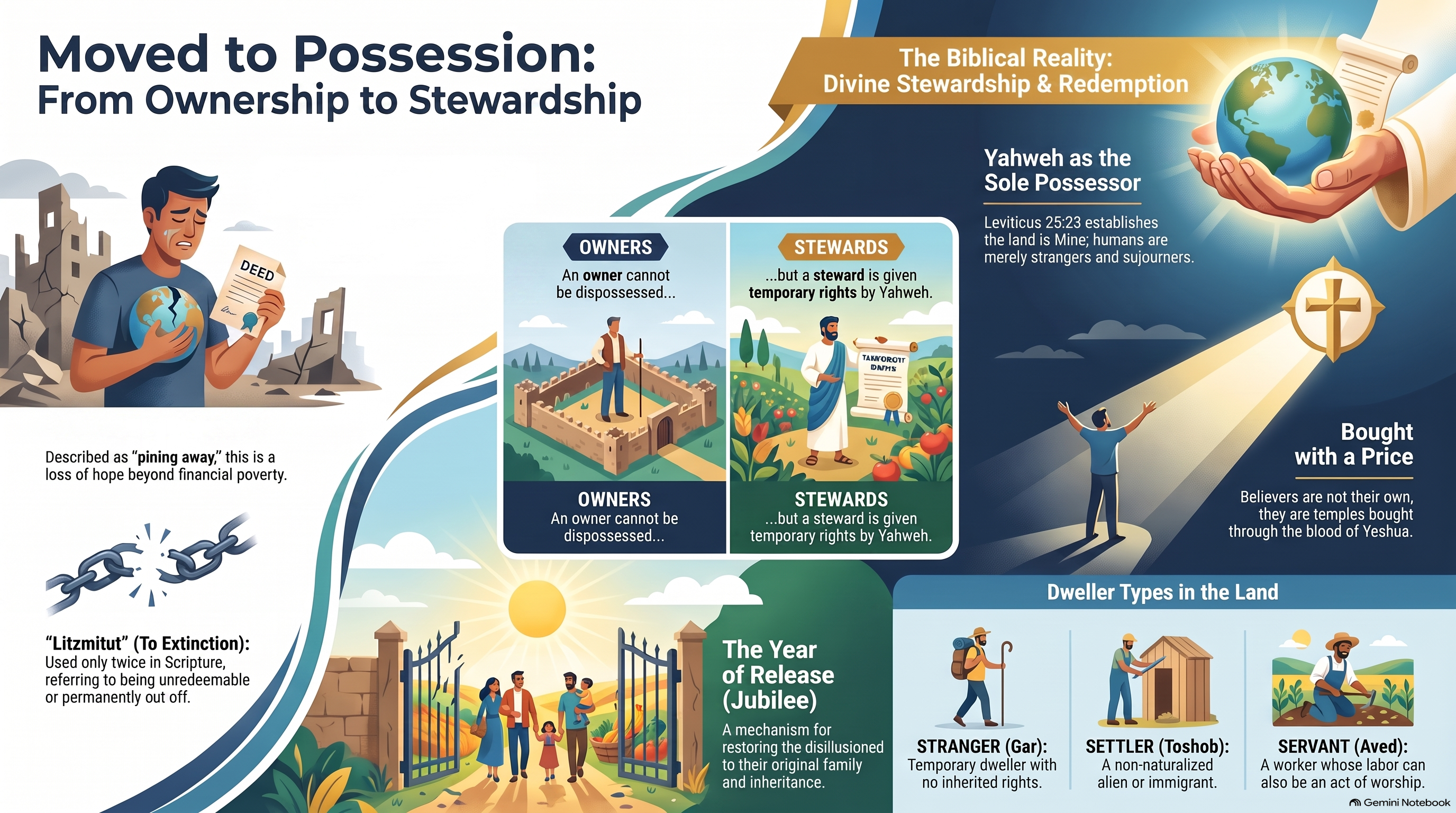
Sermon infographic — August 22, 2026
We live in a culture obsessed with "owning it." We are told to be self-made, to build our own empires, and to possess as much as possible. We think that if we work hard enough, we can finally become the masters of our own destiny. But what if the soul-crushing stress we feel actually comes from trying to play a role we were never meant to have?
There is a core truth that flips our modern worldview upside down: there is only one true Possessor in the universe, and it isn't us. That Possessor is YHWH. When we realize that we don't actually own our time, our land, or even our own bodies, everything changes. Instead of the heavy, exhausting burden of ownership, we are offered something much better: the role of a steward. Understanding this shift will change how you view your daily work, your deepest heartaches, and what it truly means to be free.
In Leviticus 25:23, YHWH makes a bold statement about the land: "The land is mine." He tells His people that they are merely "strangers and sojourners" with Him. In the ancient world, this meant the people were more like "professional tenants" or "settlers" than owners.
This is a massive shift in perspective, and it carries high stakes. A specific Hebrew word, Litzmitut, means "to extinction." When something is sold "to extinction," it is gone forever — unreachable and unredeemable. That is the danger of the "owner" mindset. If you try to own your life, you are responsible for its ultimate survival, and if you fail, you risk being "sold to extinction." But as a "steward in training," you aren't an owner who can be destroyed; you are a manager of a gift. You have the right to use the land and occupy in the graceful pursuit of righteousness, but the pressure of "forever" isn't on your shoulders.
"While Israel would have possession, they were not the owners. An owner cannot be dispossessed, but a steward is given a gift to manage."
We usually think of poverty as just having a zero balance in a bank account. However, the Hebrew word Muwk describes someone "waxing poor" — and it is much deeper than financial struggle. It means "to pine away."
Here is the life-hack for your soul: if you feel exhausted, thin, and hopeless, you aren't just "stressed." You might be pining away because your hope is in an idol rather than YHWH. To pine away is to slowly lose your health and energy because of a deep longing for something that was lost or can never be.
"This is loss of hope and disillusionment... wanting what was but is no longer there. This is the subjugation of sin in the form of idolatry as well."
When our motivation dies because the things we put our hope in have failed us, we become truly poor. Fixing this requires more than a check; it requires a restoration of the heart.
When we hear the word "buy" in the context of people, we think of something terrible. But the Hebrew word Qana means "to erect" or "to set upright." In the Bible, "buying" a brother was an act of edification — literally building them back up.
Think of the contrast between Cain and Joseph. Cain was the first natural-born "possession" (Qana), but he failed the house and was dispossessed, driven away from the presence of YHWH. On the other hand, Joseph was "sold" into the world as a servant by the house. Yet, because he remained a faithful steward, he was used to save his entire family. Buying a brother wasn't about exploitation; it was a rescue mission. It meant bringing a broken person into a healthy household so they could find their hope and purpose again.
The Hebrew word for work is Avad, which also means "to worship." This word takes us all the way back to the Garden of Eden, where Adam's original vocation was to Avad (till) the ground. Our daily labor is meant to be a form of service to YHWH.
However, the real test of our heart happens on the 7th day. Stopping our work on the Sabbath is a "sign" that proves who we actually trust. If we refuse to stop, we are acting like "owners" who believe our survival depends entirely on our own hands. If we rest, we testify that YHWH is the true Provider. This is why the "doorkeeper" matters — it is better to be a guard at the threshold, a servant at the door of YHWH's house, than to be the "owner" of a tent full of wickedness. Unbelief is what kept the wilderness generation from their rest; they couldn't stop working and start trusting.
If you've ever felt worthless, 1 Corinthians 6:19-20 points to a powerful reality: you are "bought with a price." Through Yeshua Mashiach, we have been purchased out of our disillusionment and sin. We were "pining away" in a world that couldn't save us, and Yeshua paid the ultimate price to bring us into His house. He didn't buy us to use us up; He bought us to "erect" us and restore us.
Being a "possession" of YHWH is actually the ultimate freedom. It means you are under His protection and His roof. You are no longer a stranger wandering toward "extinction"; you have been redeemed into grace.
At the end of the day, we are all servants of something. We are either serving our own flesh and our own "tents," or we are serving the Creator. "Rest" isn't just a nap in the dirt — it is a spiritual exercise available right now. The year of release is today. You don't have to wait fifty years to find hope or to stop pining away.
But to enter that rest, you have to be willing to let go of the illusion that you are the owner of your life. Are you willing to sell your own will to be purchased by the only One who can truly restore your hope?
📥 Downloads
Moved To Possession
As we reach the conclusion of the book of Leviticus, we find a powerful summary of how we are to live in relation to our Creator. A central theme of this study is the strategic importance of shifting our perspective from owners to stewards. In our modern culture, we often think that if we "possess" something, we have the ultimate right to control it. However, the Scriptures teach us that there is only one true Possessor: YHWH Elohim.
This truth is reinforced throughout the Word. In Leviticus 25:23, YHWH declares, "The land is mine; for ye are strangers and sojourners with me." The Apostle Paul echoes this in 1 Corinthians 6:19-20, reminding us that our bodies are temples of the Ruach Ha Kodesh and that we are "not our own," because we were "bought with a price." When we realize that YHWH owns everything — our land, our time, and our very lives — it changes how we treat what has been placed in our care. Understanding that we belong to YHWH is the first step toward a life of true purpose.
To maintain spiritual health, we must embrace our identity as temporary residents. The Bible uses two specific terms to describe this: Gar and Toshob. A Gar is a temporary dweller or guest with no inherited rights of their own. A Toshob is like a non-naturalized alien or an immigrant. By using these words, YHWH reminds us that our standing comes entirely from His grace and the oath He swore to the fathers, not from our own merits.
The difference between an "owner" and a "steward" is profound. An owner believes they have an absolute right to their property, but a steward knows they are merely managing someone else's assets. This is why YHWH forbids the land from being sold LitzMiTuwt — a Hebrew term meaning "to extinction" or "perpetually." It is a rare word, used only twice in the entire Bible, both times in Leviticus 25. It describes a sale toward total destruction or making something unredeemable. Because YHWH is the true owner, He forbids anything from being "extinguished" beyond His reach. He always provides a way for His possession to be recovered.
- If YHWH were to "audit" your life today, would He find a Gar (guest) who respects the Host's rules, or an "owner" who has forgotten who actually paid for the land?
- Since you were "bought with a price," how does the way you treat your physical body reflect the fact that it belongs to YHWH and not to you?
Identify one area of your life that you frequently claim to "own" — such as your career, a specific possession, or your free time. Spend time in prayer today consciously surrendering that area to YHWH's stewardship, acknowledging that you are merely managing His property.
In Leviticus 25:39, the text speaks of a brother who has "waxen poor." The Hebrew word used here is Muwk. While we often think of poverty as just a lack of money, Muwk describes a much deeper spiritual and emotional state. It means to "pine away" — to become thin, or to be deeply humbled. It is the feeling of losing your health, strength, or energy because of deep sadness or a longing for something that is gone.
This state of being "poor" often stems from disillusionment or a broken heart. The "pining away" is actually a sign of unbelief. When we place our hope in things other than YHWH — such as a job, a relationship, or a specific lifestyle — and those things fail us, we pine away. This is an "idolatry of expectation." We become poor because we trusted in things that could not sustain us. YHWH calls us to recognize this condition so we can stop pining for idols and return to Him.
- Is there an area of your life where you are "pining away"? What specific thing were you trusting in — other than YHWH — that has left you feeling empty?
- How does viewing your disappointment as a sign of "unbelief" change the way you seek comfort from YHWH?
In your prayer time, specifically name any "idols of expectation" that have caused you grief. Ask YHWH to replace that disillusionment with a renewed trust in His provision, moving from a heart of unbelief to a heart of faith.
The Bible uses the word Qana (to buy). However, in a Hebraic sense, Qana means much more than a transaction; it means to erect, to set upright, or to build up. We see a powerful contrast in Scripture regarding this word. Cain (Qayin) was the first "purchased" or "acquired" one (Genesis 4:1). He expanded the family but eventually became dispossessed and driven out because he relied on himself. In contrast, Joseph was sold to the world by his own brothers as a servant. Yet he continued to serve YHWH, and was "purchased" to eventually save and build up the very house that rejected him.
This is the pattern of Yeshua Mashiach. We were sold to sin, pining away in our poverty, but He purchased us with His blood to "erect" us and set us upright. While the world uses "ownership" to suppress people, YHWH uses His "possession" to restore and edify us. Being a possession of Mashiach means being built into a righteous dwelling place.
- How does the definition of Qana (to set upright and build up) change your view of being a "servant" of Yeshua?
- Do you feel like a slave to your past mistakes, or do you feel like a "possession" of Mashiach that is being erected for a holy purpose?
Act as a "redeemer" for someone else this week. Identify a person who is struggling and offer them words of edification or practical help to "build them up," acting as an agent of YHWH's restoration.
The Hebrew word Avad means to work or labor, but it also means to worship. The letters of Avad — Ayn, Bet, and Dallet — provide a beautiful picture: "The Eye, The House/Family, and The Door." This suggests that our work and worship is about keeping our eye on the Father's house and looking toward the Door (Yeshua).
How we spend the seventh day proves what we believe. If we refuse to stop working, we show a heart of unbelief, fearing that YHWH will not provide. Resting on the Sabbath is an act of trust. It allows us to enter into M'nucha — a glorious, restoring rest. Like the restoring waters of Psalm 23, M'nucha is the deep peace found when we cease from our "own works" and trust entirely in the Master of the House.
- Does your daily work feel like a burden of self-reliance, or are you keeping your "eye" on the "door" of the Father's house as you labor?
- Does your Sabbath reveal a heart that trusts in YHWH's provision, or does it reveal a fear of lack?
Create a specific plan for your next Sabbath to cease from "own works." This means more than just staying home from a job; it means setting aside your own agendas to focus on the M'nucha of Elohim through prayer and study.
The Scriptures present a choice: dwell in the "tents of wickedness" or be a "doorkeeper" in the house of YHWH. The "tents of wickedness" represent self-reliance and pining away for idols. A doorkeeper, however, stands at the threshold of YHWH's presence.
Isaiah 11:10 speaks of the "Root of Jesse" who stands as an Ensign — a banner or rally point — for all people. The term for Ensign comes from the word Nasas (to be lifted up). This Root of Jesse is Yeshua Mashiach. He is a sheresh, a "fixed dwelling" that stands firm even when the land is empty. He is the standard lifted up for the nations (Goyim) to see. Choosing to follow this Ensign means moving from being a possession of sin to being a possession of the King.
- In your daily life, are you trying to build your own "tent" of security, or are you seeking to be a "doorkeeper" at the threshold of YHWH's house?
- Is the "Ensign" of Yeshua clearly visible in your life, or is your banner hidden?
"Lift up the Ensign" today by sharing one specific truth about Yeshua Mashiach with a non-believer. Let the banner of His righteousness be seen through your testimony or an act of kindness.
As we conclude, we must heed the warning from Hebrews 3. The generation in the wilderness saw YHWH's works for forty years, yet they could not enter His rest because of a heart of unbelief. We are urged to "exhort one another daily, while it is called Today."
The "year of release" is a double-edged sword. For those who are purchased by the Redeemer, it is a time of glorious restoration. But for those who remain in the "tents of wickedness," it is like the Day of Vengeance (Tarua) when the walls of Jericho fell — a day of everlasting destruction and being sold to extinction. Do not let your heart be hardened by the deceitfulness of sin.
Do not wait 50 years for a Jubilee to experience freedom; the year of release is right now. If you hear His voice, do not harden your heart. Choose today to move into His possession, and find the Mana that your soul was created for.