The Wild Society
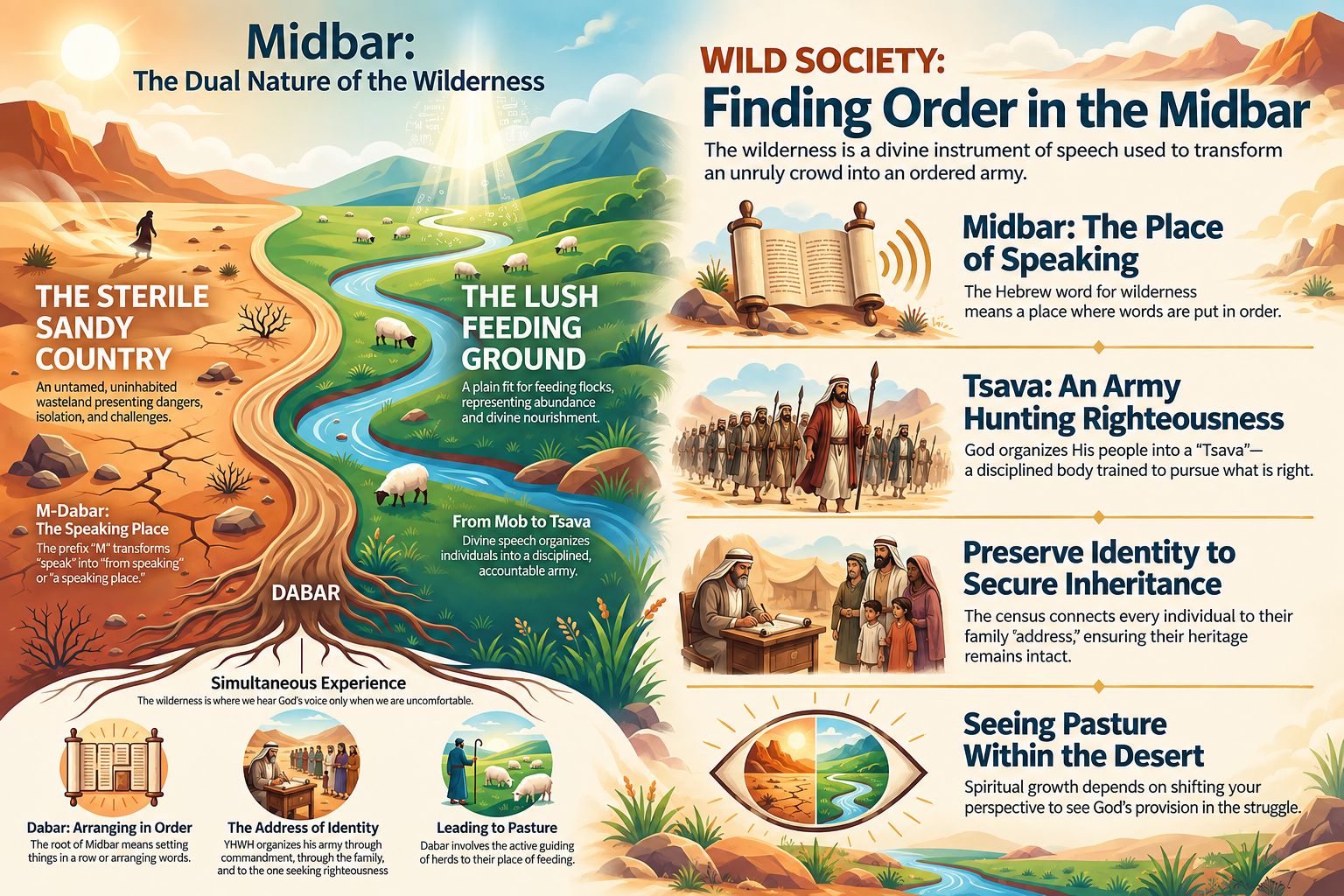
Sermon infographic — September 5, 2026
Many of us have gone through seasons that feel like a "wilderness." These are the times when life feels messy, lonely, and out of control. When we are in these dry places, it is easy to think we are being punished or that YHWH has forgotten us. We usually want to find the fastest way out so we can get back to being comfortable.
The book of Numbers, however, offers a different perspective. In Hebrew, this book is called B'midbar, which means "In the Wilderness." It describes the transition from the priestly laws of Leviticus into the organization of a "Wild Society." YHWH takes an unruly group of people and turns them into a disciplined, organized army. What looks like a sterile desert is actually a place where identity is restored and order is spoken into existence.
To understand why YHWH leads His people into difficult places, we have to look at the Hebrew word for wilderness: Midbar (H4057). This word comes from the root Dabar (H1696), which means to speak, to arrange in order, or to lead. The prefix "Ma-" (as in Ma-dabar) means "from" or "toward" — making the wilderness a "speaking place," the specific location from which divine order proceeds. Midbar carries three definitions:
- An uninhabited pasture where flocks are fed.
- A sterile, sandy desert.
- Poetically, an organ of speech — like the throat or lungs.
We often miss YHWH's voice when we are comfortable because we are surrounded by distractions. Just as people move to the desert to escape allergies and find a new perspective, we are led into the wilderness to hear more clearly. It is the place where we have nothing left to trust in but Him.
"In fact, the most fertile place for our spirit is the place we don't want to go."
In the first chapter of Numbers, YHWH orders a census of all men able to go to war. The Hebrew word for this army is Tsava (H6635). This isn't an unruly mob or a crowd; it is a disciplined mass of people organized for a campaign. The letters of Tsava reveal YHWH's chain of command:
- Tzade: The individual "hunting" or pursuing righteousness (Tzadock).
- Bet: The house or family unit.
- Aleph: The leader or father — a silent letter representing the silent strength and discipline of the Leader who "tames" the house.
In YHWH's army, the order moves from the Leader (Aleph) through the family (Bet) to the individual (Tzade) seeking righteousness. This structure keeps everyone accountable and connected, ensuring the whole "Wild Society" moves in the same direction.
In our culture, we think "blessing" means getting bigger or having more territory. However, the biblical concept is the opposite. The Hebrew word for blessing is Barack (H1288), which literally means to kneel or bow down, to break at the knee.
This lesson is found in the names of the tribal leaders. For example, the name Nethaneel means "Elohim-given smallness." To receive a divine inheritance, you must first be willing to bend the knee. In the wilderness, your own "largeness" has to cease so that YHWH can fill that space.
"Barack means to bend the knee. You cannot bless from a place of bigness. It must be small."
The census in Numbers was more than a head count; it was a "registry of heirs." By counting heads by name and father, YHWH was creating a "Dewey Decimal System" for land claims — a spiritual DNA and "address" for inheritance. The names of the leaders tell a heritage story that points to the Mashiach:
- Elizur: "Elohim is my rock."
- Nahshon: "The willing offering" — from the tribe of Judah, pointing to Yeshua.
However, a counter-example warns us: Ahira, the son of Enan. His name means "Brother of Evil," and he was from the tribe of Naphtali (which means "to wrestle"). While others wrestled through their faith, Ahira's name represents one who used his "eyes" to look for an escape from the wilderness rather than hearing from YHWH in the lush pasture. This shows how perception plays a role in how we receive our wilderness experience. Walking in sin erases spiritual identity and "breaks the address" YHWH uses to deliver your inheritance. This growth isn't easy — it is like hewing stone with dynamite, full of bumps and discomfort, but it is the only way to shape us for what is coming.
Inheritance is not just for those with the right "physical" bloodline. In Ezekiel 47, YHWH declares that "strangers" (sojourners) who live among the tribes will receive an inheritance just like the native-born. This is the process of being "naturalized." It connects to the term Ivrey (Hebrew), which means "one who crossed over." To be naturalized is to change from the world's perspective to YHWH's order.
We see this with Joseph's sons, Ephraim and Manasseh. They were born in "the world" (Egypt), but they were brought into the family and given the status of firstborn sons. This changes how we see Yeshua's parable of the lost sheep. He leaves the ninety-nine in the wilderness (Midbar) — because the ninety-nine are already in the "place of order"; they have an "address." He goes into the world to find the one who has lost their identity.
"When he hath found it, he layeth it on his shoulders rejoicing because he didn't make him walk back. He took him and carried him back."
The book of Numbers shows us that the journey through the desert is a journey of finding our place in YHWH's army. It is a process of being stripped of the world's distractions so that a divine order can be established in our lives. YHWH's deliverance doesn't always come in the "Amazon package" we expect; it usually comes through the trials that refine us.
As you navigate your own season of transition, ask yourself: in the middle of your current wilderness, are you witnessing only the sparsity of the desert, or are you listening for the order being spoken into your life? Your time in the "wild" is not a punishment — it is the preparation for the inheritance Yeshua is carrying you toward.
📥 Downloads
The Wild Society
As we transition from the Book of Leviticus to the Book of Numbers, we move from the protocols of holiness to the protocols of mobilization. In Leviticus, the focus was Qurban — learning how to "draw near" and "dwell near" the Presence of YHWH. In Numbers, or B'midbar, the focus shifts to being put in order by Him. This transition is strategically vital because holiness without order inevitably results in an "unruly mob." Adonai Zavayote (the Lord of Hosts) does not lead a chaotic crowd; He leads a disciplined body. The wilderness was not a place of abandonment, but a "speaking place" (Midbar) where distractions were stripped away so the heart of Israel could be recalibrated and set in a row.
The Hebrew name for the book, B'midbar, is often translated simply as "in the wilderness," but the linguistic roots reveal a deeper strategic purpose. There is a profound connection between Midbar (wilderness) and Dabar (to speak or to arrange in order). The prefix "Ma" or "Me" in M-dabar acts as a directional marker, meaning "from speaking" or "toward order." Thus, the wilderness is the very source and direction of divine arrangement — the instrument or organ of speech, the throat and lungs of the Almighty.
While we often view the wilderness as a "sterile desert," the Hebraic perspective also defines it as an uninhabited pasture fit for feeding flocks — a "fertile pasture" for the spirit, provided one has the ears to hear. In our modern world, we dread the wilderness because there is no comfortable distraction. We prefer the safety of the familiar, yet it is that very comfort that prevents us from hearing the voice of YHWH. In the wilderness, you often go from "wanting lunch" to "being lunch." Being "uncomfortable" is the prerequisite for spiritual discipline; it is only when human distractions are removed that we can focus on the Dabar — the Word that sets our priorities in a row.
- In my current "wilderness" season, am I focusing on the sparsity of the desert or am I looking for the "Ma" prefix — the direction toward divine order?
- What specific "favorite distractions" am I using to drown out the voice of YHWH?
Identify one area of your life that feels "wild" or disorganized. Dedicate 20 minutes of total silence this week — no phone, no music — specifically asking YHWH to "set in a row" your priorities.
The census in Numbers introduces the Tsava — an organized army mustered for service, characterized by discipline and a chain of command that ensures accountability, safety, and a unified direction. The linguistic breakdown of Tsava (Tzade-Bet-Aleph) reveals a divine hierarchy:
- Aleph — The Leader or Father: The Silent Aleph is the force that speaks creation into being and tames the individual. We serve a "voice of the voiceless" that requires us to be disciplined enough to hear what is said and act on behalf of those with no voice.
- Bet — The House or Family: The primary unit of the community.
- Tzade — The Individual who "hunts": In the Hebraic mind, the individual is one who hunts for righteousness (Tzadock). We are not passive observers; we are soldiers who actively pursue opportunities to do what is right.
This discipline is what prevents a community from becoming an "unruly crowd" and protects our spiritual inheritance. We are put in order by Adonai Zavayote, looking from the Leader through the House to the individual's pursuit of holiness.
- Am I a "disciplined soldier" in the Tsava of YHWH, or am I acting like an individual in a "mob," doing what I want regardless of the command?
- Am I actively "hunting" for opportunities to do what is right, or am I waiting for righteousness to find me?
Practice the "Barack" this week. In Hebrew, the root B-R-K means both "to bless" and "to kneel/make oneself small." Intentionally yield your "right to be right" in a conversation, choosing instead to follow the order of peace and humility by "kneeling" in your spirit.
Numbers Chapter 1 details a census that functions as a "Dewey Decimal System of righteousness." By recording names according to their families and fathers, YHWH provides every person with a specific place. This "address" is critical; to lose your identity is to become "homeless" in the spirit. Sin is the force that breaks covenant and makes us "homeless," but the order of YHWH is designed for restoration. The names of the tribal heads reveal a heritage story of who YHWH is:
- Elizur: "Elohim is my rock."
- Nethaneel: "Elohim-given smallness" — humility.
- Nahshon (Tribe of Judah): His name is linked to Nahash (to enchant or observe), yet he is the "willing offering" from the people — representing the choice between "enchanting" the world and being a willing sacrifice, a precursor to Yeshua.
These names remind us that our heritage is built on the strength of the Rock and the humility of the servant. Even the "bumps" in our lineage — the trials and the moments of being "hewn" like a stone — are used by the Father to fit us into His building.
- Do I know my "spiritual address," or do I feel like a wanderer without a clear identity in the house of YHWH?
- How have the "bumps" in my heritage actually served to "hew" me into a stone fit for His build?
Research the meaning of your own name or a "spiritual name" you identify with. Write down three ways YHWH has used your specific "lineage" — your life's trials and family history — to prepare you for your current responsibilities in His Tsava.
The "Wild Society" of the world is transformed when the "stranger" or sojourner is naturalized into Israel. As seen in Ezekiel 47, those who sojourn with Israel are to receive an inheritance as if they were "born in the country." This inclusion is personified in Ephraim, the son of Joseph. Joseph was sold into the world, yet in the "wilderness" of his affliction, he brought forth Ephraim, whose name means "doubly fruitful." From the ashes of affliction, a firstborn inheritance was birthed.
We see the Heart of the Father in the Parable of the Lost Sheep (Luke 15). The "Pharisee perspective" sees a sinner to be avoided, but the "Shepherd perspective" sees a lost sheep to be restored to the fold. Critically, the Shepherd does not make the exhausted sheep walk back through the Midbar; He lays it on His shoulders and carries it. This is "mercy restoration" — returning identity to the identity-less. As Galatians 3:29 declares, if you are Messiah's, then you are Abraham's seed and heirs according to the promise.
- Am I looking at others through the "Pharisee lens" of their sin, or the "Shepherd lens" of their potential restoration?
- Do I truly believe that through Yeshua, I am a full heir to the promise, regardless of the "ash heap" of my past?
Identify a "lost sheep" in your circle — someone the world has cast aside. This week, perform one act of "mercy restoration" for them without mentioning their "sin," acting as the shoulders of Yeshua to carry them toward the Father's house.
The journey through the wilderness is a transformation from a "Wild Society" into a restored, disciplined family. By embracing the order of the M-dabar, hunting for righteousness in the Tsava, and claiming our address in the house of the Father, we move from being lost wanderers to being an unrelenting army under the authority of Yeshua the Mashiach.