Beyond the Legal Term: 5 Counter-Intuitive Truths About the “Body” and the Mind
In the architecture of Western jurisprudence, few pillars are as foundational as Habeas Corpus. Literally translated from the Latin as "you shall have the body," it is a demand for the physical presence of a prisoner to determine the lawfulness of their detention. It is a writ of liberty. Yet, when we pivot from the courtroom to the ancient texts of the New Testament, we encounter a far more visceral and haunting dimension of this concept. In Romans 7:24, the apostle Paul lets out a desperate, existential cry: "O wretched man that I am! Who will deliver me from this body of death?"
This "body of death" is not merely physical anatomy; it is a "body of work"—a staggering collection of habits, cultural sins, and mental patterns that eventually coalesce into a self-constructed prison. By exploring the linguistic roots and ancient sacrificial metaphors of the Hebrew and Greek scriptures, we can uncover counter-intuitive truths about how our "body of work" can become our heaviest burden, and how we might finally find deliverance.
1. "Gentile" is a State of Mind, Not Just an Ethnicity
To the modern reader, "Gentile" is often a simple ethnic marker denoting a non-Jewish person. However, the etymology reveals a deeper psychological and spiritual state. Rooted in the Latin gens (race, clan) and the Greek ethnos (G1486), the term entered the English language in the late 14th to 15th century to translate the Hebrew goyim (nations).
From an etymological perspective, the "Gentile" represents the "uninitiated"—those foreign to the ways of Elohim. This is not necessarily a birthright, but a state of ignorance in applying righteousness. Whether one is a literal foreigner who "doesn't know" or a member of the community who "should have known better," the common denominator is the same: a failure to bridge the gap between divine knowledge and physical action.
"Sometimes, more knowledge only leads to more nuanced ignorance."
This insight suggests that the accumulation of theological facts is insufficient. Without the functional application of truth, knowledge simply becomes a more sophisticated way to remain uninitiated.
2. The Danger of "Inutility of the Understanding"
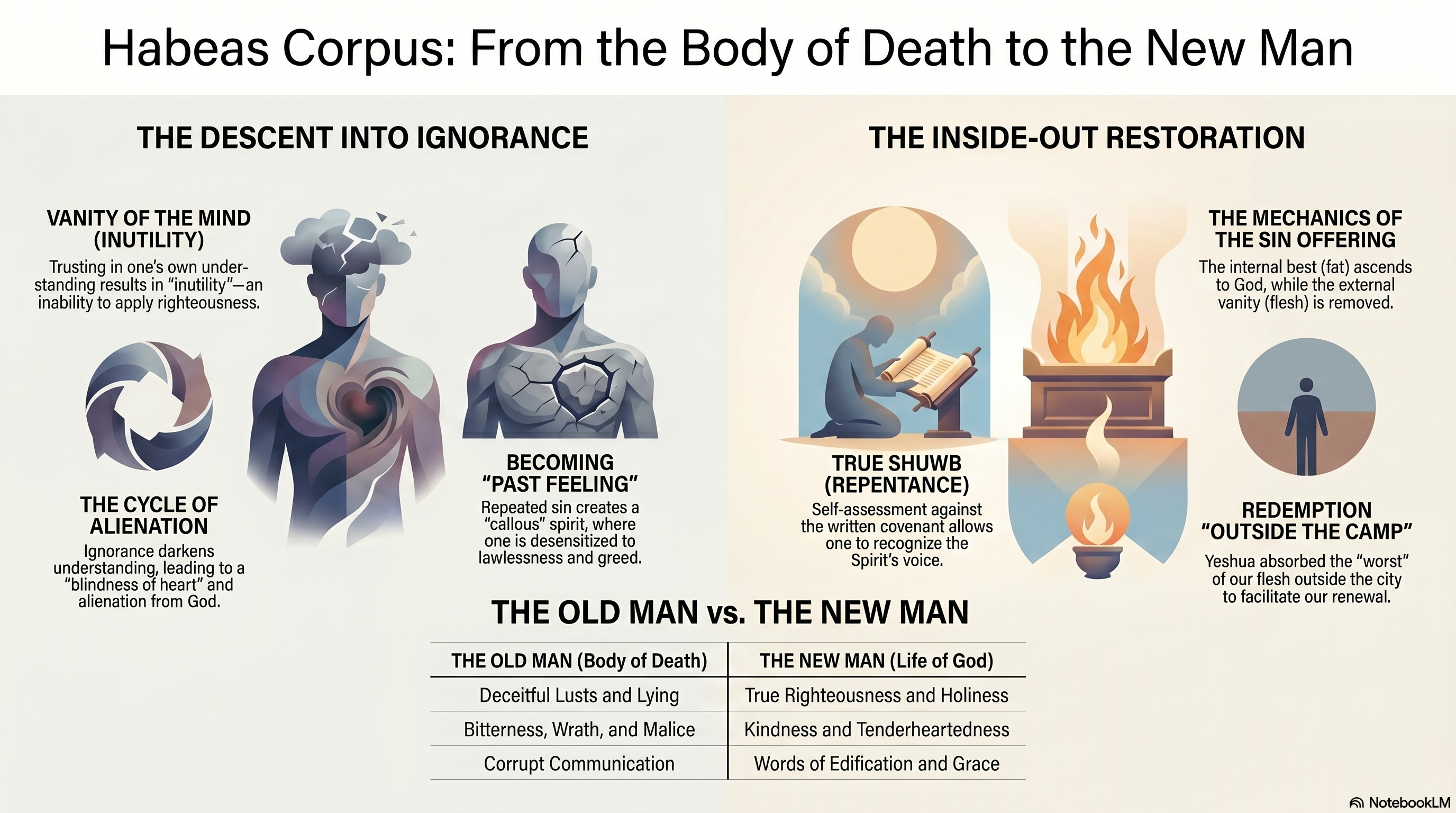
In Ephesians 4:17, the text warns against walking in the "vanity of the mind." To the digital philosopher, a more precise translation from the Greek is the "inutility of the understanding." Inutility is the quality of being useless, unprofitable, or having no practical purpose.
This state occurs when our internal biases and "mental vanity" override the clear instructions of the text. When we place unquestioned trust in our own logic, we risk normalizing "iniquity"—a term synonymous with lawlessness. This mental vanity leads to unpredictable damage; we become convinced of our own rightness while moving further away from functional, lawful living. Useless knowledge is more dangerous than no knowledge at all, as it provides the illusion of progress while one drifts into deeper lawlessness.
3. The Callous Heart and the Loss of Ruach
There is a logical, downward progression that begins in the "inutility" of the mind and ends in spiritual desensitization. The path is precise:
- Darkened Understanding: Trusting in mental vanity.
- Alienation: Being separated from the life of Elohim through ignorance.
- The Callous Heart: Being "past feeling" (Grown Callous).
When an individual becomes "past feeling," they are spiritually numb. This state inevitably leads to lasciviousness—unbridled lust or appetite. James describes lust as that which "draws us away," which serves as the linguistic opposite of Qarab (to draw near).
In Hebrew thought, the "offering" (Qaraban) is literally the "verb made noun"—the act of drawing near solidified into an object. Conversely, greedy, repeated actions create a "body of work" that desensitizes both the individual and those observing them. We become callous to the Ruach Ha Kodesh (Holy Spirit), and the nephesh (soul) becomes entirely engrossed in unrighteous appetite.
4. The Anatomy of a Sin Offering: The Outside-the-Camp Principle
The Hebrew sacrificial system provides a vivid, anatomical metaphor for dealing with this "body of work." In the Chatahat (sin offering), there is a sharp distinction between the internal and the external.
The system utilizes two distinct types of burning. The Olah refers to an ascending sacrifice that creates a "sweet aroma." In contrast, the word Sar’aph (H8313) means to lick up, consume, or swallow down in wrath. Linguistically, Sar’aph is a homonym for anger and wrath, rooted in the word aph, meaning "nose" or "nostrils"—the seat of anger in Hebrew thought.
During the sin offering, only the cheleb (the internal fat representing the "best" of the mind and the "glory") was offered on the altar to ascend. The rest—the skin and the flesh—represented the "old man" nature. Note that the skin is the body's heaviest external organ; it represents the "weighty skin of vanity." This "body of work" had to be carried outside the camp to be consumed by the Sar'aph fire. To be "clean," the external weight that induces wrath must be entirely removed from the community.
5. Yeshua and the Ultimate "Habeas Corpus"
The legal demand of Habeas Corpus reached a point of high irony in the trial of Yeshua. As Pilate stood before the crowd, he was met with a visceral demand for the body: "Let Him be crucified!" (Matthew 27:23). When Pilate saw he could not prevail, he washed his hands and delivered Yeshua to their will. In a profound legal reveal, Pilate essentially granted the crowd's demand: Habeas Corpus—"You shall have the body."
Yeshua’s execution fulfilled the ancient blueprint of the sin offering. He was led outside the city walls to Golgotha, consistent with Roman custom and the Torah's requirement that the sin offering be consumed "outside the camp." He absorbed the Sar'aph—the wrath—of the "old man" nature.
The subsequent tearing of the temple veil from the inside-out signaled the ultimate blessing of the Chatahat. It demonstrated that when the "body of work" is sincerely judged and removed, the "best" of our pursuit—our cheleb, or sincere obedience—becomes a pleasing aroma that allows us to draw near (Qarab) to the Divine.
Practical Application: Putting Off the "Old Man"
Deliverance from the "body of death" requires what Ephesians 4:23 calls a "renewal of the spirit of your mind." This is not a passive event, but a meticulous removal of the "weighty skin of vanity." This shift involves moving from shagagah—inadvertent transgressions born of a lack of attention (the "fat, dumb, and happy" state of the uninitiated)—to a truthful shuwb (turning).
According to Ephesians 4:22-32, this renewal manifests in scannable, practical shifts:
- Truth over Deception: Stripping away the "skin" of lying and speaking truth with neighbors.
- Utility over Theft: Ceasing to steal and instead laboring with one's hands to add utility to the community.
- Edification over Corruption: Removing "evil speaking" (blasphemia) and ensuring speech is used only for necessary edification.
- Kindness over Malice: Removing bitterness and wrath before the "sun goes down," mirroring the forgiveness found in Mashiach.
Conclusion: A Forward-Looking Reflection
The journey from a "body of death" to a "new man" is a journey of constant self-assessment. It requires us to judge our own "body of work" against the lawful voice of the Ruach Ha Kodesh and the written covenant. We must decide to judge our own understanding rather than unquestionably trusting it.
As you navigate your daily life, you are constantly constructing a "body of work" that others see and you must eventually carry. This leads to a provocative final reflection: If your current "body of work"—that heavy skin of habits and cultural vanity—were taken outside the camp today to be consumed, what internal "best" would be left to ascend?