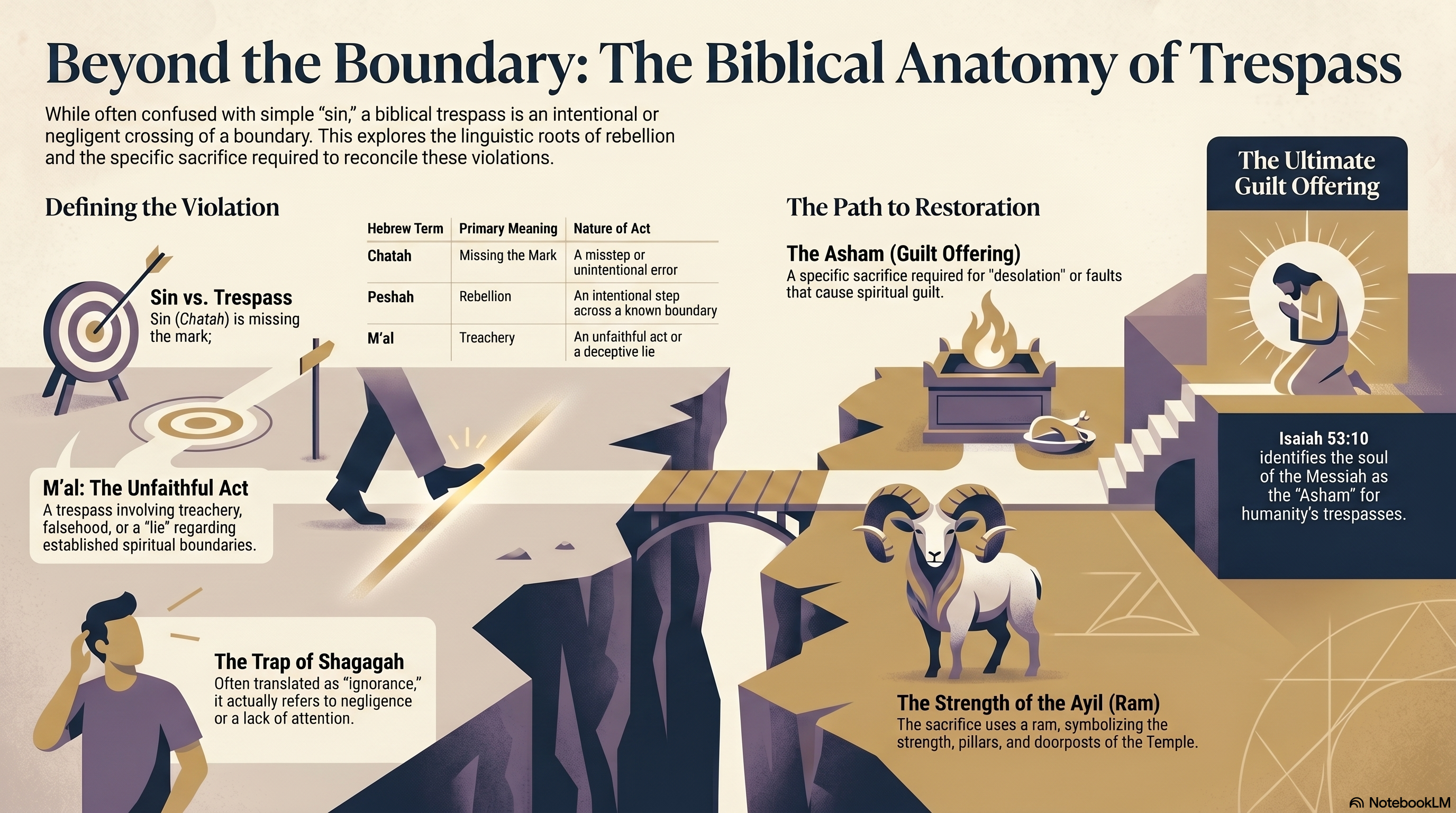
Beyond the Misstep: A Devotional Exploration of Boundaries, Trespass, and the Asham Ram
1. The Linguistic Boundary: Differentiating Sin from Trespass
In the architecture of spiritual formation, linguistic precision is a strategic weapon. We have been culturally conditioned to view divine boundaries through the lens of triviality—epitomized by the "Trespassers Will" sign in children's literature, which we are taught to read as "Trespassers William." This cuteness masks a lethal reality. In English, we lazily conflate "sin" and "trespass," but the Source Context demands a surgical distinction. The word "trespass" finds its root in the Old French trespasser, which carries the arc of "passing beyond a boundary." More soberingly, its modern French equivalent, trépasser, means "to die." To cross the boundary is not a scenic detour; it is a movement toward death.
The strategic failure of many believers lies in the "So What?" of their self-evaluation. We often classify calculated rebellion as a mere Hata—a "missing of the mark" or a "poor execution" of timing. If you slip while stepping onto a moving platform, that is a misstep (Hata); your intention was correct, but your execution failed. However, the Source Context identifies Pesha as something entirely different: a "defection" or "rebellion." This is not an accident. It is a calculated look at a divine boundary followed by an intentional step across it. When we redefine our revolts as mere "missteps," we engage in a dangerous minimization that avoids the weight of accountability and treats the Law as a suggestion rather than a sovereign border.
Self-Reflective Questions
- In my current spiritual walk, am I treating intentional rebellions as mere "missteps" to avoid the weight of accountability?
- Where have I redefined a clear divine boundary as an "unintentional error" simply because I haven't been "caught" by men?
Actionable Challenge
Identify one specific area where you have "crossed a line" on purpose this week. Write it down and explicitly label it as a "rebellion" (Pesha) rather than a mistake to acknowledge its true nature.
2. The Gravity of Maal: Secret Rebellion and Communal Impact
Individual choices are never truly isolated; they dictate collective outcomes. The Source Context defines Maal as another Hebrew word translated as the English “trespass,” meaning an act of unfaithfulness or treachery—a "treacherous lie." We see the strategic devastation of Maal in the valley of Achor. After the supernatural victory at Jericho, one man’s secret rebellion caused the entire community to "lose big time" at the lightly populated city of Ai, resulting in the deaths of thirty-six men. Achan’s choice was not a simple Hata; it was a Maal that sullied the entire camp, proving that hidden unfaithfulness prevents the community from "standing before their enemies." We must recognize the rarity and weight of this judgment: Achan’s execution was the third of only seven total stoning executions recorded in the entire Bible.
The psychology of Achan reveals a fundamental delusion: He began to view the spoils not as "accursed things" belonging to Yahweh, but as resources for his own enrichment. He prioritized his own wealth over his role as a steward of God’s command.
The Anatomy of Rebellion: Achan’s Confession
- Visual Enticement: Achan prioritized vision over hearing. He saw a goodly Babylonish garment, two hundred shekels of silver, and a fifty-shekel wedge of gold.
- Internal Rationalization: He moved from observation to covetousness, assigning personal value to things God had labeled "accursed."
- Physical Appropriation: He reached out and "took them," physically enacting the rebellion of his heart.
- Calculated Concealment: He buried the items in the earth in the midst of his tent. The act of hiding transformed the theft into a Maal—a treacherous lie maintained even while his brothers died in battle.
Self-Reflective Questions
- What "spoils"—a Babylonish garment, a secret debt, a hidden resentment—have I buried in the midst of my tent?
- How is my hidden unfaithfulness causing "trouble" for my family or community?
Actionable Challenge
Perform a "tent audit" today. Identify one thing you are hiding out of fear of judgment. Do not wait for a "deathbed confession" forced by discovery. Bring it to light before a trusted mentor today.
3. The Path of Recognition: From Negligence to Conviction
Restoration begins when we move from the rationalization of our behavior to the realization of our guilt (Asham). Many of our trespasses stem from Shagagah—a lack of attention or negligence. This is the tactic of "asking for forgiveness rather than seeking permission," assuming the boundary is flexible. The Source Context warns that a confession forced by discovery, like Achan's, is a "sham." True Asham—guilt—is processed internally before the judgment falls. Judging oneself through conviction acts as a safeguard; it is the path of Qarab, drawing near, while the "Door" is still open.
Biblical forgiveness is never a passive sentiment; it requires a Kapor—atonement—that carries the weight of Yom Kippur. This process involves tangible restitution. The Law required the "fifth part"—a 20% requital added to the original debt. This ensures that the offender is not merely "sorry they got caught," but is actively making amends for the harm done to the "holy thing." Through the mediation of the Priest and the sacrifice of the Ram, the individual is not merely pardoned, but restored to the fold.
Requirements of the Asham: Guilt Offering
- The Specific Sacrifice: The offender must bring a "Ram without blemish" (Ayil), representing strength and righteousness.
- The Role of the Priest: The Priest performs the Kapor, mediating the return to a state of purity.
- Tangible Restitution: Amends must be made for the actual harm caused by the negligence or treachery.
- The "Fifth Part": A 20% penalty is added, transforming the act of repentance into a substantive requital.
- The Divine Result: The promise that through this precision of remedy, the soul "shall be forgiven."
Self-Reflective Questions
- Is my lack of spiritual progress a result of Shagagah—a calculated negligence of the borders?
- Am I waiting for my "identity to be confirmed" on Judgment Day, or am I willing to be convicted today?
Actionable Challenge
Identify a situation where your negligence harmed another. Apply the "fifth part" principle: go 20% beyond a verbal apology by performing a tangible act of service or restitution that costs you something.
4. The Ayil of Righteousness: The Strength of the Guilt Offering
The Hebrew word Ayil—Ram—is polymorphic, a term that changes its face but never its "DNA of strength." It is the "mighty man," the "chieftain," and the "pillar" of the temple. Most significantly, it is the "lintel"—the structural post that held the blood of the Pesach lamb in Egypt, denying access to the destroyer. When you bring an Asham offering, you are bringing the "mighty one" to stand at the boundary you have violated.
Isaiah 53:10 reveals the prophetic fulfillment of this imagery. While Achan’s vision was fixed on spoils for self-enrichment, Yeshua’s vision was fixed on "his seed" through the travail of his soul. As the Asham Ram, Yeshua is the "mighty one" who possesses the strength to righteously cross the border—separating himself outside the camp to endure the "heaviness" of the Father’s wrath—to retrieve those who have wandered too far. He is the Ram "willingly entangled" in the thicket by his own strength—his horns—laying down his power to become our guilt offering.
The Multifaceted Strength of the Ayil
- The Ram: The strong animal provided in the thicket as a substitute for the promise.
- The Post/Pillar: The foundation of Ezekiel’s temple, representing mature, righteous judgment.
- The Lintel: The boundary-marker of the Passover, where blood provides the sign of protection.
- The Tree: The "Ayil of Righteousness" from Isaiah 61:3, representing those planted by Yahweh to be glorified.
- The Mighty Chieftain: The one with the authority to create a way through the wilderness.
Self-Reflective Questions
- Do I recognize the Asham as a specific remedy for my personal rebellions, or just a generic religious event?
- Does the image of the "Mighty Ram" willingly caught in the thicket change my understanding of divine strength?
Actionable Challenge
Spend 15 minutes in silence reflecting on Isaiah 53:10. Replace the generic word "sin" with "my specific guilt" and "my intentional rebellion" to internalize that Yeshua took the weight of your Maal.
5. The Act of Receiving: Lambano and the Hand of Recognition
The spiritual journey concludes with the strategic act of "receiving." In the Greek, this is Lambano—to take with the hand, to lay hold of, or to claim for oneself. This is the exact New Testament parallel to the Hebrew Yadah, confession, which literally means to "put your hand toward" the Creator. True receiving is not a passive agreement with a theological concept; it is the hand of recognition. It is reaching out and proactively taking hold of the "Door" because you have been confronted with your own guilt.
The "Good Shepherd" is not merely a comforting image; it is an image of boundary-crossing authority. He leaves the ninety-nine to enter the wilderness—the place beyond the border—to retrieve the sheep who has wandered. He has the power to lay down his life and the power to "take it again." We do not just "believe in" the Shepherd; we Lambano him—we lay hold of his strength to pull us back across the line we should never have crossed.
Takeaways from the Good Shepherd: John 10
- The Voice: Shma. His voice prompts action; the sheep hear and follow him back to the fold.
- The Knowledge: He knows his sheep intimately and is known by them.
- The Mission: He seeks the "other sheep" who are currently outside the boundary.
- The Power: He is the "Mighty Chieftain" who lays down his life and takes it back by his own authority.
Self-Reflective Questions
- Am I merely "agreeing with the idea" of the Shepherd, or have I reached out my hand (Lambano) to claim his life for mine?
- Can I hear the Shepherd's voice (Shma) over the noise of the "spoils" that enticed me?
Actionable Challenge
Practice Yadah, confession, by physically extending your hand toward Heaven. Vocalize your recognition of Yeshua as your Asham. This physical act reinforces the "hand of recognition" and the proactive claim of his restoration.
Closing Reflection
The transition from the secret "tent" of Achan to the extended "hand" of Lambano marks the passage from death to life. There is immense joy in the "heaviness" (Kavowd) of Heaven over the one who recognizes their guilt, turns from the boundary, and returns to the fold. By refusing to trivialize our trespasses and laying hold of the "Mighty Ram," we move from being "too far gone" to being children of the living Elohim.