Beyond the Blueprints
1. Introduction: Beyond the Blueprints
To the untrained eye, the technical specifications of Exodus and Leviticus—the meticulous measurements of the Tabernacle and the exhaustive inventories of sacrifice—read like dry, archaic manuals. However, as a spiritual architect, one recognizes these are not merely historical records; they are the blueprints for a sophisticated spiritual technology. These "installation" rituals provide the structural framework required to reconcile our heavy physical limitations with the weight of a divine presence (Kavowd). The goal of this analysis is to explore how Truth is fermented and distilled from more than a mere collection of Facts. By examining the Tabernacle's "Installation Day," we uncover the load-bearing truths necessary for the human soul to transition from mechanical tradition to psychological and spiritual alignment.
2. Chronology is Secondary to Growth (The "Two Perspectives" Rule)
In the construction of the character, spiritual progression frequently overrides linear time. The transition from the physical mechanics of Exodus to the internal applications of Leviticus serves as a primary example of this structural evolution. We often demand a straight-line narrative, yet the Torah cycles back, revisiting witnessed events to reveal deeper layers of systemic truth. This reflects a fundamental law of spiritual architecture: Facts provide the skeleton—the rigid framework of what happened—but Truth is the "installation" that occurs through experience. Meaning is not found in real-time observation but in the distant place where memory is enlightened by trial.
"Facts inform on what happened, giving us a framework that leads us to the truth... but the account of historical figures... come from a distant place of observation, fermented and distilled with memory enlightened by experience."
This "two perspectives" rule challenges our linear thinking, forcing us to recognize that growth is measured not by the clock, but by the depth of what we have installed within our own history.
3. The "Ear Witness" vs. The "Eyewitness"
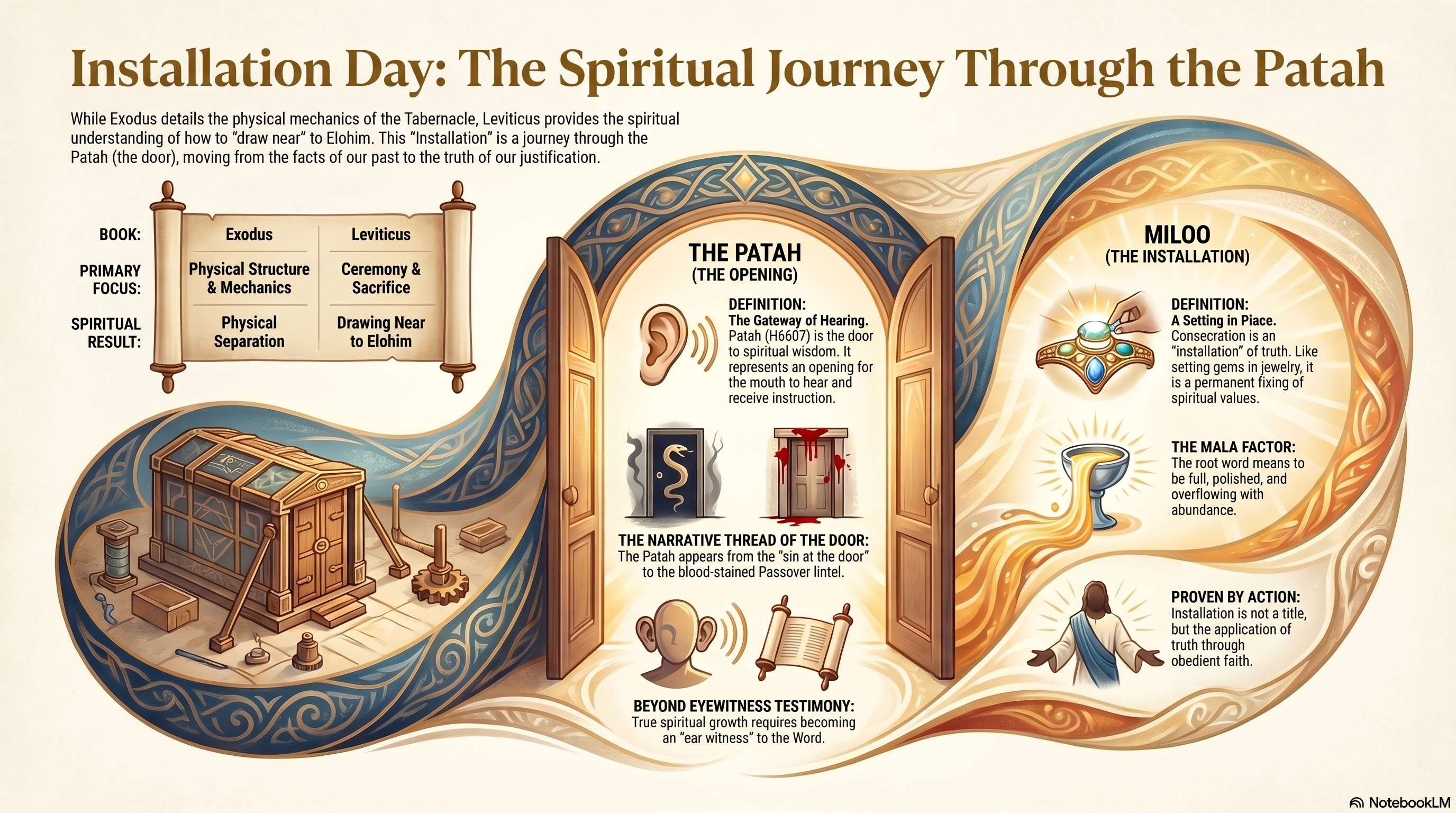
In the semiotics of the Tabernacle, the call to assemble (Edah) carries a specific technical meaning. The root word Ed (H5707) is a compound construction of the letters Ayn (the Eye) and Dalet (the Door). While modern culture prioritizes the "eyewitness," the biblical blueprint favors the "ear witness."
The Edah is not a group of passive spectators—the "gawk-em-holy" who merely watch from a distance—but a congregation of recorders. This involves the Patah (H6607), the narrow opening or "door," which serves as a metaphorical mouth. As specified in Proverbs 8:33–34: "Hear instruction, and be wise... watching daily at my gates, waiting at the posts of my doors (Patah)."
The promise of wisdom is found at this threshold. To be an ear witness is to move beyond the superficial gawk of the eye and to internalize instruction at the very door of the divine, transforming a physical location into a recording of the heart.
4. The Valley of Achor and the "Cord of Escape"
Within the geography of the soul, we often find ourselves in the "Valley of Achor." Etymologically, Achor (H5911) signifies "trouble" or "disturbance." The narrative grounds this in the historical figure of Achan, whose sin brought a heavy disturbance upon the people. However, the spiritual architect looks for the Tiqvah (hope) promised in Hosea 2:15, where the valley of trouble becomes a "door (Patah) of hope."
In this technical context, Tiqvah is not a vague sentiment; it is a physical technology. It literally refers to a cord or rope. It is a tangible thread of trust that one must grab to escape the fate of "Guilty Achan."
"Tiqvah is about a cord or rope, expectation in the face of disturbance. Something to hang on to, or a rope of escape. A way of escaping the valley of trouble, or the fate of Guilty Achan."
Hope is the load-bearing rope we hang onto when the disturbance of our own past failures creates a "heaviness" that seems unapproachable. It is the tether that leads us back to the door.
5. Consecration is an "Installation" of Abundance
Popular tradition often treats "consecration" as a title bestowed upon a person. However, the Hebrew Mi'loo reveals a far more precise process of "installation." This is the same term used for the "setting" of fine, polished gems into jewelry. It is an architectural finishing, rooted in the word Mala (H4390), meaning "to be full" or to "overflow with abundance."
This is a rigorous process of application, not a one-time ceremony. The term Mi'loo appears with exclusive frequency in the context of the Tabernacle's installation, with its only later appearance describing David's heart as he prepared the materials for Solomon's Temple. Consecration is the "filling" of a vessel with the intent of use. Our deeds are the technical proof of what we have installed as truth; we are "polished" by our obedience to instruction, proving we are not merely watching, but are full of the Word we have heard.
6. Justification vs. The "Facts" of Our Deeds
The most critical distinction in the spiritual blueprint is the difference between the "Facts" of a person's deeds and the "Truth" of their justification. The narrative arc of the Patah (Door) across scripture proves this distillation:
- The Door of the Heart: Where sin "crouched" for Cain.
- The Door of the Ark: Which served as the structural seal against judgment.
- The Door of the Tent: Where Sarah listened and laughed at the promise of Yitzchak.
- The Door of Passover: Where blood on the posts protected those inside.
In the "Installation Day" ceremony, we see the mechanic of transferal. Through the washing, dressing, and the eating of the remnant of the sin offering at the Patah, the sin of the individual is symbolically transferred to the Anointed Priest. The "Truth" of justification through the Door (Yeshua) overrides the "Facts" of the sin.
"For he hath made him to be sin for us, who knew no sin; that we might be made the righteousness of Elohim in him... having therefore boldness to enter into the holiest by the blood of Yeshua, by a new and living way, which he hath consecrated for us, through the veil, that is to say, his flesh." (2 Corinthians 5:21; Hebrews 10:19–20)
Justification is the ultimate installation: the blood of the Lamb on the Patah of the heart sanctifies the entire building of the body, regardless of the "facts" found in the record of our deeds.
7. Conclusion: The Ongoing Installation
"Installation Day" is not a static point on a timeline; it is an ongoing process of holding fast to the "profession of our faith without wavering." The spiritual architecture of our lives requires a daily decision to remain at the Patah, listening for instruction rather than merely gawking at the ritual. It is the persistent act of holding the Tiqvah—the cord of hope—as we navigate our own valleys of disturbance.
As you evaluate your own structural integrity, ask yourself: What have you installed as your truth? Are you governed by the "facts" of your past disturbances, or have you grabbed the "cord of hope" that leads through the door of justification? Let us continue to provoke one another to love and good works, knowing that our "filling" has no end, for it is powered by the inexhaustible capacity of the One who promised.