The Consecrated Code: A Study in Divine Installation and the Peril of Self-Will
1. Defining the Divine Installation: The Etymology of Mi'loo and Mala
In the architecture of the Kingdom, "consecration" is not a vague religious sentiment but a rigorous technical process of system integration. It is the strategic hardware mounting of divine order within the human vessel. This installation is totalizing, replacing the fragmented logic of the world with the precision of YHWH's operational standards. To grasp the mechanics of this installation, we must analyze the Hebrew etymology of the core protocols.
- Mi'loo (H4394): This term denotes being "installed" or "set as a jewel." In technical terms, it represents the precise placement and securing of a component within a larger mainframe. It is the moment the hardware is mounted into its designated slot, ready for data throughput.
- Mala (H4390): The root of Mi'loo, meaning to be "full," "accomplished," "ended," or "complete." It carries the connotation of "overflowing with abundance." Crucially, it refers to the finalization protocol—being "polished" like a finished jewel.
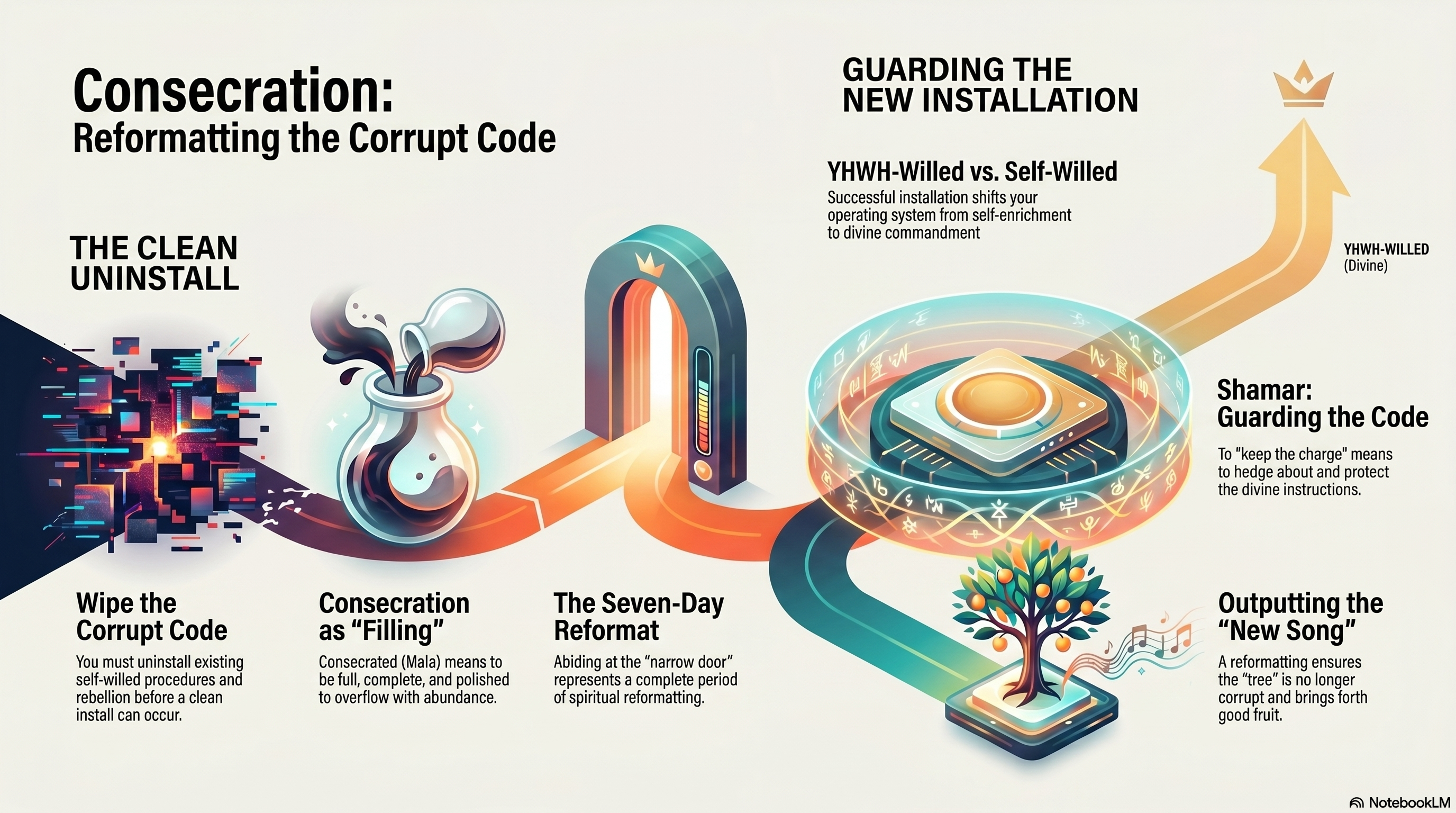
The synthesis of these terms reveals that a consecrated life is a finished, polished system where divine instructions have reached their intended completion. Consecration is defined by the quality of the "fill"; it is an installation that leaves no sector of the hard drive available for competing data. This filling, however, is impossible without a prior partition wipe. The vessel must undergo a systematic clearing of the registry to remove legacy corruption before the divine code can be initialized.
2. The Necessity of the "Clean Install": Reformatting the Corrupt Spirit
A primary failure in spiritual development is the attempt to "reinstall" over corruption. Users often try to patch their lives with religious behavior while the underlying spirit—the "set of written instructions for operation"—remains compromised by self-will. This results in a "breach" (Perets), because, as recorded in 1 Chronicles 15:13, the failure to seek YHWH after the "due order" (the correct syntax) inevitably leads to system failure and judgment.
To achieve a "clean install," the believer must submit to a total system reformat. YHWH's instructions do not coexist with human-willed procedures; they require the absolute uninstallation of legacy "Me First" logic. Without this purge, hidden sectors of rebellion will eventually override the new instructions, leading to catastrophic data loss and spiritual breach.
Operational Protocols
| Parameter | Rebellion / "Me First" Logic | Obedience / YHWH-Willed Syntax |
|---|---|---|
| Source | Originates in user-generated desire and "My Way" code. | Originates in the commandment and word of YHWH. |
| Method | Attempts an unauthorized override of established order. | Requires a partition wipe to receive Installation. |
| Outcome | Breach (Perets), corruption, and judgment fire. | Consecration, holiness, and functional "Due Order." |
| Status | Unlawful code injection; foreign to the system. | "Polished," finalized, and complete (Mala). |
This reformatting takes place in the crucible of the "narrow door," a controlled environment where the new code is tested before full-scale operation.
3. Shamar Mi'sh'mret: Guarding the Narrow Door
The installation reaches its critical phase at the Patah—the narrow door of the Tabernacle. Here, the candidate is quarantined for seven days, a period analogous to the week of a marriage or the duration of Hag Ha Matzah. This is not idle waiting; it is an intensive period of character debugging where the individual is no longer permitted to execute personal whims but must "abide" under the total observation of the Kavowd (Glory) and the Edah (Witnesses).
Central to this quarantine is the execution of the charge: Shamar Mi'sh'mret.
- Shamar (H8104): Properly, to hedge about as with thorns; to guard, protect, attend to, or look narrowly. It is the act of a watchman "looking narrowly" to ensure no unauthorized data enters the system.
While "charge" is often translated from Tsava, here it is Mi'sh'mret—literally, "what comes from the guarding." Shamar is informed by Shama (hearing); one must process the Father's voice to know the correct commandment syntax worth protecting. In this state, the priest becomes a firewall and a bridge, ensuring that the act of "drawing near" (Qarab) follows the exact code of the commandment rather than the impulses of human self-enrichment.
4. The Eighth Day Encounter: Perception and the "New Song"
The "Eighth Day" is the moment of system deployment. It is where the installation meets active operation, and the glory of YHWH manifests to the congregation. This is the ultimate inspection of the "hardware mounting." Unlike the glory that previously filled the tent and prevented entry, this manifestation is for the Edah to Ra'ah—to see, inspect, and perceive.
The progression toward deployment follows a rigid sequence:
- System Preparation: Sacrifices offered according to the exact protocols of Leviticus 1–7.
- Initialization: Aaron and his sons bless the people from the Patah.
- Operation: Divine fire executes from YHWH, consuming the sacrifice on the altar.
- System Output: Upon seeing (Ra'ah) the fire, the people respond with a "shout" (Ranan).
This Ranan is a system output—a "new song" that reflects the quality of the prior consecration. It is described as a "tremulous and stridulous sound, like a mast or pole in the wind." The "So What?" of this encounter is binary: the sound produced is determined by the "tree" (the nature of the code). To Ra'ah (perceive/inspect) requires the observer to "consider themselves in respect to what they see." If the self-will was never uninstalled, the encounter with divine fire results in a sound of horror; if the installation was clean, the output is the "new song" of joy.
5. The Breach of Order: The Fate of Nadav and Abihu
The danger of legacy corruption is highlighted by the unauthorized override attempted by Nadav and Abihu. Despite being anointed, they failed the Shamar Mi'sh'mret. They treated the holy as an open-source platform for personal expression, attempting an unlawful code injection by offering "strange fire" which was "foreign" to YHWH's commanded syntax.
Their actions were effectively a user-generated script attempting to bypass the Master Kernel:
def _worship_YHWH(His_will, my_way) {
    application = my_way_override
}
Because they offered what was not commanded, they breached the spiritual authority landscape and were immediately purged from the system. This stands in stark contrast to Aaron, who adhered to the "Due Order" and waited for the Divine fire to initialize.
The Contrast of Execution
Consecrated Action (Aaron / "Due Order")
- Protocol: Followed the "Due Order" of sacrifice (Lev 1–7).
- Execution: Waited for fire to originate from YHWH.
- Auth: Acted only by commandment; no self-will injection.
- Result: System success; blessing and the appearance of Glory.
Strange Fire (Nadav & Abihu / "Self-Will Override")
- Protocol: Offered "Foreign" fire (unauthorized action).
- Execution: Generated their own "fire" (user-generated action).
- Auth: Acted on personal whim; ignored the "Charge" (1 Tim 1:3–4).
- Result: Immediate system purge; fire of judgment.
6. The Perfect Protocol: Yeshua's Consecration as the Divine Echo
The only uncorrupted "Golden Image" of consecration is Yeshua. He represents the Master Kernel, the final and perfect "code" whose entire existence was a total rejection of the "self-will" override. He operated with a 100% adherence rate to the Father's set of operations, serving as the benchmark for all future installations.
As expressed in John 5:24, Yeshua's operational life was a perfect echo; he only repeated and executed what he saw the Father do. His consecration was the "perfecting of holiness," a total cleansing from all filthiness of flesh and spirit (2 Corinthians 7:1). He did not introduce "other doctrines" or foreign code but functioned as the bridge that ensures our own "drawing near" is validated by the Father's syntax.
Conclusion
The "Consecrated Code" is not a suggestion; it is the only operating system capable of surviving the Eighth Day inspection. It demands a technical uninstallation of the self-willed procedures that corrupt our spirit. By observing the Shamar Mi'sh'mret and abiding in the "due order," the believer transitions from a "corrupt tree" to a vessel "polished like a jewel," ready to produce the "new song" of the Kingdom. Yeshua is the perfect installation—the Golden Image—and only through His uncorrupted code can we avoid the breach and stand in the presence of the Divine Fire.